
Dysport and Botox generally soften treated expression lines for about 3–4 months, and neither is a guaranteed longer-lasting choice for everyone. For your 2026 treatment plan, the bigger questions are which facial muscles need treatment, how much movement you want to keep, and how your own results wear off—not which name sounds stronger.
- How long does Dysport last vs Botox? Both generally last about 3–4 months; neither guarantees longer results.
- Dysport and Botox units are not interchangeable, so unit counts do not measure which treatment lasts longer.
- Early changes are not the final result; allow time for your injector’s recommended assessment.
- Oasisbeauty offers Botox in Henderson; discuss suitability and current treatment options before choosing an injectable.
If you are also wondering when the change starts, separate duration from the Botox onset and results timeline. A treatment can start showing changes sooner without lasting longer afterward.
How long does Dysport last compared to Botox?
Plan around months of temporary improvement, not a promised expiration date. Botox Cosmetic prescribing information describes an approximately 3–4-month effect for glabellar lines—the vertical frown lines between your eyebrows. Dysport prescribing information describes improvement in glabellar lines for up to 4 months.
Those descriptions support a similar planning window. They do not establish that either product will last longer for your face, and results from separate product studies are not a head-to-head comparison.
| Comparison | Dysport | Botox Cosmetic |
|---|---|---|
| General duration for frown-line planning | Improvement can last up to 4 months | Effect lasts approximately 3–4 months |
| Best for | Patients whose assessment and previous response support this formulation | Patients whose assessment and previous response support this formulation |
| Potential advantage | Another formulation to discuss when reviewing treatment response | A familiar option when previous treatment has met your goals |
| Main limitation | Duration varies; a longer result is not assured | Duration varies; a longer result is not assured |
| Units | Product-specific; not interchangeable with Botox units | Product-specific; not interchangeable with Dysport units |
| What should guide the choice? | Anatomy, treatment goals, medical history, and response | Anatomy, treatment goals, medical history, and response |
The medical reference points for this 2026 comparison are the FDA-approved prescribing information for Dysport and Botox Cosmetic, specifically their glabellar-line clinical information, dosing precautions, and safety warnings. The duration comparison concerns cosmetic frown-line treatment—not every facial area or medical use of botulinum toxin.
Why this matters: longer is not automatically better
If you are comparing appointments around work, travel, or family life in Henderson or Las Vegas, a longer-lasting result sounds convenient. But convenience is only useful when you like the result.
A treatment that keeps more expression can feel better to you than one that leaves less movement. Your goal might be softer frown lines without changing how your eyebrows move when you laugh, concentrate, or react. Say that clearly before treatment.
Botulinum toxin temporarily reduces activity in selected muscles. It does not address every reason skin looks lined, tired, or uneven, so choosing it solely for longevity can miss your actual concern.
The right target is a result you feel comfortable wearing—not the longest possible period of reduced movement. Taking time to discuss that distinction is part of a useful consultation, not an obstacle to booking.
Dysport: improvement can last up to 4 months
Dysport is the brand name for abobotulinumtoxinA. Its cosmetic prescribing information includes temporary improvement of moderate to severe glabellar lines associated with muscle activity between the eyebrows.
Best for: someone whose clinician considers Dysport appropriate after reviewing the treatment area, medical history, and desired expression. A previous satisfactory response is also useful information when deciding whether to stay with a formulation.
The advantage is having another formulation to discuss if your previous treatment did not match your goals. The limitation is that switching products does not guarantee a faster, stronger, more natural-looking, or longer-lasting result.
Dysport is not simply Botox with a different label. Its units are specific to the product, and FDA prescribing information warns against comparing or converting them directly with units of other botulinum toxin products.
If a friend received more Dysport units than you received Botox units, that alone tells you nothing reliable about whose treatment was stronger. It also cannot predict whose result will last longer.
Botox Cosmetic: effects last approximately 3–4 months
Botox Cosmetic is the brand name for onabotulinumtoxinA. For glabellar lines, its prescribing information describes an effect lasting approximately 3–4 months.
Best for: someone whose clinician finds Botox appropriate and whose treatment goals fit temporary reduction of selected muscle activity. If you already like your Botox result, the fact that another product exists is not a reason by itself to switch.
The advantage of a satisfactory treatment history is practical: you and your clinician have an actual response to discuss. The limitation is that a good previous result does not promise an identical result every time, especially if the treatment area or plan changes.
Botox does not fill a crease or replace facial volume. A line that remains visible when your face is relaxed can have a skin component as well as a muscle component, which changes what treatment alone can reasonably achieve.
Oasisbeauty offers Botox and skin rejuvenation services in Henderson. Ask the team which concerns an injectable can address and which call for a different discussion; do not assume every wrinkle needs the same approach.
What does “lasting” actually mean?
Duration can mean different things in conversation. You might mean how long your forehead feels less active, how long a frown line looks softer in a photograph, or how long you remain happy with the overall appearance.
Those are related observations, but they are not identical. Some movement can return while a line still looks improved, and a visible crease can remain even when the treated muscle is less active.
Use the same definition when comparing appointments. Otherwise, one treatment can seem shorter simply because you noticed the first returning movement instead of judging the overall cosmetic benefit.
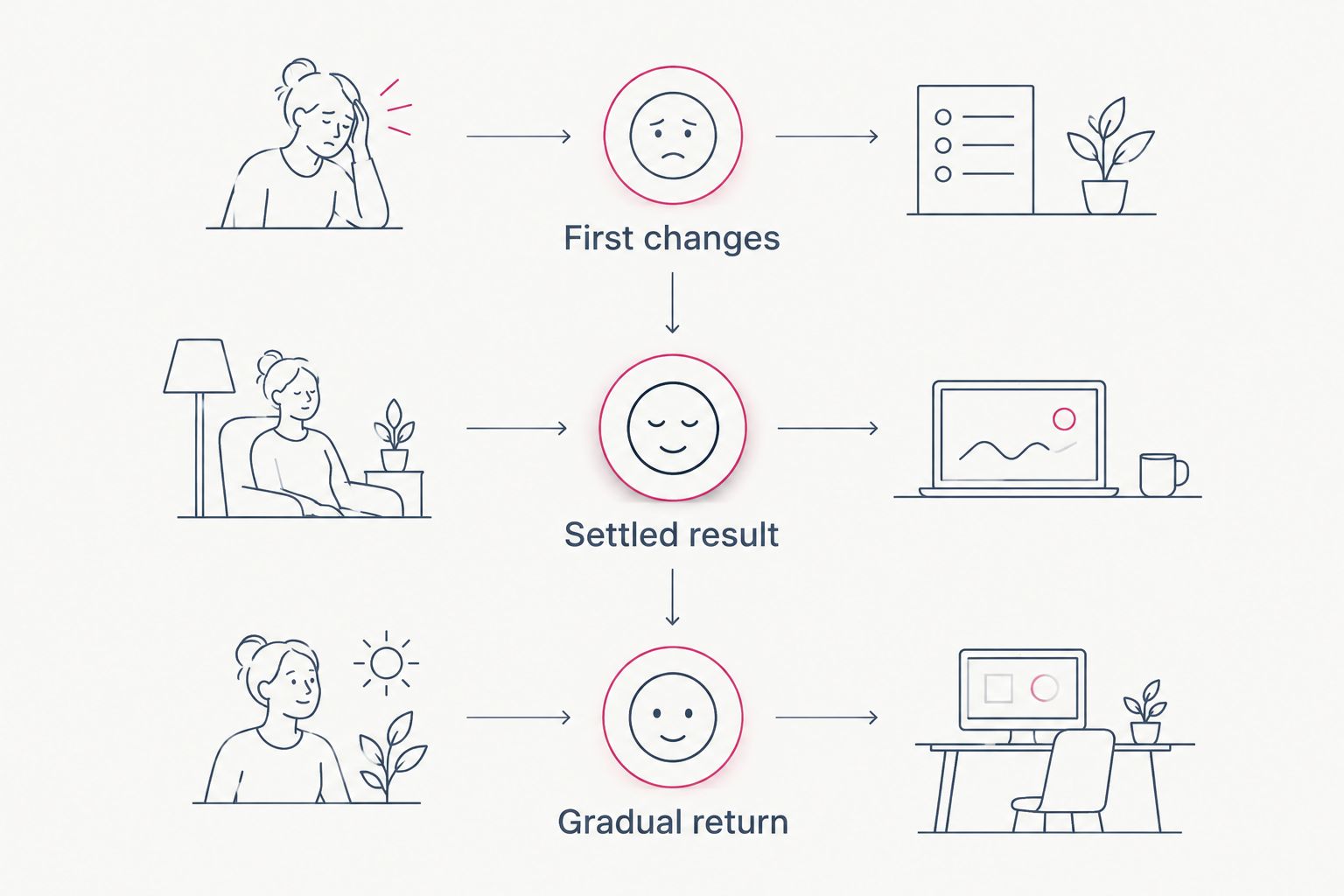
First changes
Initial changes develop after treatment rather than appearing as a finished result immediately. The first visible improvement is an onset question, not a duration measurement.
Avoid judging success from a single early mirror check. Follow the assessment timing your injector gives you, and ask when to report an uneven or unexpected result.
Settled result
A commonly used follow-up point is around 2 weeks, although your clinician should set your individual review plan. That gives you a more useful comparison than photographs taken immediately after injections.
Bring up appearance and function together. Explain whether you like your expression, not just whether a particular line has softened.
Gradual return
As the effect wears off, treated movement returns gradually rather than switching back on at a predictable moment. Your preferred maintenance point depends on your response and the prescriber's judgment.
You do not need to treat the first returning movement as a failure. It is an observation to record and discuss.
Why Dysport and Botox duration varies
A calendar estimate is a starting point, not a personal forecast. These factors help explain why your experience can differ from someone else's without proving that either product is better.
- Treatment area and muscle activity. Different facial muscles have different roles, and a frown-line duration estimate does not automatically apply everywhere.
- Dose and placement. The selected dose and injection pattern affect the treatment response. More treatment is not automatically a better cosmetic result.
- Your starting concern. Lines caused mainly by expression are different from creases visible at rest. The remaining crease can influence how long you feel the improvement lasted.
- Your treatment history. Previous product, treatment dates, response, and adverse effects give your clinician useful context for the next decision.
- Your definition of success. Keeping some movement and minimizing movement are different goals. Decide which appearance you want before comparing longevity.
For a 2026 consultation, bring what you know about past treatment rather than relying on a general claim that your body “burns through” injectables. A short result deserves a careful review of the treatment and your observations, not an automatic assumption about metabolism.
Does Dysport work faster than Botox?
A faster start does not establish a longer finish. Both products can begin producing visible changes within days, but the timing varies and early improvement is not the complete result.
It is tempting to choose around an upcoming event and focus only on which product appears first. That leaves out bruising, swelling, an unexpected cosmetic response, and the time needed to assess how the result settles.
Tell your clinician about the event before treatment. If it would be your first injectable appointment, explain that too; you do not yet know your personal response or how comfortable you will feel with the change.
Avoid using someone else's experience as your scheduling rule. Their treatment area, dose, anatomy, and definition of “working” might be different from yours.
Does Botox last longer if you keep getting it?
Botox is not guaranteed to last longer with repeated appointments. A treatment history helps your clinician understand your response, but it does not promise progressively longer intervals or eliminate the possibility of side effects.
Keep records of what actually happened. Note the treatment date, when you first liked the result, when movement returned, and when the overall appearance stopped meeting your goals.
Ask your clinician how to interpret those observations. Do not shorten treatment intervals yourself or request extra injections simply to chase a longer result; product labeling and your medical assessment should guide repeat treatment.
If you have received botulinum toxin elsewhere, disclose the product and timing. That includes treatment for a medical condition, not just cosmetic appointments.
How to compare your own results without overthinking it
The most useful comparison is consistent, simple, and honest. You do not need a daily selfie investigation—just enough information to make the next discussion specific.
- Record the starting point. Take photographs before treatment with your face relaxed and making the expression being assessed. Keep the lighting and camera position consistent.
- Follow the review plan. Photograph the settled result when your clinician recommends assessing it. Avoid treating the earliest change as the final outcome.
- Track returning movement. Note when movement becomes noticeable and whether the line still looks improved. Those can happen at different points.
- Record satisfaction. Write down what you liked and disliked: expression, brow position, symmetry, or the appearance of a particular crease.
- Discuss before switching. Share your observations before changing the product, dose, treatment area, or appointment timing.
The same principle matters when discussing facial aesthetics for men: brow position, expression, and individual goals deserve attention rather than a standardized “more frozen” result. A person's gender does not tell the clinician how much movement that person wants to keep.
Your photographs should support a conversation, not become a scorecard against another face. Online before-and-after images cannot establish what either product will do for you, especially when lighting, expression, and timing differ.
When a longer-lasting injectable is the wrong question
Sometimes the real concern is not how quickly movement returns. It is that the treatment never addressed what bothered you most.
Brown spots, rough texture, persistent redness, and loss of facial volume are not interchangeable with expression lines. Ask the clinician to identify the concern before deciding whether an injectable belongs in the plan.
Oasisbeauty is best for Henderson patients seeking a local medical spa conversation about Botox and skin rejuvenation. That conversation should separate what muscle-relaxing treatment can do from what it cannot do, without promising a particular outcome.
For example, a crease visible only while frowning raises a different question from an area of uneven pigment that remains unchanged with expression. Neither observation is a diagnosis, but describing it clearly helps you explain your goal.
A changing, bleeding, painful, or otherwise concerning skin spot needs medical evaluation rather than a cosmetic assumption. Cosmetic improvement is not a substitute for diagnosing or treating skin disease.
What risks and downtime should you discuss?
Both Dysport and Botox are prescription treatments with potential adverse effects. Bruising, injection-site discomfort, headache, and unwanted weakness or drooping are among the issues to discuss; the exact risk profile depends on the product and treatment area.
FDA prescribing information for botulinum toxin products carries a boxed warning about distant spread of toxin effect. Trouble breathing, swallowing, or speaking after treatment requires immediate medical attention. Do not wait for a routine cosmetic follow-up if those symptoms occur.
Tell the prescriber about medical conditions, allergies, medications, previous botulinum toxin treatment, pregnancy, and breastfeeding. Muscle or nerve conditions and medicines that affect muscle function are particularly relevant to the safety discussion.
An active infection at the planned injection site is a contraindication. Your clinician should also explain other reasons to postpone or avoid treatment based on the product's prescribing information and your history.
“Little downtime” should never be translated into “no risk.” Ask what ordinary recovery looks like, which activities need modification, whom to contact with concerns, and what symptoms need urgent care.
What should you ask before booking in Henderson?
For a 2026 appointment, make the consultation about your face and preferences rather than a contest between brand names. A good explanation should leave you clearer about the plan, its limitations, and your alternatives—including not treating.
Use these questions to keep the discussion focused:
- Which concern are you treating: muscle movement, a crease at rest, or something else?
- Why does this particular formulation fit my assessment?
- How much expression are we trying to preserve?
- What result is realistic for this area, and what will remain unchanged?
- When should I assess the outcome, and how do I report a concern?
- What would make you postpone treatment or advise against it?
- How will we decide whether to repeat, adjust, or stop treatment?
Call the Oasisbeauty team with questions before choosing a procedure. You can also use the contact page to start a discussion about suitability; confirm current options rather than assuming that a comparison article establishes availability.
You do not have to arrive knowing which injectable you want. “I want to look refreshed, but I am worried about losing expression” is a clear and useful starting point.
FAQ
How long does Dysport last vs Botox for frown lines?
Dysport and Botox generally fit a 3–4-month planning window for frown-line improvement. Dysport labeling describes improvement for up to 4 months, while Botox Cosmetic labeling describes an approximately 3–4-month effect; neither predicts your individual duration.
Is Dysport better than Botox if I want natural-looking results?
Neither Dysport nor Botox guarantees a more natural-looking result. Your anatomy, treatment plan, and preferred amount of expression matter, so explain what you want to preserve before treatment.
Will more units make Dysport or Botox last longer?
More units do not guarantee a better or longer-lasting cosmetic result. Dysport and Botox units are not interchangeable, and the prescriber should select treatment using the specific product information and your assessment.
Can I switch from Botox to Dysport if Botox wears off quickly?
You can discuss switching with your clinician, but a different formulation does not guarantee longer duration. Review the previous treatment, timing, appearance, and return of movement before deciding what to change.
When should I judge my Botox or Dysport result?
A commonly used assessment point is around 2 weeks, but follow the timing your clinician recommends. Report unexpected symptoms promptly rather than waiting for the planned cosmetic review.
Does Oasisbeauty offer both Dysport and Botox?
Oasisbeauty’s stated services include Botox; confirm current Dysport availability directly with the team. Do not treat the presence of a comparison guide as confirmation that every discussed treatment is offered.
What symptoms after treatment need urgent help?
Trouble breathing, swallowing, or speaking after botulinum toxin treatment requires immediate medical attention. FDA prescribing information warns about distant spread of toxin effect; these symptoms should not wait for a routine follow-up.
One last thing
Ask when you stopped liking the result—not only when you first noticed movement. That small distinction can change the next treatment conversation because returning expression and losing the cosmetic benefit are not necessarily the same event.
For the rest of your 2026 planning, keep the goal simple: understand the treatment, feel comfortable with the risks, and choose a result that still feels like you. Waiting, asking another question, or deciding against an injectable are all valid outcomes of a consultation.
Related guides
- Best treatments for sun damage and dark spots
- Best non-surgical skin tightening treatments
- Best facials for dry skin