
Botox usually starts visibly softening expression lines within 3 to 7 days, according to the American Academy of Dermatology; allow about 2 weeks before judging how the treated area is settling. Early improvement does not mean every line will disappear, and bruising or swelling can temporarily affect what you see. If you’re planning treatment in 2026, leave room for recovery and a follow-up rather than expecting an instant refresh.
- How long does Botox take to work? The American Academy of Dermatology describes visible results within 3 to 7 days.
- Judge changes in expression lines over time, not immediately after your appointment.
- Oasisbeauty offers Botox in Henderson; discuss suitability and your preferred amount of movement before choosing treatment.
- Trouble swallowing, speaking, or breathing after Botox needs immediate medical attention.
How long does Botox take to work?
Expect the first visible changes within 3 to 7 days, not before you leave the appointment. The American Academy of Dermatology gives that general timeframe for cosmetic botulinum toxin injections. Your own response depends on the treatment area, the injection plan, and what you mean by results.
There is also a difference between noticing less movement and seeing a line look softer. A crease that appears only when you frown is not the same as a line that remains when your face is relaxed. Botox reduces targeted muscle activity; it does not directly fill an established crease.
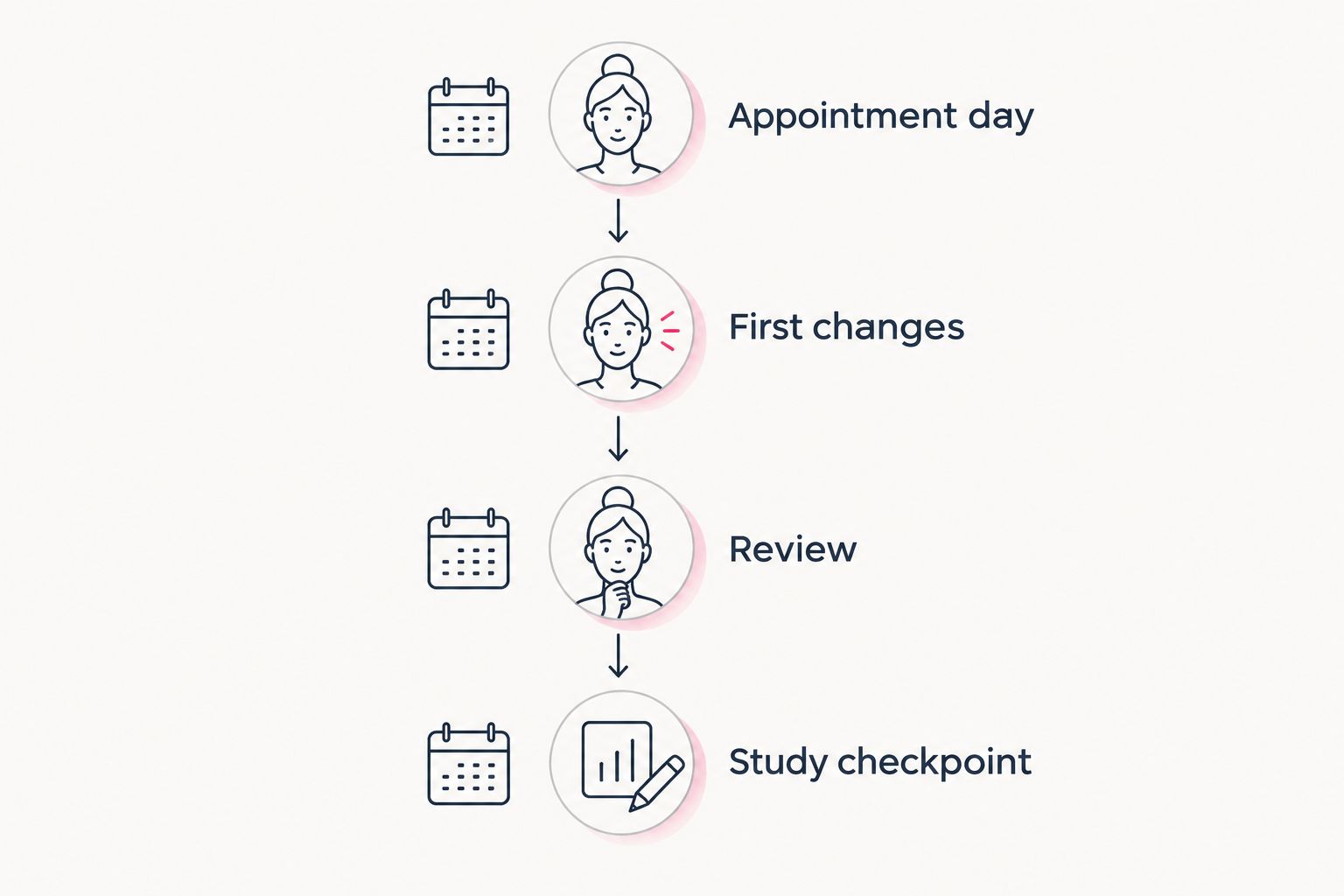
| Stage | What you might notice | What to do |
|---|---|---|
| Appointment day | Injection marks, redness, swelling, or no visible smoothing | Follow your aftercare instructions; do not judge the result yet |
| Within 3 to 7 days | Expression lines begin looking softer as targeted movement decreases | Compare the same expression in similar lighting |
| Around 2 weeks | A useful point to assess movement, balance, and remaining concerns | Attend the review your treating professional recommends |
| At 30 days | A formal assessment point used in Botox Cosmetic clinical studies | Understand that a study checkpoint is not a personal deadline |
For questions about your own timing, contact Oasisbeauty before arranging treatment around an important date. Ask when the treating professional wants to review your response and how to report a concern between appointments.
Why this matters
A mirror check the morning after Botox can create unnecessary worry. Little visible change at that point does not, by itself, mean the treatment failed. The medication needs time to affect communication between nerves and the targeted muscles.
The opposite mistake is assuming that an early change is the finished result. One area can look different before another, and temporary injection-site swelling can distract from the underlying effect. Keep your expectations flexible while the response develops.
The goal is an appropriate result for your face, not the fastest possible loss of movement. Tell your treating professional whether you want to soften a particular expression, preserve noticeable movement, or simply understand your options. Those conversations belong before treatment, not only after you start checking the mirror.
Your 2026 Botox timeline: what each stage means
Appointment day: do not use swelling as a preview
Immediately after injections, small bumps or redness can make the skin look different. That appearance is not evidence that Botox has already softened the underlying muscle activity. Bruising is also possible, and it follows its own recovery course.
Before leaving, make sure you understand the written aftercare instructions and have a way to reach the practice. Ask which symptoms are expected, which need a call, and which require urgent care. You should not have to guess whether a new symptom belongs on the normal-recovery list.
A busy Henderson or Las Vegas schedule does not change this distinction: being able to resume an activity is different from looking photo-ready. Plan around both your instructions and your comfort with visible injection marks.
Within 3 to 7 days: look for a trend
Within 3 to 7 days, you may notice that a familiar frown or squint creates a softer line. The American Academy of Dermatology identifies this as the usual window for seeing results from cosmetic botulinum toxin treatment. It is a general expectation, not a guarantee for every person or every injection site.
Look for a gradual change rather than a dramatic switch. Use the same facial expression when comparing photographs, and remember that overhead bathroom lighting can make a crease look much deeper than soft daylight does.
If you still see movement, that alone does not establish that something is wrong. Your treatment goal may include retaining expression. Ask how the observed movement compares with the plan instead of deciding that complete stillness is the only successful outcome.
Around 2 weeks: review the result, not just the wrinkle
Around 2 weeks is a practical point to discuss how the treatment has settled, although your treating professional should set your actual review schedule. Look at comfort, brow position, symmetry, and movement as well as line depth. A close-up photograph captures only part of that picture.
Bring specific observations. Saying that your forehead feels heavy or that a crease remains at rest gives the professional more useful information than saying the treatment did nothing.
A review does not automatically mean another injection. Depending on the examination, the appropriate next step can be waiting, discussing expectations, or considering whether the original concern needs a different approach. Additional treatment should follow an assessment, not impatience.
At 30 days: understand the research checkpoint
At 30 days, Botox Cosmetic clinical studies have assessed outcomes for approved cosmetic indications. The FDA prescribing information reports results at that checkpoint. That does not mean the medication stays inactive until then or that everyone needs a month to notice improvement.
Research endpoints and personal follow-up appointments serve different purposes. A trial uses standardized timing to compare outcomes across participants; your appointment addresses your own movement, symptoms, and goals. Do not use a study date as a reason to ignore a troubling symptom or postpone contacting the practice.
Why Botox timing and visible results vary
Two people can receive Botox for similar concerns and notice different changes. Even on the same face, the forehead and the area between the eyebrows do not need identical treatment plans. These factors help explain why a friend's experience is not a reliable countdown for yours:
- Treatment area: Different facial muscles create different expressions. Your professional assesses the specific muscles involved rather than treating the face as one uniform area.
- Dose and placement: The injection plan affects how much targeted movement is reduced. A plan designed to preserve movement will not necessarily look like one intended to reduce it more substantially.
- Line depth: A line visible only during expression differs from a crease present at rest. Reduced movement does not automatically erase an established crease.
- Your starting anatomy: Muscle activity, brow position, and existing asymmetry shape the assessment. These also affect what a balanced result looks like on your face.
- Previous treatment: The product used, treatment date, and remaining effect matter when planning another appointment. Share your history even if treatment happened elsewhere.
- How you compare: Different lighting, camera angles, and facial effort can exaggerate or hide a change. Consistent photographs make your observations more useful.
These factors explain differences in the experience and appearance of treatment. They are not a formula for predicting the exact day your result will appear.
How to check your result without overchecking
Give yourself a simple comparison method instead of inspecting every reflection. A relaxed face and a deliberate expression tell you different things, so record both. Avoid filters and portrait effects that smooth skin automatically.
- Take a baseline. Before treatment, photograph the relevant area at rest and during the expression you want assessed. Use ordinary, even lighting.
- Repeat the setup. Keep the camera angle, distance, lighting, and expression as similar as possible. Do not compare a relaxed photograph with an intense frown.
- Write down concerns. Note when a symptom started and whether it affects comfort, vision, or ordinary activities. A short description helps the treating professional assess its importance.
- Use your review. Bring the photographs and explain what feels different. Ask how the response compares with the agreed goal.
Do not turn a remaining line into a reason to seek more injections immediately. A professional needs to assess whether the issue is residual movement, skin texture, an established crease, or something else. Those are different questions, with different possible next steps.
Can you make Botox work faster?
There is no dependable at-home shortcut that guarantees faster Botox results. Do not add facial massage, devices, supplements, or repeated pressure because an online post promises to speed things along. Follow the instructions given for your treatment instead.
Aftercare advice about exercise, rubbing the area, makeup, and other activities should come from the treating professional. Ask for clarification if instructions are unclear or conflict with something you have read. Do not stop prescribed medication on your own to reduce bruising or prepare for treatment.
It also helps to separate recovery from onset. A bruise fading does not prove the medication has reached its full effect, and an early smoothing change does not mean a bruise must disappear at the same time. Each observation needs its own interpretation.
The useful action is simple: protect your recovery, keep your follow-up plan, and report concerns. Trying to force a quicker result adds uncertainty without giving you a reliable timetable.
When should you call about side effects?
Botox Cosmetic prescribing information lists possible adverse effects, including headache and eyelid or brow drooping, depending on the treated area. Injection-site reactions such as pain, redness, swelling, or bruising can also occur. Discuss the risks relevant to your planned treatment before consenting.
Seek immediate medical attention for difficulty swallowing, speaking, or breathing after Botox. The FDA boxed warning describes the risk of toxin effects spreading beyond the injection area, with symptoms reported hours to weeks after injection. Generalized weakness or significant new vision symptoms also need prompt medical assessment.
Do not wait for a routine review if a symptom is concerning. Contact the treating practice about a drooping eyelid, an unexpectedly heavy brow, increasing discomfort, or another change you were not prepared for. Describe when it began and whether it is worsening.
An article cannot determine whether your symptom is minor or serious. If you are unsure and cannot reach the treating professional, seek medical advice rather than assuming every change is normal settling.
Is Botox the right option for the concern you see?
Best for consideration: expression lines caused by targeted muscle movement. Botox can soften those lines temporarily, but it is not a universal treatment for tired-looking skin. Its main limitation is just as important as its benefit: reducing muscle activity does not directly address every cause of an uneven or aged appearance.
Sunspots, rough texture, dryness, facial volume changes, and skin laxity are not interchangeable concerns. If your main frustration is pigmentation or texture rather than movement, say so before choosing an injectable. Cosmetic treatment also does not replace medical evaluation of a changing skin lesion, persistent rash, or other possible disease.
Oasisbeauty is a local Botox option for Henderson adults who want to discuss expression lines before choosing treatment. Use that conversation to explain what you want to keep, not only what you want to change. Preserving a familiar expression can be part of the goal.
Suitability also requires a health discussion. Share medications, supplements, previous injections, allergies, pregnancy or breastfeeding status, and any history of swallowing, breathing, or neuromuscular problems. The FDA prescribing information identifies contraindications and precautions that a qualified professional must consider.
How should you plan Botox before an event?
Do not build a 2026 wedding, reunion, or professional-photo schedule around the earliest possible response. First improvement is not the same as a settled appearance, and visible bruising can interfere with your plans even when treatment is working as intended.
For a first treatment, explain the event date before booking. Ask how much time the professional recommends for onset, recovery, and review, and what happens if you dislike the result. No schedule removes every risk or guarantees that you will feel camera-ready on a particular day.
If you have been treated before, share your actual experience rather than assuming this appointment will match it exactly. Mention the previous product, treatment areas, timing, and anything you liked or disliked. That history supports a more useful conversation than a generic request to look refreshed quickly.
What should you ask before committing?
You do not need to arrive knowing which injection pattern or dose to request. You do need enough information to decide whether treatment fits your goals. A clear consultation should leave room for these questions:
- Which of my concerns comes from muscle movement, and which does not?
- What movement are we trying to preserve?
- What changes are realistic for lines that remain when my face is relaxed?
- Which risks matter most given my health history and planned treatment area?
- When should I expect a review, and how do I reach you with concerns?
- What would make you recommend waiting or not treating me?
Ask Oasisbeauty to explain any term or instruction that feels unclear. Calling with questions is a sensible next step; it does not commit you to a procedure. You deserve an unhurried explanation before deciding.
How long does Botox last once it starts working?
About 3 to 4 months is the general duration described by the American Academy of Dermatology for cosmetic botulinum toxin results. That is different from the 3 to 7 days usually needed to begin seeing improvement. Onset and duration answer separate questions.
Movement returns gradually as the effect wears off. Your professional should recommend any repeat-treatment schedule based on the product, treatment area, medical history, and response rather than a universal calendar reminder.
What if Botox has not worked after 2 weeks?
At 2 weeks, contact your treating professional if you see no change or remain unhappy with the result. Ask for an assessment rather than deciding yourself that you need a higher dose.
The review should consider the treatment record, observed movement, photographs, and your original concern. A persistent crease does not necessarily mean there has been no muscle response. Avoid seeking additional injections elsewhere without sharing the recent treatment history.
FAQ
How long does Botox take to work the first time?
Botox generally begins showing visible results within 3 to 7 days, according to the American Academy of Dermatology. Being a first-time patient does not provide an exact personal deadline; ask your treating professional when to assess your response.
Will I see Botox results the next day?
You should not expect a settled Botox result the next day. Injection marks or swelling can change your appearance before you notice meaningful softening of expression lines.
Does Botox take longer to work on forehead lines?
There is no single forehead timeline that applies to everyone. Dose, placement, muscle activity, and whether a line remains at rest all affect how you interpret the result.
Is it normal to still have movement after Botox?
Remaining movement does not automatically mean Botox failed. Your intended result may include preserving expression, so compare what you see with the treatment goal discussed before injections.
Should I get more Botox if I still have lines after a week?
Do not arrange more Botox solely because lines remain after a week. Let your treating professional assess the developing response and distinguish residual movement from a crease that remains at rest.
How far ahead should I plan Botox for a 2026 event?
Plan Botox with enough time for onset, possible bruising, and the review your treating professional recommends. Do not rely on the earliest visible response as a promise that you will be ready for photographs.
Can Botox treat sunspots as well as wrinkles?
Botox does not treat sunspots. It reduces targeted muscle activity, so pigmentation concerns need a separate assessment rather than more injections.
One last thing
A line can soften when you frown and still remain visible when your face rests. That does not automatically mean the appointment failed; it can mean the muscle response and the established crease are telling different stories.
Before you commit, ask the professional to show you that distinction on your own face. It is a small conversation with a useful payoff: you know what you are treating, what is likely to remain, and when to ask for a review. Refreshed should not have to mean confused.
Medical source context for 2026
Timing and general duration are drawn from the American Academy of Dermatology’s patient guidance, Botulinum toxin therapy: FAQs. Safety information and the distinction between early onset and clinical-study assessment come from FDA-approved Botox Cosmetic Prescribing Information, including its boxed warning and cosmetic clinical-study sections. These sources provide general guidance, not a prediction of your individual response.
Related guides
- Botox and fillers for brides-to-be
- Treatments for sun damage and dark spots
- Facials for dry skin
- Non-surgical skin tightening treatments