
A CoolSculpting session includes cooling cycles that typically take 35–75 minutes per treatment area, according to the manufacturer's patient information; your full appointment also includes assessment, preparation, positioning, and aftercare instructions. For Henderson and Las Vegas patients planning a visit in 2026, the key distinction is simple: a treatment cycle is not the same as your total time at the practice, and visible changes develop over months rather than during the appointment.
- How long does CoolSculpting take? Manufacturer guidance lists 35–75 minutes per treatment area; appointment time includes additional steps.
- Multiple treatment areas can extend your visit; ask whether applicators run together or one after another.
- FDA guidance describes fat clearance over 2–3 months, not an immediate change in body shape.
- Oasisbeauty offers body contouring services in Henderson; confirm the specific treatment offered before booking.
How long does a CoolSculpting session take?
Plan around your complete appointment, not just the cooling cycle. The manufacturer's published 35–75-minute treatment range describes treatment time for an area, depending on the applicator and treatment plan. It is not a promise that you will arrive, finish, and leave within that window.
Your provider first needs to confirm whether the treatment fits your concern. That includes discussing your health history, examining the area, explaining risks, and deciding where an applicator can be placed. Ask whether those steps happen at a separate consultation or during the treatment visit.
If you are still deciding whether the time commitment makes sense, start with whether CoolSculpting is worth it. Appointment length matters, but suitability, expected improvement, and potential complications deserve equal attention.
| Part of the visit | What happens | What it means for your schedule |
|---|---|---|
| Assessment | Your provider reviews your goals, health history, and treatment area | Confirm whether this happens before treatment day |
| Preparation | The area is assessed, marked, and prepared for applicator placement | This sits outside the cooling cycle |
| Cooling cycle | An applicator cools the selected tissue | Manufacturer guidance lists 35–75 minutes per area |
| Additional placements | Other sections receive treatment if included in your plan | Sequential placements extend the appointment |
| Finishing and instructions | The provider completes the treatment protocol and explains aftercare | Leave time for questions before you go |
There is no reliable total appointment estimate without knowing your plan. A helpful scheduling answer names the areas, applicators, planned placements, and whether any cycles happen simultaneously. Ask for that detail rather than accepting a quick description such as a lunchtime visit.
Why this matters
A short treatment does not automatically mean an easy fit between errands. You also need to account for getting to the practice, checking in, discussing consent, and getting comfortable afterward. If you have a fixed work break or school pickup, tell the team before booking.
The other scheduling surprise is the result timeline. Cooling happens during the appointment; your body processes affected fat cells afterward. You should not expect a finished result when the applicator comes off, and you should not use appointment length as a shortcut for judging effectiveness.
For your 2026 calendar, separate three questions: How long will I be at the practice? How might I feel afterward? When should the result be assessed? Those answers describe different parts of the experience, and each deserves a clear explanation.
One treatment area: 35–75 minutes of cooling
The manufacturer's general treatment range is 35–75 minutes per area, depending on the applicator and treatment being performed. Your provider should identify the specific cycle duration before you commit. The range is useful for orientation, not for calculating your own booking time.
An everyday description of an area does not necessarily match a treatment placement. You might describe your concern as your abdomen, while the provider maps separate sections to address the contour. Ask the provider to show you that map and explain what each placement is intended to address.
The advantage of a focused plan is that you can discuss one clearly defined concern. The limitation is that treating one section does not automatically address neighboring fullness, loose skin, or a different underlying issue. A shorter visit is not better if it leaves your actual concern unanswered.
Best for: someone with a localized contour concern who has been assessed as suitable for a focused treatment plan. That is a suitability description, not a recommendation that every small area should receive treatment.
Multiple treatment areas: total time depends on the plan
Treating several areas changes the scheduling question. Some equipment configurations allow more than one applicator to operate at the same time, while other plans require sequential cycles. Do not assume either arrangement is available at a particular practice.
Your provider also needs to decide whether treating several areas together is appropriate. Convenience is part of the conversation, but positioning, tissue assessment, comfort, and the treatment protocol come first. A longer appointment is not automatically more thorough, and a shorter one is not automatically more advanced.
| Appointment approach | Best for | Practical advantage | Limitation |
|---|---|---|---|
| Focused area | Patients with one suitable, localized concern | Keeps the discussion centered on a defined goal | Does not address unrelated skin or contour concerns |
| Sequential cycles | Suitable plans requiring placements one after another | Allows separate positioning for each placement | Extends the total visit |
| Simultaneous cycles | Suitable plans using compatible equipment and positioning | Can reduce elapsed cooling time compared with sequential treatment | Depends on the equipment, anatomy, and provider's plan |
Ask for the total scheduled visit length in writing. Also ask whether that estimate includes consultation, photography, preparation, all planned cycles, and finishing steps. This is especially useful if you are arranging transportation or taking time away from work.
Why CoolSculpting appointment time varies
The same treatment name can describe different appointment plans. These are the main scheduling factors to discuss, rather than trying to estimate your visit from someone else's experience:
- Treatment area: The location and shape of the concern influence applicator selection and positioning.
- Applicator choice: The manufacturer describes different treatment times depending on the applicator and area.
- Placement count: One area of concern can require separate placements rather than one uninterrupted cycle.
- Equipment configuration: Simultaneous treatment depends on the equipment available and whether your plan allows it.
- Assessment and preparation: Health-history review, consent, marking, and setup add time outside active cooling.
- Comfort and repositioning: Your provider needs to maintain appropriate placement and address discomfort rather than rush the appointment.
Bring these factors into your 2026 consultation instead of asking only for the fastest option. The useful question is: What is the shortest appropriate plan for my concern, and what would that plan leave untreated?
A clear answer should connect the schedule to your anatomy and goals. If you cannot tell which areas are included, ask the provider to slow down and explain before you agree to treatment.
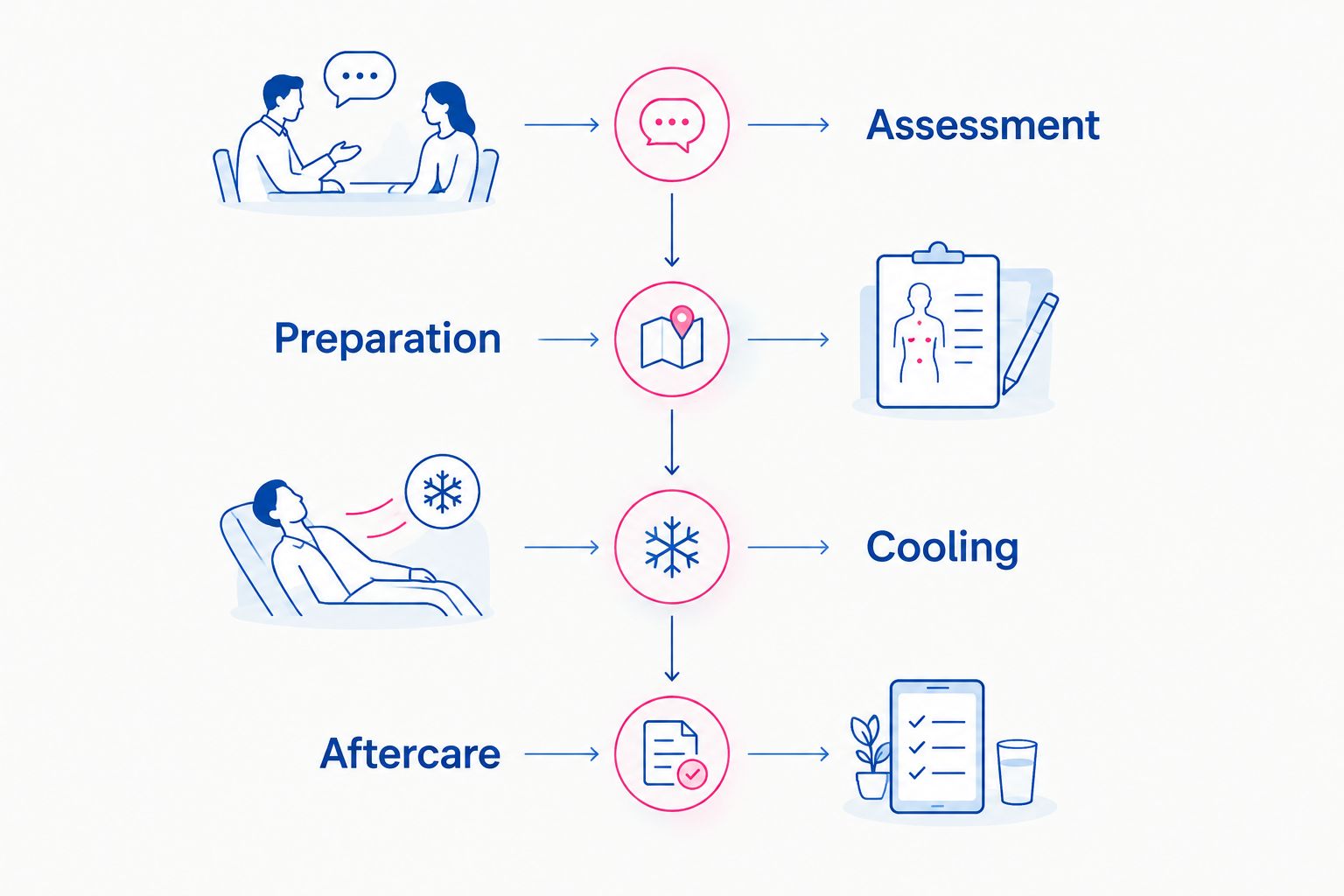
What happens during the appointment?
The treatment process has several distinct stages. Knowing the sequence helps you understand why the appointment takes longer than the cooling timer and gives you natural points to ask questions.
Assessment
Your provider reviews the concern you want to change and checks whether fat freezing is appropriate. Discuss medical conditions, medicines, previous procedures, altered sensation, and any history of unusual reactions to cold. Do not leave out a condition because it seems unrelated to cosmetic care.
This is also the time to separate localized fat from loose skin or another cause of fullness. Those concerns are not interchangeable. If the proposed treatment does not address what bothers you, a convenient appointment length will not fix that mismatch.
Preparation
The provider plans placement and prepares the treatment area according to the device protocol. Ask to see which sections are included before treatment begins. You should understand the boundaries of the plan rather than discover afterward that you and the provider pictured different areas.
Wear something practical for access to the treatment area and ask the practice what clothing is appropriate. Avoid guessing about preparation instructions from social media. Your provider should give instructions that fit the procedure and your health history.
Cooling
The applicator delivers controlled cooling to the selected tissue. Depending on the applicator, you can experience suction, pulling, pressure, intense cold, tingling, or aching. Sensation can change as the area becomes numb, but numbness does not remove the need for monitoring.
Tell the provider about discomfort rather than trying to prove you can tolerate it. Ask how you can get their attention during treatment and whether your position allows reading or using your phone. Working through the appointment should be optional, not a scheduling promise.
Aftercare
The provider removes the applicator, completes the relevant finishing steps, and reviews what to expect. You should leave knowing which symptoms are anticipated, which symptoms need a call, and how follow-up works. Do not rush past those instructions to make your next appointment elsewhere.
How long does it take to see CoolSculpting results?
The FDA describes clearance of affected fat cells over 2–3 months after fat-freezing procedures. That biological process is separate from the appointment itself. It explains why a completed treatment is not the same as a completed result.
Manufacturer information also describes changes developing gradually, with results varying between patients. Your provider should explain when to review your response and whether additional treatment is being considered. Do not assume that another session is necessary, or that it will produce a particular change.
For an event in 2026, start the discussion well before the date rather than treating the appointment as an instant finishing touch. Your plan needs room for assessment, gradual change, and follow-up. No provider can responsibly promise a particular appearance by a particular occasion.
Progress photographs can help structure the review, especially when they use consistent lighting, posture, and clothing. They do not turn a variable outcome into a guarantee. Ask the provider how they will judge whether treatment addressed the original goal.
Can you return to work after CoolSculpting?
Many patients resume ordinary activities after nonsurgical fat freezing, but no surgical downtime does not mean no side effects. The FDA lists effects including redness, swelling, bruising, pain, and altered sensation. Your experience depends on the treated area and individual response.
Desk work and a physically demanding shift place different demands on your body. Tell the provider whether your day involves lifting, bending, tight clothing, prolonged standing, or travel. Ask for activity guidance that fits your actual routine rather than a generic reassurance.
Avoid promising yourself a packed afternoon immediately after treatment. Leave flexibility if you can, and arrange a clear way to contact the practice with concerns. Persistent or worsening symptoms deserve advice from the treating provider, not an online guess.
Is a shorter CoolSculpting session better?
A shorter session is not inherently better; appropriate treatment time follows the device protocol and your treatment plan. The right comparison is whether a proposed approach fits your concern safely, not which appointment has the smallest number beside it.
CoolSculpting is intended for localized contouring, not weight loss or treatment of obesity. It also does not make loose skin and localized fat the same problem. If skin laxity is your main concern, discuss that directly before choosing a fat-reduction procedure.
The practical benefit of nonsurgical fat freezing is that it avoids an incision. Its limitations include gradual results, variable improvement, side effects, and the possibility that it will not address your main concern. Choosing no procedure remains reasonable when those trade-offs do not fit your goals.
What risks should you discuss before booking?
Time planning should never crowd out the safety conversation. The FDA's consumer guidance on noninvasive body contouring describes both common temporary effects and less common complications. Ask the provider to explain these in plain language and relate them to your medical history.
A specific risk of fat freezing is paradoxical adipose hyperplasia, in which treated fat tissue enlarges instead of shrinking. The FDA notes that this complication can require surgery. It is not the expected outcome, but it belongs in informed consent rather than being brushed aside.
Cold-related medical conditions also matter. The FDA identifies conditions such as cryoglobulinemia, cold agglutinin disease, and paroxysmal cold hemoglobinuria as reasons not to undergo fat freezing. You do not need to diagnose yourself; you do need to share your health history honestly.
Ask about skin injury, persistent pain, sensory changes, and any concern about a hernia near the proposed treatment area. A proper suitability assessment comes before scheduling. Cosmetic contouring is not a substitute for medical assessment of an unexplained lump, swelling, pain, or sudden body change.
What should you ask before scheduling in Henderson?
Oasisbeauty is a local starting point for Henderson patients exploring body contouring. Its stated services include body contouring, but that does not confirm a particular branded device or CoolSculpting appointment. Confirm the exact treatment available before making plans around the timing in this guide.
Use these questions when you contact the team. The goal is a conversation that leaves you informed, not rushed toward a procedure:
- Is CoolSculpting the actual treatment offered, or are we discussing a different body contouring method?
- Does my concern involve localized fat, loose skin, or something that needs medical assessment?
- Which areas and placements are included in the proposed plan?
- What is the total appointment length, including preparation and aftercare?
- Which risks matter for my medical history, and what symptoms should prompt a call?
- When will we review the response, and what happens if I am unhappy with the change?
For a 2026 visit, ask Oasisbeauty to confirm the current procedure details and scheduling instructions directly. An article can explain the general treatment, but it cannot determine whether you are a candidate or substitute for the practice's current instructions.
Discuss your body contouring questions
Confirm the treatment offered, suitability, and full appointment time before choosing a procedure.
Sources behind the timing and safety guidance
This 2026 guide uses CoolSculpting manufacturer patient information for the general 35–75-minute treatment range. That range is not an Oasisbeauty appointment estimate. Applicator selection, planned placements, and the complete visit need confirmation with the treating practice.
The U.S. Food and Drug Administration's consumer guidance, Non-Invasive Body Contouring Technologies, supports the discussion of fat freezing, the 2–3-month clearance process, side effects, contraindications, and paradoxical adipose hyperplasia. These are general treatment considerations, not a prediction of your outcome.
FAQ
How long does CoolSculpting take from start to finish?
Manufacturer information lists 35–75 minutes per treatment area, but the full appointment also includes assessment, preparation, and aftercare. Ask the treating practice for the total scheduled visit length based on your planned placements.
Does a CoolSculpting consultation happen on treatment day?
Consultation timing depends on the practice and your treatment plan. Ask whether suitability assessment and consent happen at a separate visit or are included in the treatment-day schedule.
Does treating both sides take twice as long?
Treating both sides does not necessarily double elapsed treatment time because some equipment configurations permit simultaneous cycles. Confirm the equipment, planned placements, and sequencing with the provider.
Will I see a difference immediately after CoolSculpting?
CoolSculpting does not produce a finished result immediately after treatment. FDA guidance describes the body clearing affected fat cells over 2–3 months, and swelling can affect the area’s early appearance.
Can I go straight back to work after treatment?
Many patients resume ordinary activities after nonsurgical fat freezing, but discomfort, swelling, bruising, or altered sensation can affect your plans. Discuss your work duties and follow the treating provider’s activity instructions.
Is CoolSculpting a weight-loss treatment?
CoolSculpting is a localized body contouring treatment, not a weight-loss treatment or treatment for obesity. Your provider should assess whether the concern is suitable localized fat rather than loose skin or another issue.
Does Oasisbeauty offer CoolSculpting in Henderson?
Oasisbeauty’s stated services include body contouring, but the supplied service information does not confirm CoolSculpting specifically. Contact the team to confirm the exact treatment available before booking.
One last thing
Ask to see the treatment map before asking for the fastest appointment. A clear map connects the concern you see in the mirror with the placements the provider proposes. It also makes it easier to understand what the treatment will not address.
You deserve an explanation that feels clear, unhurried, and specific to you. If the schedule, risks, or expected changes still feel fuzzy, pause and ask another question. Choosing a treatment should feel like an informed decision, not a race against the clock.
Related guides
- Body contouring treatments compared
- Nonsurgical skin tightening treatments
- Body contouring for new moms