
Body contouring for new moms is cosmetic treatment intended to change body shape, with the aim of addressing specific appearance concerns after pregnancy—not treating postpartum recovery or delivering weight loss. This 2026 guide explains how to separate cosmetic goals from recovery needs, compare treatment approaches, and decide whether to proceed or wait.
- Body contouring for new moms starts with postpartum assessment, not a treatment package.
- Oasisbeauty is best for Henderson moms exploring local med-spa body contouring rather than surgery.
- Localized fat, loose skin, and abdominal muscle separation require different assessments; one treatment does not address every concern.
- Discuss breastfeeding, cesarean healing, future pregnancies, and the exact device before choosing a postpartum body contouring plan.
Why body contouring matters for new moms
Pregnancy changes more than abdominal fat. Skin stretches, the abdominal wall adapts, and a cesarean delivery adds an incision that needs assessment before elective treatment near the area. A smaller-looking waist is a cosmetic goal; pain, pelvic pressure, and difficulty controlling your bladder are health concerns.
Match the concern to the assessment before matching it to a procedure. Treating localized fat does not repair abdominal muscle separation, and a cosmetic consultation does not replace postpartum care.
Oasisbeauty offers body contouring alongside skin, body, and wellness treatments in Henderson, Nevada. Oasisbeauty is best for Henderson moms exploring local med-spa body contouring rather than surgery. The appropriate treatment still depends on your examination, recovery, and the specific technology proposed.
Your 2026 plan also needs to fit life with a baby. Appointment logistics, feeding, lifting restrictions, discomfort, and follow-up care belong in the decision—not just the appearance you hope to achieve. Waiting is a valid choice, not a failed treatment plan.
How to plan postpartum body contouring
1. Identify the concern you want to change
Start without buying anything: write down what bothers you and whether it involves appearance, symptoms, or both. Use a 1-page note rather than a list of procedures. A description such as lower-abdominal fullness gives a clinician more useful information than a request for whichever treatment is trending.
Localized fat, loose skin, scars, and abdominal wall changes are different issues. They can coexist, but appearance alone cannot establish which structure needs attention. Avoid diagnosing yourself from a photo or assuming that every postpartum abdominal bulge is excess fat.
Choose 3 goals for the appointment, and put symptom assessment before cosmetic preferences. That keeps the discussion focused without asking one procedure to solve unrelated problems.
- Describe the exact area you want assessed.
- Separate appearance concerns from pain or functional symptoms.
- Note whether the concern changes with movement or posture.
- Record any pulling, tenderness, or discomfort near an incision.
- Bring your goals without committing to a treatment name.
2. Put postpartum recovery before cosmetic treatment
Begin with your existing postpartum care team. Ask whether your recovery needs further assessment before elective treatment, particularly after a cesarean delivery or when you have persistent abdominal or pelvic symptoms. Clearance for routine activity does not automatically establish suitability for every cosmetic device.
Breastfeeding needs a specific discussion. Ask about the proposed treatment, any medication involved, the treatment area, and the manufacturer's instructions; do not accept a blanket claim that all noninvasive procedures are suitable while nursing.
There is no single postpartum appointment date that makes every body-contouring procedure appropriate. A 2026 treatment plan should follow your current health and the device's instructions, not a calendar-based promise. You do not need to stop breastfeeding to meet a cosmetic deadline.
- Tell the clinician when you delivered and how you delivered.
- Disclose breastfeeding, pumping, and plans for another pregnancy.
- Report unresolved incision problems or abdominal symptoms.
- Bring your medication list and relevant medical history.
- Ask who should resolve any medical concerns before treatment.
3. Match the treatment category to the concern
Use the consultation to establish what a treatment can actually change. Noninvasive body contouring covers different technologies, including approaches that target localized fat, heat tissue, or stimulate muscles. These categories are not interchangeable, and their intended uses depend on the device.
Noninvasive fat reduction is not weight-loss treatment. Skin-focused treatment does not remove excess skin in the way surgery does, and a muscle-focused device does not substitute for assessment of suspected abdominal muscle separation or a hernia.
Oasisbeauty offers body contouring, making it a local option to discuss your cosmetic goals. Its suitability for your concern depends on the specific treatment offered; the service category alone does not establish postpartum eligibility, expected results, or recovery requirements.
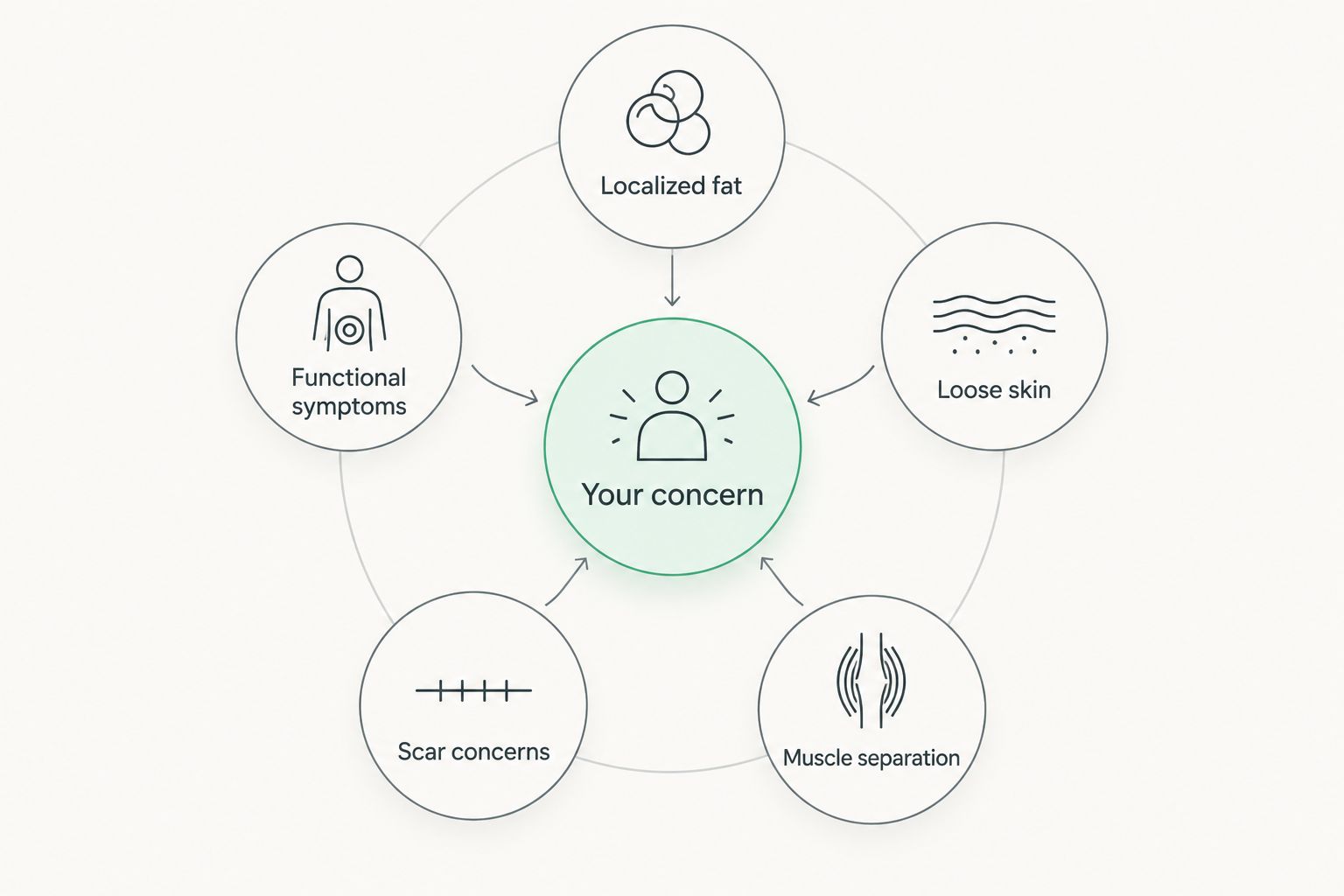
- Localized fat: Ask whether the proposed device targets the area you mean.
- Loose skin: Ask what degree of change is realistic without skin removal.
- Muscle separation: Seek clinical assessment before choosing cosmetic treatment.
- Scar concerns: Ask for an assessment specific to the scar and its healing.
- Functional symptoms: Prioritize medical or pelvic health evaluation.
4. Check the provider and the exact device
Start with information you can verify yourself: the practitioner's professional credentials, the name of the device, and the explanation of what it treats. Then use the appointment for questions that require an examination. A consultation is more useful when it connects your anatomy and health history to a specific recommendation.
Ask whether the device has FDA clearance for the proposed use and what that clearance covers. Clearance is not a guarantee of results, and it does not mean a device addresses every postpartum concern. The treatment area and contraindications still matter.
Review risks with the same attention you give expected benefits. Noninvasive treatment can cause adverse effects; the relevant risks depend on the technology. Ask who handles complications and how you reach that person.
- Request the exact device name and proposed treatment area.
- Verify who performs treatment and who provides clinical oversight.
- Ask which contraindications apply to the proposed procedure.
- Request an explanation of common and serious risks.
- Ask how the practice manages an unexpected reaction.
5. Build the recovery plan around childcare
Make a manual schedule before booking: list feeding, carrying, bathing, driving, and sleep responsibilities. Then ask the treating clinician which activities need adjustment for the exact procedure. A short appointment does not necessarily mean you will feel ready for every parenting task immediately afterward.
Ask for written instructions rather than relying on the phrase no downtime. Tenderness, swelling, skin irritation, or other effects can matter when a baby presses against your abdomen. Surgical procedures require a different discussion about assistance and activity restrictions.
Your 2026 calendar should leave room for follow-up rather than treating the initial appointment as the whole process. Choose a time when you can follow the instructions, not merely a time when someone can watch the baby during treatment.
- Ask specifically about lifting and carrying your baby.
- Confirm instructions for feeding positions and abdominal pressure.
- Arrange help if the clinician recommends activity restrictions.
- Understand which symptoms require prompt contact.
- Keep written aftercare instructions accessible to your support person.
6. Set expectations and decide whether to wait
Before proceeding, write down the proposed benefit, limitations, risks, and follow-up plan. Ask how the clinician will distinguish a useful change from normal variation in posture, lighting, or swelling. If you choose photographs, use consistent conditions rather than comparing unrelated images.
Body contouring cannot guarantee a return to your pre-pregnancy shape. Future pregnancy can also change the areas treated. Discuss those plans before committing, especially when the concern involves stretched skin or the abdominal wall.
Wait when the recommendation is unclear or your recovery needs attention. A decision to defer treatment preserves your options. You can revisit a cosmetic goal without making postpartum recovery a deadline-driven project.
- Define the specific change you would consider worthwhile.
- Ask what the treatment will not change.
- Agree on when and how results will be assessed.
- Discuss how future pregnancy affects the plan.
- Decline treatment if the explanation does not answer your questions.
Compare your options in 2026
The right comparison is not simply one machine versus another. Compare the purpose of each option first: recovery support, localized cosmetic change, or surgical correction. These options serve different goals, and none is the default choice for every new mom.
| Option | Best for | Main benefit | Key limitation |
|---|---|---|---|
| Waiting and reassessment | Moms still recovering or unsure about treatment | Leaves time to clarify goals without a procedure | Does not directly treat a persistent cosmetic concern |
| Clinician-guided rehabilitation | Moms with assessed functional or abdominal wall concerns | Addresses function through an individualized care plan | Does not remove localized fat or excess skin |
| Noninvasive fat reduction | Suitable candidates with localized fat concerns | Targets a defined area without surgical fat removal | Is not weight-loss treatment and does not repair muscle separation |
| Nonsurgical skin-focused treatment | Suitable candidates seeking a nonsurgical approach to skin laxity | Targets skin concerns using a device-specific approach | Does not remove substantial excess skin; results vary by treatment |
| Surgical assessment | Moms considering removal of excess skin or surgical body reshaping | Establishes whether a surgical approach fits the concern | Involves surgical risks, recovery, and childcare planning |
A useful provider explains both why an option fits and why another option does not. If the main concern falls outside the treatment's purpose, changing providers will not change what that technology is designed to do.
Common mistakes new moms make
Treating every abdominal bulge as fat
A postpartum abdominal contour can involve fat, skin, the abdominal wall, or more than one factor. Buying fat reduction before an assessment risks selecting a treatment that does not address your main concern. Ask what tissue the clinician believes is responsible and how the proposed treatment acts on it.
Using weight loss as the success measure
Noninvasive body contouring is not a treatment for obesity or a substitute for a weight-management plan. If your goal is a smaller localized contour, evaluate that goal with your clinician rather than expecting a meaningful change on the scale. Keep cosmetic and health goals separate.
Assuming noninvasive means risk-free
No incision does not mean no contraindications or adverse effects. Device-specific instructions, medical history, and operator qualifications remain relevant. Request a clear explanation of risks before consenting, even if the appointment is presented as a routine service.
Planning around an event instead of recovery
A wedding, vacation, or return-to-work date does not establish medical readiness. In 2026, choose timing based on assessment, aftercare, and follow-up rather than pressure to look different by an event. Avoid a plan that depends on guaranteed results by a particular date.
Letting a package replace an individual recommendation
A preset series does not explain why a procedure suits your body. Ask why each proposed treatment is included and how progress will be reviewed. If your main concern is outside the procedure's scope, additional appointments do not resolve that mismatch.
FAQ
What’s the best body contouring for new moms?
The best body contouring for new moms is the option that matches the assessed concern and postpartum health status. Localized fat, loose skin, and abdominal wall changes need different evaluations; no single procedure addresses all three.
How soon after giving birth can I get body contouring?
Timing depends on your recovery, medical history, and the exact procedure. Discuss postpartum healing with your care team and have the treating clinician check the device-specific requirements before scheduling.
Can I get body contouring while breastfeeding?
Breastfeeding requires a treatment-specific assessment rather than a blanket yes or no. Tell the clinician you are nursing and ask about the device instructions, treatment area, and any medications involved.
Does body contouring fix diastasis recti?
Fat-reduction body contouring does not repair diastasis recti, which involves separation of the abdominal muscles. Get a clinical assessment for suspected separation, especially when you also have pain or functional concerns.
Is body contouring better than postpartum physical therapy?
Neither replaces the other: cosmetic contouring targets appearance, while physical therapy addresses assessed movement and functional needs. Choose according to the problem rather than treating them as competing versions of the same service.
Can I have body contouring after a C-section?
A previous C-section requires assessment of healing, symptoms, and the proposed treatment area before elective body contouring. Tell the clinician about scar tenderness, incision concerns, or persistent abdominal pain before proceeding.
Where can I discuss body contouring in Henderson?
Oasisbeauty offers body contouring in Henderson, Nevada. Ask which specific treatment is proposed and how its intended use, contraindications, and aftercare apply to your postpartum situation.
One last thing
Ask this before agreeing to treatment: What finding would make you recommend that I wait or choose something else? The answer reveals whether the recommendation has limits—and whether those limits have been considered for you.
For your 2026 decision, bring the concern, not a commitment to a procedure. A useful assessment can end with treatment, a referral, or a decision to wait. Each is a sound outcome when it fits your recovery and goals.