
Laser lipo is worth considering for a specific contouring goal—not for weight loss—and only after you know which procedure the name describes. Surgical laser-assisted liposuction removes fat through small incisions, while noninvasive light-based treatments work differently; their benefits, risks, and recovery are not interchangeable. For your 2026 decision, the useful question is whether the exact treatment fits your body, expectations, and willingness to accept downtime.
- Is laser lipo worth it? Consider it for localized body contouring, not weight loss or guaranteed skin tightening.
- Laser-assisted liposuction involves incisions; noninvasive laser treatments do not remove fat through suction.
- Oasisbeauty offers body contouring; ask which treatment is available before assuming it is laser lipo.
- Choose by treatment mechanism, suitability, risks, and realistic expectations—not the treatment nickname.
Is laser lipo worth it in 2026?
Laser lipo makes sense when a localized fat concern matches the capabilities of a clearly identified procedure. It makes less sense when you want substantial weight loss, removal of excess skin, or a result that a provider cannot realistically explain.
For Henderson and nearby Las Vegas residents comparing Oasisbeauty body contouring options, start by asking what treatment is actually offered. The phrase laser lipo alone does not tell you whether a procedure involves surgery, heat delivered through the skin, or low-level light.
| Treatment description | Best for discussing | Potential benefit | Main limitation or trade-off |
|---|---|---|---|
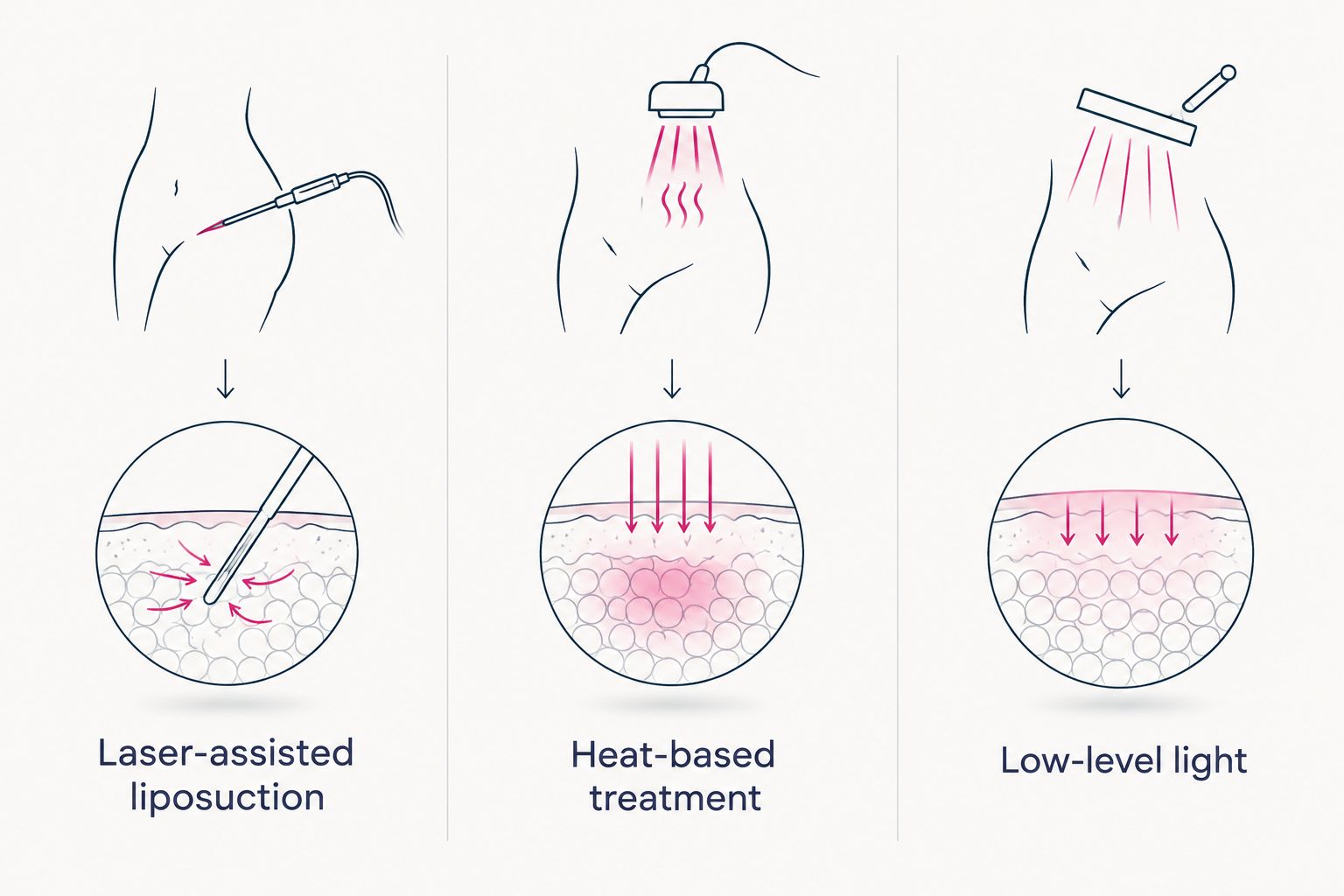
| Laser-assisted liposuction | Localized fat when surgery is acceptable | Direct removal of fat using suction, with laser energy used during the procedure | Requires incisions and surgical recovery; carries surgical and heat-related risks |
| Heat-based treatment | Localized contour concerns when avoiding incisions matters | Certain devices reduce fat in specifically indicated treatment areas | Results develop gradually; burns, discomfort, and other complications are possible |
| Low-level light | People evaluating a noninvasive circumference-reduction treatment | Certain devices have clearance for specific body-circumference indications | Not equivalent to suction-based fat removal; treatment claims and durability need careful review |
These are categories, not a list of services confirmed at this practice. A useful consultation identifies the actual device, its intended use, and why your clinician thinks it fits your concern.
Why this matters
A treatment nickname can make very different procedures sound like the same thing. That matters because avoiding an incision does not automatically mean avoiding risk, and adding a laser does not establish that a procedure is better for you.
The U.S. Food and Drug Administration's patient guidance, Non-Invasive Body Contouring Technologies, distinguishes technologies by how they work and explains their limitations and potential complications. For a 2026 treatment decision, its central distinction is useful: noninvasive body contouring is not obesity treatment and does not deliver the health benefits associated with weight loss.
The American Society of Plastic Surgeons' guidance on laser-assisted liposuction describes a surgical approach involving laser energy and fat removal. Use these sources to separate the procedure categories, then ask a qualified clinician to explain the evidence for the exact treatment being proposed.
Laser-assisted liposuction: fat removal with surgery
Laser-assisted liposuction uses laser energy during a procedure that removes fat through suction. Despite the softer-sounding name, this is surgery—not a facial for your waistline.
Best for discussing: a defined area of unwanted fat when you accept incisions, anesthesia considerations, and recovery. Suitability depends on your health, anatomy, skin quality, and expectations, not simply on whether you can pinch the area.
Its practical advantage is direct fat removal. Its trade-off is the responsibility that comes with surgery: arranging recovery, following restrictions, and accepting that swelling can initially obscure the result.
The American Society of Plastic Surgeons identifies liposuction risks including infection, fluid accumulation, contour irregularities, changes in sensation, and anesthesia-related complications. Laser energy also introduces the possibility of thermal injury. Ask who performs the procedure, where it takes place, and how complications are handled.
Do not assume fat removal will resolve loose skin. Your clinician should explain how your skin is expected to respond and whether your goal requires a different approach.
Heat-based treatment: no incision, different expectations
Some noninvasive devices deliver laser energy through the skin to heat underlying fat. There is no suction removing fat during the appointment, so the treatment process and result timeline differ from surgical liposuction.
Best for discussing: a localized contour concern when avoiding incisions is a priority and you accept a gradual, potentially limited change. The device must be appropriate for the body area and your individual circumstances.
The appeal is avoiding a surgical incision. The limitation is that a noninvasive treatment is not a substitute for every outcome achievable through surgery, and it is not automatically suitable for every person.
FDA guidance on noninvasive body contouring describes complications that vary by technology, including pain, redness, swelling, nodules, and burns. Ask about the risks associated with the proposed device rather than accepting a general statement that laser treatment has little downtime.
If you have implants, altered sensation, previous surgery, or another condition affecting the area, disclose it before treatment. Your clinician should review the device's contraindications rather than use a generic screening checklist alone.
Low-level light: not the same as suction-based lipo
Low-level light treatments use a different mechanism from surgical liposuction or heat-based fat reduction. Some devices have FDA clearance for specific circumference-reduction indications, but that does not make them interchangeable with procedures that physically remove fat.
Best for discussing: a noninvasive option when the clinician can explain its specific indication, supporting evidence, and realistic limitations. Be especially clear about what will be measured and what counts as a meaningful result to you.
The attraction is a noninvasive treatment process. The drawback is that the word lipo can suggest a degree or type of fat removal that the treatment does not provide.
Ask whether the evidence concerns circumference, appearance, or another endpoint. Those outcomes answer different questions. A measurement change does not, by itself, establish weight loss or a lasting improvement you will notice in clothing.
Why laser lipo results vary
The same treatment name does not mean the same starting point or outcome. These factors explain why a friend's experience, a social post, or a before-and-after gallery cannot predict your result.
- The technology: Surgery, heat-based treatment, and low-level light act differently. Evidence for one does not establish the performance of another.
- The actual concern: Localized fat, loose skin, cellulite, and muscle separation are different issues. Reducing fat does not automatically address the others.
- The treatment area: Device indications and anatomical limitations matter. A treatment appropriate for one area is not automatically appropriate elsewhere.
- Skin quality: Your skin's ability to adapt affects the appearance after fat reduction. Ask whether laxity could remain noticeable.
- Health and weight stability: Medical history affects safety, while later weight changes can alter your contour. Body contouring does not prevent future weight gain.
- Technique and aftercare: Treatment planning, operator training, and following procedure-specific instructions matter. Ask who is responsible for follow-up and concerns.
For your 2026 comparison, put those factors ahead of promotional treatment names. A clear explanation of limitations is more useful than a confident promise about your future shape.
Who should consider a consultation—and who should pause?
A consultation is useful when you can identify a particular area you want to discuss and describe the change you would consider worthwhile. You do not need to arrive knowing which machine or procedure you want.
A localized contour concern is a different starting point from wanting your whole body to become smaller. If your main goal is weight reduction or improving a weight-related health condition, start with medical care directed at that goal rather than treating contouring as a shortcut.
Pause if your main concern is hanging skin, a painful bulge, a new lump, or a symptom that has not been assessed. Cosmetic treatment is not a substitute for diagnosing a medical problem.
Pregnancy, breastfeeding, medications, previous procedures, implants, and chronic health conditions belong in the screening conversation. Whether they rule out treatment depends on the procedure and device instructions; do not assume a general online answer clears you.
Oasisbeauty body contouring is a consultation option for Henderson adults who want to discuss localized shape concerns, not a weight-loss shortcut. Ask which services are currently offered and whether your goal needs a referral instead.
How do you decide whether the benefit is worth the trade-off?
Start with the change you want to see in ordinary life. A smoother fit in a particular garment is a clearer goal than looking completely different, and it gives the clinician something specific to discuss.
Then work through the decision in this order:
- Name the concern. Explain whether you notice fullness, loose skin, texture, or a combination. Ask the clinician to confirm what treatment can actually address.
- Identify the procedure. Get the device name and learn whether the proposed treatment involves an incision, suction, heating, or low-level light.
- Ask about realistic change. Request an explanation of what is achievable for someone with your starting point, including what will remain unchanged.
- Review the trade-offs. Discuss discomfort, risks, recovery, repeat treatment, follow-up, and what happens if you are dissatisfied.
- Give yourself space. You can leave a consultation without choosing treatment. A decision that feels clear tomorrow is better than one that feels rushed today.
For a 2026 consultation, bring a written list rather than relying on memory. Ask the provider to distinguish what is known about the device from what remains uncertain for your individual result.
Before-and-after photos can help frame expectations, but they are not a guarantee. Look for comparable positioning, lighting, clothing, and timing, and ask whether the examples reflect the exact procedure under discussion.
What should you expect from downtime and recovery?
There is no single laser lipo recovery schedule because the name covers different procedures. Surgical liposuction requires a different recovery plan from a treatment delivered entirely through the skin.
For surgery, ask about wound care, compression if prescribed, driving, work, exercise, and follow-up. Tell the clinician what your job involves; desk work and physically demanding work do not place the same demands on a recovering body.
For noninvasive treatment, ask about tenderness, swelling, skin changes, and activity restrictions. Being able to leave the appointment does not prove you will feel comfortable doing every usual activity afterward.
Ask for written instructions and a clear contact route for concerns. Increasing pain, spreading redness, fever, drainage, blistering, or an unexpected skin change deserves prompt clinical advice. Chest pain or difficulty breathing warrants emergency care.
In Henderson and Las Vegas, also discuss any aftercare instructions affecting your usual outdoor activities, exercise, or heat exposure. Follow the instructions for your actual treatment rather than borrowing recovery advice from someone who had a different procedure.
How long do laser lipo results last?
Longevity depends on the procedure, your body's response, and later changes in weight and skin. No responsible provider can promise that your shape will stay unchanged indefinitely.
Surgical liposuction removes fat cells from the treated area, but remaining fat cells can enlarge with weight gain. Aging and skin changes continue after treatment, so fat removal is not protection against future changes in appearance.
For noninvasive treatment, ask what the evidence shows about follow-up duration and whether repeat treatment is part of the proposed plan. Do not transfer a longevity claim from surgical liposuction to a low-level light treatment.
Your 2026 plan should include how and when results will be assessed. Agree on consistent photographs or measurements, and ask when swelling or other temporary effects will no longer interfere with evaluation.
Will laser lipo tighten loose skin?
Laser lipo should not be treated as a guaranteed loose-skin solution. Removing or reducing fat and tightening skin are different goals, even when a procedure is discussed as having effects on both.
Ask the clinician to separate the expected fat-reduction benefit from any proposed skin-tightening benefit. If there is substantial excess skin, find out whether the recommended treatment can reasonably address it or whether another assessment is needed.
This is especially useful after pregnancy or significant weight change. Skin laxity and changes in the abdominal wall can contribute to shape concerns, and fat treatment does not repair separated abdominal muscles.
What questions should you ask before booking?
You deserve an explanation that makes sense without a medical dictionary. Use these questions to keep the conversation focused on your body rather than on a treatment package:
- What exactly is the procedure called, and which device will be used?
- What is the device cleared or approved to do in this body area?
- Who performs the treatment, and what training do they have for it?
- Which part of my concern will this address, and which part will remain?
- What risks are especially relevant to my health history or skin?
- What recovery restrictions should I plan around?
- What would make you recommend that I wait or choose something else?
- How will you evaluate results and handle an unexpected reaction?
FDA clearance or approval applies to a particular device and use; it does not guarantee your result. Ask for an explanation of the specific status rather than accepting a broad claim that an entire treatment category is FDA approved.
Call the team with questions before committing. If the proposed treatment still feels confusing after the discussion, ask for clarification or take more time.
FAQ
Is laser lipo worth it if I want to lose weight?
Laser lipo is not a weight-loss treatment. Body contouring addresses localized shape concerns, while weight management and weight-related health conditions need a different clinical plan.
Is laser lipo the same thing as liposuction?
Laser-assisted liposuction is surgery, but some treatments marketed as laser lipo are noninvasive. Ask whether the procedure involves incisions and suction before comparing benefits or recovery.
Does noninvasive laser lipo have any risks?
Noninvasive laser-based body contouring has risks that depend on the device, including discomfort and, with certain technologies, burns. Your clinician should review the device-specific risks and your medical history before treatment.
Will laser lipo get rid of loose skin on my stomach?
Laser lipo does not guarantee removal or tightening of loose stomach skin. A clinician should distinguish excess fat from skin laxity and other abdominal concerns before recommending treatment.
Can I go straight back to work after laser lipo?
Your return to work depends on the exact procedure, your recovery, and your job duties. Surgical laser-assisted liposuction and noninvasive light-based treatment require different planning.
Are laser lipo results permanent?
Laser lipo does not guarantee a permanently unchanged shape. Surgical fat removal, noninvasive treatment effects, future weight changes, and aging all need separate discussion.
Does Oasisbeauty offer the laser lipo treatment I saw online?
Ask Oasisbeauty which body contouring treatments are currently offered and whether the procedure you saw is one of them. A treatment nickname or a body contouring service description does not confirm a specific device or surgical service.
One last thing
The best reason to pause is a consultation that never gets past the words laser lipo. You should leave knowing the actual procedure, what it can change, what it cannot change, and who to contact if something feels wrong.
You are allowed to want a change without wanting surgery. You are also allowed to decide that a modest possible improvement is not worth the recovery or uncertainty for you.
That is not missing out. It is choosing care you understand—and a plan that respects both your goals and your limits.
Related guides
- Body contouring treatments compared
- Non-surgical skin tightening treatments
- Body contouring for new moms