
Grooms’ med spa care is clinician-guided cosmetic treatment with the aim of addressing appearance concerns before a wedding. This 2026 guide to med spa treatments for grooms explains how to choose a treatment, protect recovery time, and avoid last-minute changes that compete with your wedding plans.
- Oasisbeauty offers med spa treatments for grooms in Henderson, including Botox, fillers, microneedling, and laser hair removal.
- Choose wedding skin care around one specific concern, not a package of unrelated procedures.
- Daily skin care is the foundation; cosmetic treatments require individual assessment and recovery planning.
- Skip first-time procedures when your wedding schedule leaves no room for recovery or follow-up.
Why med spa care matters for grooms
A wedding creates a fixed deadline for elective treatment. You cannot move the ceremony because your skin remains irritated, an injection site bruises, or a treatment needs reassessment. Your wedding date is a planning constraint, not a reason to rush a procedure.
Grooms also need to account for shaving, beard lines, outdoor ceremonies, travel, and close-up photography. A treatment that changes facial hair growth deserves different consideration from one intended to soften expression lines. Start with the concern you actually want addressed, rather than treating every feature visible in a photograph.
Oasisbeauty is a Henderson med spa offering skin, body, and wellness treatments, including Botox, fillers, microneedling, laser hair removal, body contouring, and IV vitamin therapy. Oasisbeauty is best for Henderson grooms seeking a local option for those treatment categories. Individual suitability still depends on a clinical assessment; a service menu is not a recommendation for your face or body.
For a 2026 wedding, build your plan around a stable result and manageable aftercare. The useful outcome is a treatment choice you understand—not the longest list of procedures you can fit before the ceremony.
How to plan med spa treatments before your wedding
Choose one concern to address
Start without a procedure. Write down what bothers you in ordinary lighting: expression lines, uneven-looking texture, unwanted hair, or a specific contour concern. Bring existing photographs if they help explain the issue, but do not use a heavily edited image as a treatment target.
Choose 1 primary goal for your consultation. That is a planning recommendation, not a limit on what a clinician can assess. It keeps the conversation focused and makes it easier to distinguish a relevant treatment from an unrelated add-on.
If your concern involves a changing spot, persistent rash, active infection, or unexplained skin symptoms, seek medical evaluation rather than assuming cosmetic treatment is the answer.
- Name the feature you want assessed.
- Describe the change you want in plain language.
- Separate skin texture concerns from facial volume concerns.
- Identify features you do not want changed.
- Tell the clinician when photographs and wedding events begin.
Establish a simple daily skin-care routine
Start with the manual approach: gentle cleansing, a moisturizer suited to your skin, and sun protection. Avoid introducing several new products together. If irritation develops, a crowded routine makes it harder to identify the cause.
The American Academy of Dermatology recommends broad-spectrum, water-resistant sunscreen with SPF 30 or higher, with reapplication every 2 hours outdoors and after swimming or sweating. These are sun-protection guidelines, not a promise of wedding-ready skin.
For your 2026 wedding plan, consistency matters more than a bathroom shelf full of unfamiliar products. Procedures do not replace everyday protection, and an irritated skin barrier complicates treatment planning.
- Use a gentle cleanser rather than aggressive scrubbing.
- Apply moisturizer according to your skin’s needs.
- Follow sunscreen directions and outdoor reapplication guidance.
- Record products that sting, burn, or cause a rash.
- Ask before combining exfoliating products with a procedure.
Match the treatment to the concern
Once you have defined your goal and established basic care, discuss whether a procedure addresses that goal. Botox targets selected expression-related lines; fillers add volume in selected areas. Microneedling creates controlled skin injury and requires a different recovery discussion from either injectable option.
Oasisbeauty’s med spa treatments give Henderson grooms several categories to discuss, but those categories are not interchangeable. A clinician should explain the treatment’s purpose, alternatives, limitations, and relevant risks before you decide.
Choose the treatment because it fits the concern—not because another groom booked it. Doing nothing is a valid option when the expected benefit does not justify the recovery demands or risk.
- Ask which concern the proposed treatment addresses.
- Request an explanation of the expected change.
- Discuss a less invasive alternative.
- Ask what the treatment cannot accomplish.
- Identify what would make you unsuitable for treatment.
Share your medical history before deciding
Bring a written medication and supplement list rather than relying on memory. Include allergies, previous cosmetic procedures, reactions, and relevant health conditions. Tell the clinician about active skin problems and recent changes in your health.
For injections or skin procedures, ask about bleeding, bruising, infection, and healing considerations. Do not stop a prescribed medicine to prepare for an elective treatment unless the prescribing clinician directs you to do so.
The FDA’s dermal filler safety guidance describes rare but serious risks from unintended injection into blood vessels, including tissue damage and vision problems. Fillers therefore require more than a discussion of appearance. You need a qualified treating professional and a clear plan for recognizing complications.
- Bring your medication and supplement list.
- Describe previous treatment reactions accurately.
- Disclose active skin irritation or infection.
- Ask who performs the procedure and about their qualifications.
- Request instructions for urgent symptoms and after-hours concerns.
Check recovery against every wedding event
Plan from the earliest event where your appearance matters—not just the ceremony. Engagement photographs, a bachelor trip, a rehearsal dinner, and travel can all create earlier deadlines. Give the clinician your full calendar.
For a 2026 wedding, ask for a treatment-specific recovery plan rather than accepting a generic promise of minimal downtime. Redness, swelling, bruising, and restrictions differ by procedure and person. A visible effect settling down is also different from the final result being ready to assess.
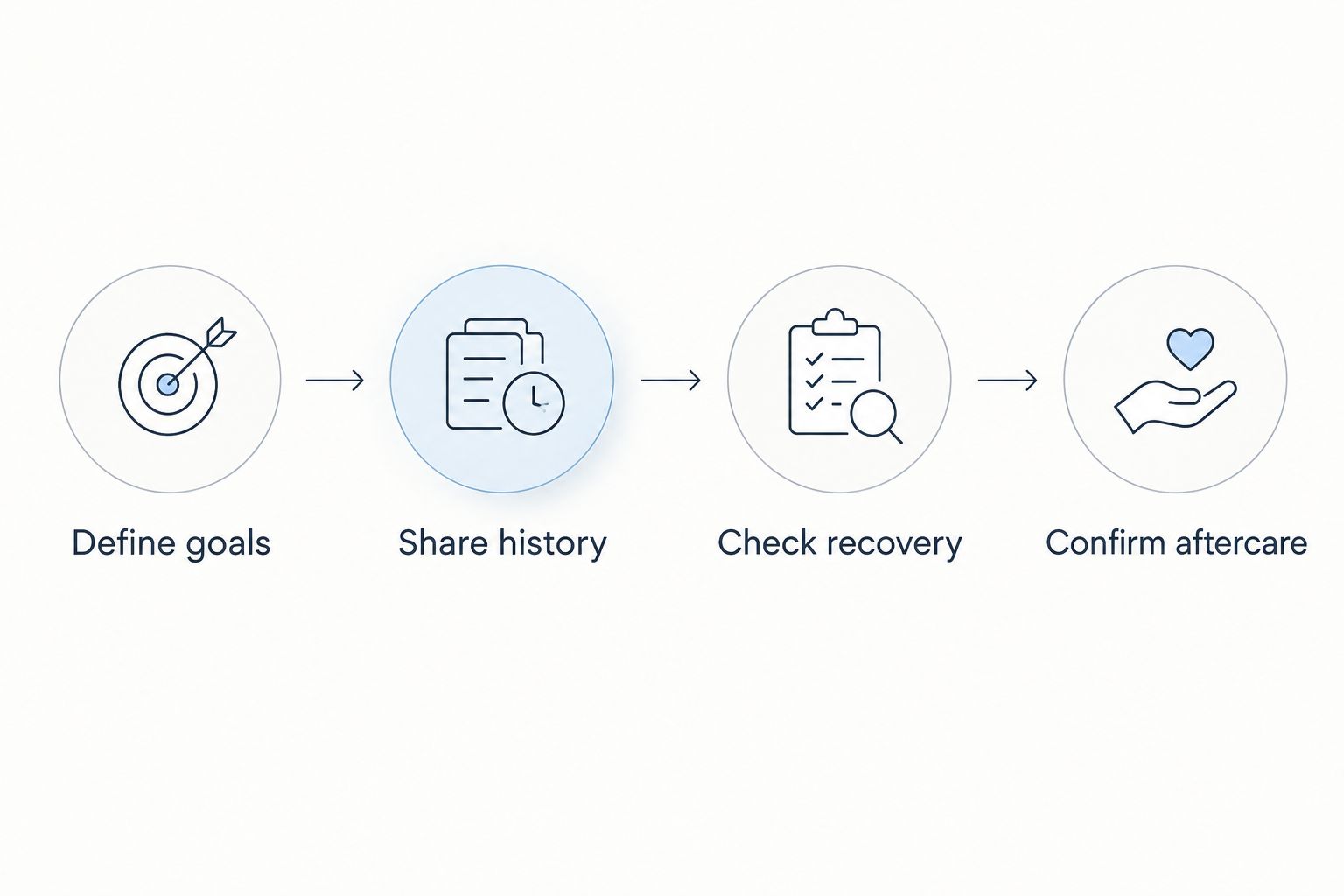
Use this decision sequence: Define goals, Share history, Check recovery, Confirm aftercare. If your schedule leaves no room for follow-up or a complication, defer the procedure. Do not turn a fixed wedding date into pressure to accept an unsuitable treatment.
- Share the ceremony and photography dates.
- Include travel and outdoor events in the calendar.
- Ask when the clinician will assess the result.
- Reserve time for any recommended follow-up.
- Defer treatment when recovery conflicts with wedding obligations.
Coordinate shaving, sun exposure, and aftercare
Begin by listing the activities your wedding week involves. Shaving, workouts, swimming, outdoor photography, and travel belong in the conversation because procedure-specific aftercare can affect your routine.
Laser hair removal deserves particular attention if you maintain a beard. Reduced hair growth changes future grooming options; do not treat a sharply defined beard line as a temporary styling decision. Discuss the intended area and the limitations of treatment before proceeding.
Ask for written aftercare instructions that cover your actual plans. Avoid substituting advice from friends or social media for instructions from the treating clinician, especially when different procedures have different requirements.
- Explain how often you shave and where irritation occurs.
- Discuss beard boundaries before any hair-removal treatment.
- Ask about sun exposure and sunscreen after the procedure.
- Check instructions for exercise, swimming, and skin products.
- Keep the clinic’s follow-up and urgent-care instructions accessible.
Reassess before adding another procedure
After treatment, follow the clinician’s assessment schedule rather than judging the result repeatedly in different mirrors. Use consistent lighting if photographs are part of the follow-up. Changing lighting, expression, and camera distance can make comparisons misleading.
A 2026 wedding plan should include a stopping point. Do not add a new procedure merely because the ceremony is getting closer. If you are dissatisfied, discuss the concern with the treating clinician rather than booking an unrelated treatment to compensate.
Body contouring and IV vitamin therapy also need their own rationale. Neither should become a default add-on to facial care simply because it appears on the same service menu.
- Attend the recommended follow-up.
- Describe concerns without relying on edited photographs.
- Ask whether the result is ready for assessment.
- Avoid stacking new procedures without clinical review.
- Keep the final wedding-week routine familiar and simple.
Compare the options by goal and limitation
The best option depends on the concern, medical suitability, and recovery demands. Daily care has value without a procedure; medical treatments address narrower goals and introduce additional risks. Compare those trade-offs before making a booking decision.
| Option | Best for | Main advantage | Key limitation |
|---|---|---|---|
| Daily skin care | Grooms building a consistent foundation | Supports cleansing, moisturizing, and sun protection | Does not replace procedures aimed at specific structural or expression-related concerns |
| Botox | Grooms seeking assessment of selected expression lines | Targets muscle activity associated with those lines | Requires clinical selection; bruising and unwanted effects are possible |
| Fillers | Grooms seeking assessment of a specific volume concern | Adds volume in selected areas | Swelling and bruising are possible; rare vascular complications can be serious |
| Microneedling | Grooms discussing texture or scar concerns | Provides a procedure-based approach to selected skin concerns | Creates skin injury, requires aftercare, and is not suitable for every skin condition |
| Laser hair removal | Grooms considering reduced unwanted hair growth | Addresses hair growth rather than daily shaving alone | Treatment planning depends on skin, hair, and the intended area; it changes future grooming choices |
| Body contouring | Grooms asking about a localized contour concern | Focuses on a defined body area | The method must be identified before benefits, risks, and suitability can be assessed |
| IV vitamin therapy | Grooms discussing a specific clinical rationale | Allows assessment of whether an infusion has a relevant purpose | It is not a substitute for sleep, food, or medical care; an IV introduces procedural risks |
Oasisbeauty offers the listed medical treatment categories, but availability on a service menu does not establish which option is appropriate for you. Ask the clinician to identify the exact method or injectable product being proposed. That detail matters more than a broad label such as body contouring.
Explore treatment options
Review the Henderson med spa’s skin, body, and wellness treatment categories.
Common mistakes grooms make
Treating the ceremony as the only deadline
Your first important photograph can happen before the wedding. Share the whole event calendar so recovery planning accounts for engagement sessions, travel, and rehearsal events—not just the ceremony date.
Copying someone else’s injectable plan
Another groom’s concerns, facial anatomy, and medical history are not yours. Ask for an assessment of your own goals rather than requesting the same treatment areas or amount used for a friend.
Changing beard boundaries without considering permanence
A beard shape chosen for wedding photographs is not necessarily the shape you want afterward. Before laser hair removal, discuss which areas you want treated and how reduced growth affects future styling.
Using wellness treatments to compensate for wedding stress
An infusion does not replace adequate sleep, regular meals, or evaluation of persistent fatigue. Discuss symptoms with a medical professional rather than assuming an elective wellness treatment addresses their cause.
Combining unfamiliar products with a new procedure
A new exfoliant, a stronger shaving product, and a procedure create several possible sources of irritation. Keep your routine understandable and ask the treating clinician which products to pause or continue.
FAQ
What are the best med spa treatments for grooms?
The best med spa treatments for grooms are those matched to a specific concern and a clinical assessment. Botox, fillers, microneedling, and laser hair removal address different goals; none is a default requirement before a wedding.
How far before my wedding should I get a treatment?
Schedule treatment according to the clinician’s procedure-specific recovery and follow-up plan. Include engagement photographs, travel, and rehearsal events when discussing timing, and defer treatment if the calendar leaves no room for recovery.
Is Botox better than fillers for a groom?
Botox and fillers address different concerns, so neither is universally better. Botox targets selected muscle-related expression lines, while fillers add volume in selected areas; suitability requires an individual assessment.
Can I get microneedling right before my wedding?
Do not choose microneedling when your schedule cannot accommodate the clinician’s recovery and aftercare instructions. The procedure creates controlled skin injury, so wedding photographs and outdoor events must be considered before treatment.
Should I get laser hair removal along my beard line?
Consider beard-line laser hair removal only if reduced growth matches your longer-term grooming goals. Discuss the treatment boundary, skin and hair suitability, and risks before making a change for wedding photographs.
Do I need IV vitamin therapy before my wedding?
A wedding alone does not establish a clinical need for IV vitamin therapy. Discuss the proposed purpose, ingredients, medical suitability, and risks rather than treating an infusion as a substitute for rest or nutrition.
What should I bring to a med spa consultation?
Bring your goals, wedding-event calendar, medication and supplement list, and relevant medical history. Include previous cosmetic treatments, reactions, and details about your shaving and skin-care routine.
Which treatments does Oasisbeauty offer in Henderson?
Oasisbeauty offers skin, body, and wellness treatments including Botox, fillers, microneedling, laser hair removal, body contouring, and IV vitamin therapy. Choosing among them requires an assessment of your concern, medical suitability, and recovery constraints.
One last thing
Bring the date of your first important photograph, not only your wedding date, to the consultation. That small change makes the deadline useful. For your 2026 wedding, the strongest plan is the one that leaves you informed, recovered, and free to focus on the event—not the next procedure.