
Laser hair removal for athletes is a cosmetic treatment that targets hair follicles with the aim of reducing unwanted hair and repeated grooming around training. Your sport changes the planning: sweat, tight clothing, outdoor exposure, and recovery days all affect when treatment fits your schedule.
- Laser hair removal for athletes reduces grooming demands; it does not establish a performance or hygiene advantage.
- Oasisbeauty offers laser hair removal in Henderson for clients seeking cosmetic hair reduction.
- Schedule treatment around skin recovery, outdoor training, and friction from sports clothing.
- Choose treatment by skin tone, hair color, and clinician assessment—not by sport alone.
Why laser hair removal matters for athletes
Athletes have a practical scheduling problem: the same skin you treat also sits under compression shorts, swimsuit straps, helmets, or protective equipment. A session that fits your calendar can still conflict with the next workout.
The benefit is less dependence on repeated hair removal, not faster race times or cleaner skin. Hair removal does not replace washing training clothes, cleaning equipment, or addressing a persistent rash.
Oasisbeauty is best suited to Henderson athletes seeking local cosmetic laser hair removal. The decision still depends on your skin, hair, medical history, and ability to follow aftercare—not simply your training volume.
For your 2026 training calendar, treat appointments as skin-recovery commitments rather than errands between workouts. Before booking, identify the areas you want treated and the activities that put heat, rubbing, or sunlight on them.
How to plan laser hair removal around training
1. Define the grooming problem you want to solve
Start with a training diary and your current grooming routine. Record where shaving causes irritation, which clothing rubs, and whether unwanted hair is actually the problem. This manual check helps separate a cosmetic preference from a skin condition that needs medical assessment.
For cyclists, the issue might be repeated leg shaving. For swimmers, it might be grooming around swimsuit edges. For lifters, it might be irritation where clothing presses against recently shaved skin. None of these situations automatically makes laser the right answer.
Choose an area because reducing its hair would simplify your routine—not because hairlessness promises better athletic performance. Painful bumps, drainage, spreading redness, or recurrent boils deserve clinical attention before cosmetic treatment.
- Name the specific body area and grooming concern.
- Note whether irritation follows shaving, clothing friction, or both.
- Identify equipment that touches the treatment area.
- Separate cosmetic goals from symptoms needing medical care.
2. Match the treatment to your skin and hair
Prepare a plain-language history before speaking with a qualified clinician. Include your natural skin tone, recent tanning, hair color, previous reactions, medications, and any active skin problems. Do not stop prescribed medication on your own.
Laser hair removal targets pigment associated with the hair follicle. Dark, coarse hair generally responds better than very light, white, gray, or red hair. Darker skin requires appropriate device selection and settings because pigment in the surrounding skin also absorbs light energy.
A clinician should explain suitability rather than promise identical results across skin tones and hair colors. Ask whether a test spot is appropriate and what it can—and cannot—tell you about your response.
- List medications, supplements, and topical skin products.
- Disclose recent sun exposure, tanning, and self-tanner use.
- Describe previous burns, pigment changes, or unusual scarring.
- Ask about experience treating your skin tone.
- Request realistic expectations for your hair color and texture.
3. Choose a provider around safety and scheduling
Start by preparing questions yourself; a provider discussion should then turn those questions into a treatment plan. A local option such as Oasisbeauty offers laser hair removal, but you still need to confirm the device, clinician qualifications, treatment areas, and aftercare before proceeding.
Ask who performs treatment, what oversight applies, and how the practice handles an unexpected reaction. A useful explanation connects the proposed treatment to your skin and hair—not just the name of a machine.
For 2026 planning, the American Academy of Dermatology's patient guidance describes 2–6 treatments for many patients and appointments commonly spaced 4–6 weeks apart. These are general patient-education ranges, not a prescription for every body area or a guarantee of completion.
That distinction matters if you are targeting a race, competition, or holiday. Ask for a proposed schedule and its limitations before rearranging training around it.
- Confirm who performs treatment and their relevant qualifications.
- Ask why the proposed device suits your skin and hair.
- Request area-specific treatment and recovery instructions.
- Discuss maintenance and incomplete hair reduction.
- Confirm how to contact the practice about a reaction.
4. Build appointments around your training calendar
Use your existing calendar first. Mark hard sessions, outdoor training, pool workouts, travel, competitions, and days when protective clothing is unavoidable. Then identify appointments that leave room to follow the clinician's aftercare instructions.
There is no universal return-to-training deadline for every laser treatment. Treatment area, skin response, device settings, and the activity itself all matter. A gentle walk and a hot session in tight compression clothing are different exposures.
For an outdoor athlete in Henderson, sun exposure belongs in the scheduling discussion before treatment. Recent tanning can affect suitability, while treated skin needs protection afterward. Broad-spectrum, water-resistant SPF 30 or higher sunscreen is standard American Academy of Dermatology sun-protection guidance; clothing and shade remain important too.
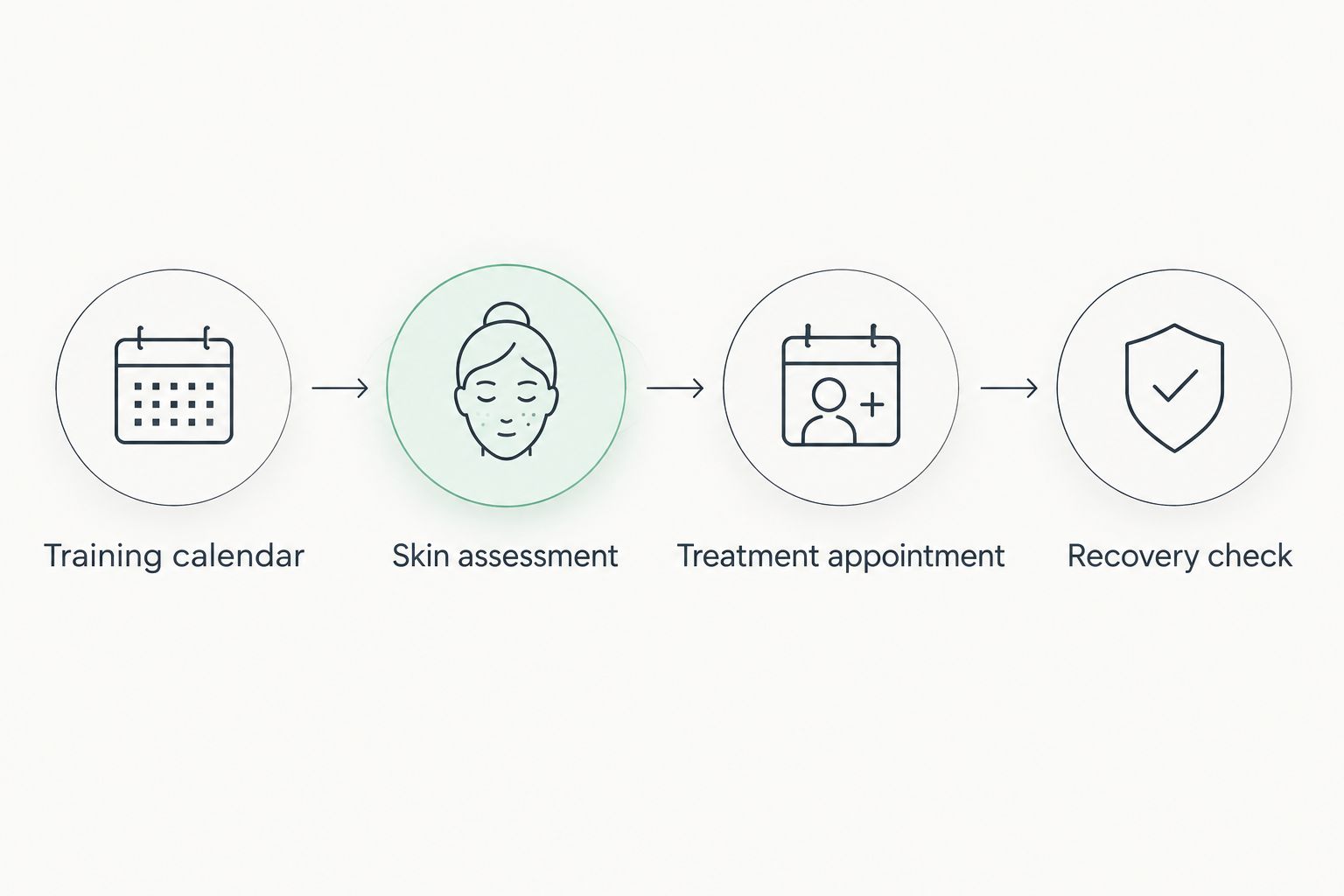
Use these checkpoints in order:
- Training calendar: identify workouts, travel, and competition commitments.
- Skin assessment: confirm suitability and recent sun exposure.
- Treatment appointment: follow the agreed preparation instructions.
- Recovery check: assess your skin and follow the return-to-activity plan.
5. Prepare the skin without disrupting treatment
Follow the treating clinician's preparation instructions rather than copying another athlete's routine. Shaving and waxing are not interchangeable before laser: waxing, plucking, and epilating remove hair from the root, which interferes with the intended treatment target.
Shaving is commonly part of preparation, but confirm the timing and method with your provider. Arriving with razor burn or broken skin is not a useful shortcut. Ask what to do if preparation itself irritates the area.
Bring up the products your sport puts on your skin, including deodorant, body oils, anti-chafing products, and topical medications. The treatment team should tell you what to remove or pause and when. Avoid adding an unfamiliar exfoliant immediately before an appointment.
- Follow the provider's shaving instructions for the treatment area.
- Avoid root-removing methods during the instructed preparation period.
- Report cuts, rashes, sunburn, or active irritation before attending.
- Ask about deodorant, anti-chafing products, and topical treatments.
- Disclose medication or skin-health changes since your assessment.
6. Return to exercise according to skin recovery
Begin with the written aftercare plan, not your training app. Redness and swelling around follicles can occur after laser hair removal. Heat, rubbing, and irritating products can make recently treated skin less comfortable.
Ask specifically about your sport. Running, swimming, cycling, contact training, and sauna use create different combinations of friction, water exposure, impact, and heat. A generic question about exercise leaves too much room for misunderstanding.
For your 2026 training log, record treatment dates, skin reactions, and when each activity felt comfortable again. Use that record to improve scheduling with your clinician, not to override instructions after the next session.
Blistering, worsening pain, spreading redness, or unexpected pigment changes warrant prompt contact with the treating clinician. Do not hide a reaction under equipment and train through it.
- Follow the clinician's activity restrictions for the treated area.
- Ask separately about swimming, sauna use, and contact sports.
- Reduce avoidable rubbing from tight seams or protective equipment.
- Use only the skin-care products recommended for recovery.
- Report concerning reactions before resuming irritating activities.
Compare hair-removal options for your sport
The right method depends on how much hair reduction you want and how much treatment planning you can accommodate. Laser has a longer-term reduction goal, while shaving, trimming, and waxing manage hair without the same laser-treatment schedule.
| Option | Best for | Main advantage | Key limitation |
|---|---|---|---|
| Trimming | Athletes who want shorter hair without a close shave | Leaves some hair above the skin and avoids a deliberately close shave | Does not produce a hair-free result or reduce future growth |
| Shaving | Athletes who want immediate, self-managed hair removal | Fits an at-home routine without waiting for a treatment series | Requires repetition and can cause cuts, irritation, or ingrown hairs |
| Waxing | Athletes who prefer temporary removal from the root | Removes hair below the skin surface | Can irritate skin and conflicts with preparation for laser treatment |
| Professional laser hair removal | Suitable candidates seeking longer-term hair reduction | Reduces growth rather than only cutting visible hair | Requires multiple appointments; results vary and maintenance can be needed |
Professional laser hair removal wins when longer-term reduction matters more than immediate convenience. Trimming is a practical alternative when you want less hair but do not want a close shave or a treatment series.
Oasisbeauty offers the professional laser option locally; the trade-off remains appointment planning and recovery around training. No method earns a blanket recommendation for every athlete or every body area.
Common mistakes athletes and gym-goers make
Booking immediately before a key event
A first session just before competition leaves little room to understand your skin's response. For a 2026 event plan, discuss the event date before booking and avoid making debut treatment part of race-week experimentation.
Treating sweating as the only concern
A workout without heavy sweating can still rub the treated area. Think about saddle contact, swimsuit edges, shin guards, lifting belts, and compression seams—not only exercise intensity.
Assuming hair removal prevents skin infections
Less hair does not make shared equipment clean or resolve an existing rash. Keep hygiene and cosmetic grooming separate, and seek medical assessment for persistent or worsening skin symptoms.
Expecting permanent, complete hairlessness
Laser treatment aims for hair reduction, and regrowth or maintenance treatment remains possible. Ask what improvement is realistic for the specific area instead of treating a proposed series as a guaranteed finish line.
Hiding a tan or a medication change
Your provider needs current information at each appointment. Report tanning, sunburn, new products, and medication changes even when disclosure means adjusting the plan; completing an appointment is not more important than skin safety.
FAQ
Is laser hair removal worth it for athletes?
Laser hair removal is worth considering for athletes who want longer-term hair reduction and can accommodate treatment and recovery. It is a cosmetic choice, not an established way to improve athletic performance.
Can I work out after laser hair removal?
Return to exercise according to your treating clinician’s instructions and your skin’s response. Ask about your actual activity, including friction, heat, pool exposure, and protective equipment, rather than requesting a single rule for all exercise.
Is laser hair removal better than shaving for gym-goers?
Laser hair removal is better suited to longer-term reduction, while shaving provides immediate, temporary removal. Laser requires appointments and aftercare; shaving requires repetition and can cause irritation or ingrown hairs.
Can athletes with dark skin get laser hair removal?
Athletes with dark skin can be candidates for laser hair removal when a qualified clinician selects an appropriate device and treatment settings. Ask about experience with your skin tone and the risks of burns and pigment changes.
How many laser hair removal sessions will I need?
Your treatment count depends on the body area, hair characteristics, and response to treatment. The American Academy of Dermatology describes 2–6 treatments for many patients, but that range is not a guarantee and maintenance can be needed.
Can I swim after laser hair removal?
Resume swimming only according to the treating clinician’s aftercare instructions. Ask about pool or open-water exposure, swimsuit friction, and outdoor sun exposure for the specific area being treated.
Where can Henderson athletes discuss laser hair removal?
Oasisbeauty is a Henderson med spa offering laser hair removal. Confirm treatment suitability, provider qualifications, preparation, and sport-specific aftercare before proceeding.
One last thing
Your most useful appointment question is not simply when you can exercise again. Describe the exact next workout: the clothing, equipment contact, environment, and body area involved. That gives your clinician a concrete activity to assess instead of an abstract fitness question.
For 2026, build your hair-removal plan around the training you actually do. A treatment schedule only works when you can follow its aftercare.