
PRP microneedling is worth discussing for diagnosed pattern hair loss, but the added value of microneedling over PRP injections alone is not firmly established. Combining them adds scalp injury, aftercare, and recovery considerations without guaranteeing more growth. Before choosing a treatment, confirm what is causing your thinning and ask what evidence supports the exact procedure being proposed.
- Is PRP microneedling worth it for hair loss? Diagnosis and evidence for the proposed combination should drive your decision.
- PRP injections and scalp microneedling are different procedures; evidence for one does not automatically support the combination.
- Oasis Beauty Medical Aesthetics suits local cosmetic-care conversations; unexplained hair loss needs medical evaluation.
- Discuss scalp health, realistic expectations, recovery, and established alternatives before committing to treatment.
Is PRP microneedling worth it for hair loss?
Consider it an optional discussion after diagnosis—not the default first step when you notice thinning. PRP has clinical research behind its use for pattern hair loss, but treatment methods vary. Adding microneedling introduces another variable, and studies of different combinations do not establish one universal protocol.
If you are comparing cosmetic care locally, Oasis Beauty Medical Aesthetics offers a starting point for questions about its stated aesthetic services. Ask directly whether scalp PRP or hair-loss microneedling is offered; facial microneedling does not establish that a practice provides either procedure.
| Option | Best for discussing when | Main limitation or concern |
|---|---|---|
| PRP injections | You have diagnosed pattern hair loss and want to discuss an additional procedure | Preparation, treatment schedules, and results vary; injections cause discomfort and bruising |
| Scalp microneedling | A qualified medical professional recommends it within a defined hair-loss plan | Skin injury brings infection and irritation risks; evidence depends on the treatment combination |
| PRP with microneedling | You understand the proposed method and its uncertain added benefit | More procedural steps do not automatically mean better hair growth |
| Topical minoxidil | You want to discuss an established option for pattern hair loss | Ongoing use is generally needed to maintain benefits, and scalp irritation can occur |
None of these options is best for every person with shedding. A treatment comparison only becomes useful once you know which type of hair loss you have.
Why this matters before you book
Hair thinning can feel personal long before anyone else notices it. You deserve a conversation that takes that concern seriously without turning your first appointment into a commitment.
The American Academy of Dermatology explains that identifying the cause of hair loss is essential to choosing treatment. Pattern hair loss, temporary shedding, traction-related loss, and inflammatory scalp conditions do not all respond to the same approach.
For a 2026 treatment decision, the useful question is not whether a procedure is popular; it is whether the procedure fits your diagnosis. A scalp that looks less dense after an illness needs a different conversation from a scalp with slowly widening part lines or painful, inflamed patches.
Cosmetic procedures also do not replace evaluation for an underlying medical problem. New or unexplained hair loss belongs in a medical assessment before you add an elective scalp treatment.
What exactly are you being offered?
PRP stands for platelet-rich plasma. A clinician draws blood and processes it to obtain a platelet-containing portion of the plasma, which can then be injected into the scalp.
Microneedling makes controlled punctures in the skin. In a hair-loss plan, the proposed treatment might involve scalp needling, PRP injections, PRP placed on the scalp after needling, or a combination of these steps.
Those are not interchangeable procedures. When a clinic says PRP microneedling, ask the clinician to describe exactly where the PRP goes and how the needling fits into the plan.
The distinction matters for evidence as well as safety. Research involving injected PRP does not automatically prove that PRP applied over a freshly needled scalp produces the same outcome. Likewise, research on microneedling combined with minoxidil does not establish the effectiveness of microneedling combined with PRP.
The U.S. Food and Drug Administration states that microneedling devices are not approved for delivering cosmetics, medications, vitamin solutions, drugs, or blood products such as PRP into the skin. That regulatory limitation belongs in an informed discussion, not buried beneath a treatment name.
What does the evidence actually tell you?
The American Academy of Dermatology includes PRP among procedures used for hair loss and describes it as an option that requires repeat treatment. That supports a discussion about PRP; it does not establish that every PRP preparation or combination works equally well.
Clinical studies of PRP for pattern hair loss use different preparation methods, treatment schedules, and outcome measurements. That variation limits how confidently you can apply one study's result to a different clinic's protocol.
For the combined procedure, ask a narrower question: does the evidence compare this exact combination with PRP alone, or does it study something else? A paper about microneedling plus minoxidil is not direct evidence that adding microneedling to PRP improves your outcome.
In 2026, a credible explanation separates evidence for PRP, evidence for microneedling, and evidence for using them together. A treatment menu that blends those categories makes the decision harder, not clearer.
Also ask what success meant in the research being discussed. Measured hair density, patient satisfaction, and a flattering photograph answer different questions. None guarantees that your hair will return to its previous thickness.
When is the combination worth discussing?
Diagnosed pattern hair loss
Pattern hair loss is a reasonable setting for a PRP conversation because it is a major focus of the available research. A medical assessment still needs to establish that the pattern fits and that another condition is not being missed.
Best for: someone with a confirmed diagnosis who wants to discuss an additional procedure alongside established options. The limitation is that individual response remains uncertain, even when the diagnosis is clear.
A clear goal and realistic expectations
A useful goal describes what bothers you: a widening part, reduced density through the crown, or a change in how much scalp shows. That gives your clinician something more specific to assess than wanting thicker hair everywhere.
Best for: someone prepared to judge change gradually and accept that visible improvement is not assured. PRP microneedling is a poor fit if only a dramatic transformation would feel worthwhile.
Willingness to follow a longer-term plan
Hair-loss care often involves reassessment rather than a single procedure followed by a permanent result. Ask what continued care would involve if the treatment appears to help.
Best for: someone comfortable with follow-up and honest progress checks. The drawback is the ongoing time, discomfort, and practical commitment, especially when the benefit is uncertain.
When should you pause and get evaluated first?
Do not treat every new patch or episode of shedding as a cosmetic problem. Sudden loss, scalp pain, persistent redness, heavy scaling, sores, or areas that look scarred need medical attention before elective needling.
Inflammatory and scarring forms of hair loss can require prompt diagnosis and treatment to help protect remaining follicles. An aesthetic procedure is not a substitute for treating the underlying disease.
Temporary shedding also deserves context. Tell your clinician about recent illness, childbirth, major stress, dietary changes, medications, and changes in your general health. Those details can alter the investigation and treatment discussion.
The American Academy of Dermatology describes normal shedding as about 50–100 hairs per day. That range is background information, not a home diagnostic test: visible thinning, a change from your usual pattern, and scalp symptoms still matter.
Avoid repeatedly counting every hair to decide whether you qualify for treatment. Describe what changed, when it started, and whether it is progressing; those details are more useful at an appointment.
Why the value of PRP microneedling varies
The same treatment name can describe different experiences. These factors change whether the procedure makes sense for you:
- Diagnosis: A procedure discussed for pattern hair loss is not automatically appropriate for temporary shedding or an inflammatory scalp condition.
- Procedure details: Injected PRP and PRP placed on a needled scalp are different methods. Ask which one is proposed.
- Scalp health: Irritation, infection, or active skin disease can change whether needling is appropriate.
- Medical history: Medicines, bleeding issues, platelet disorders, and other health conditions affect procedural assessment.
- Treatment burden: Repeated visits, discomfort, aftercare, and maintenance influence whether an uncertain benefit feels worthwhile.
- Your definition of success: A modest density change and restoration of a former hairline are very different expectations.
For Henderson and nearby Las Vegas residents comparing options in 2026, convenience belongs on the list—but below diagnosis, suitability, and safety. A nearby appointment does not make an unsuitable treatment a better choice.
What are the risks and recovery considerations?
PRP injections can cause tenderness, swelling, pinpoint bleeding, and bruising. Microneedling can cause redness, irritation, bleeding, and temporary skin sensitivity; infection, pigment changes, and scarring are also recognized risks.
Using your own blood does not make PRP risk-free. Blood handling, sterile technique, skin preparation, and the procedure itself still matter.
Do not accept a blanket promise of no downtime. Recovery depends on the treatment method, your scalp, and the reaction you experience. Ask what symptoms are expected and what would require a call or medical assessment.
Before treatment, disclose prescription medicines, supplements, allergies, prior scalp reactions, and relevant medical conditions. Do not stop a prescribed medicine because a cosmetic treatment is scheduled unless the prescribing clinician tells you to.
Ask for written instructions about washing your hair, using styling products, exercising, and restarting scalp medications. Those instructions should come from the professional responsible for your procedure rather than a generic online routine.
Increasing pain, spreading redness, drainage, fever, or other concerning symptoms after treatment need prompt medical advice. Do not assume worsening symptoms mean the treatment is working.
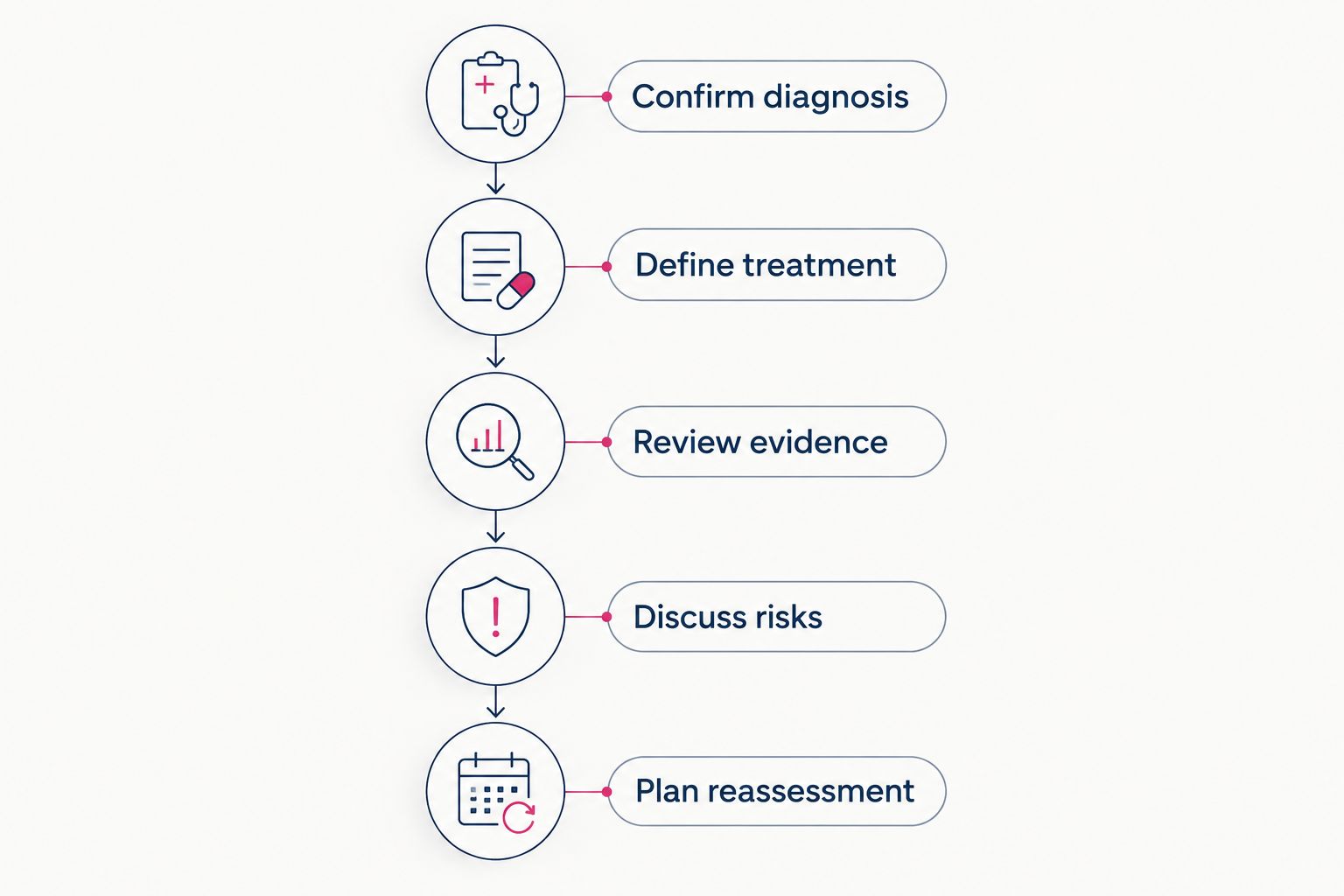
How should you compare your options at a consultation?
Bring your questions before choosing a package or setting a treatment date. A good consultation gives you room to understand the recommendation, consider alternatives, and decide not to proceed.
- Confirm diagnosis. Ask what type of hair loss is suspected, what supports that conclusion, and whether you need a dermatologist's assessment.
- Define treatment. Ask whether PRP will be injected, applied after needling, or both. Request a plain-language explanation of each step.
- Review evidence. Ask what supports that exact approach and whether adding microneedling has demonstrated a meaningful advantage over PRP alone.
- Discuss risks. Review your health history, scalp condition, expected recovery, and instructions for getting help after treatment.
- Plan reassessment. Agree on how progress will be documented and when the plan should change if it is not helping.
For your 2026 consultation, bring a medication list and photographs that show how your hair has changed. Mention your usual styling practices, including tight hairstyles, extensions, bleaching, or other treatments that affect your scalp or hair.
Call Oasis Beauty Medical Aesthetics with questions about its stated microneedling and cosmetic-care services, and ask whether your concern needs a separate hair-loss evaluation. You do not need to arrive knowing which procedure you want.
Ask about your next step
Discuss your concern and confirm which services and evaluations fit before choosing a procedure.
Should you discuss minoxidil before PRP microneedling?
Yes—established treatment options belong in the conversation before you choose an elective combination procedure. Topical minoxidil is used for pattern hair loss, although suitability depends on your diagnosis, health circumstances, and the product instructions.
The American Academy of Dermatology advises that minoxidil can take 6–12 months to show results. Continued use is generally needed to maintain its benefit, and irritation or unwanted hair growth can occur.
That does not mean everyone should start minoxidil without advice. Pregnancy, breastfeeding, scalp problems, other health concerns, and uncertainty about the cause of hair loss are reasons to speak with a qualified medical professional first.
Best for discussing: an established, nonprocedural approach to diagnosed pattern hair loss. Its limitations include the ongoing routine, delayed assessment of results, and the possibility that it will not provide the improvement you want.
A clinician can also explain whether other prescription treatments are appropriate. You do not have to add every available treatment at once; a clear plan makes it easier to understand tolerability and progress.
Is PRP microneedling better than PRP injections alone?
An added benefit is not firmly established across treatment methods. Ask for evidence comparing the proposed combination directly with PRP injections alone, rather than accepting evidence about either treatment separately.
Adding a procedure also adds another source of discomfort and skin injury. The combination needs a reason beyond the assumption that more treatment must produce more growth.
Can you get the same result with a home dermaroller?
A home dermaroller is not an equivalent substitute for a professionally assessed hair-loss plan. Device differences, technique, hygiene, scalp condition, and the substances applied afterward all affect risk.
Do not apply blood products or improvise a PRP routine at home. Ask a qualified professional before needling a thinning, irritated, or otherwise symptomatic scalp, especially if you are already using scalp medication.
How can you judge whether treatment is helping?
Use consistent photographs rather than checking your hairline under different bathroom lights each day. Keep the lighting, camera angle, part placement, and hair condition as similar as possible so comparisons are meaningful.
Ask your clinician how progress will be assessed and whether objective measurements are available. Photographs taken with wet hair in one image and dry, styled hair in another can exaggerate a difference.
Also agree on a review point before starting. If your scalp becomes more irritated, shedding changes, or the expected improvement does not appear, the next step is reassessment—not automatically adding another procedure.
Sources behind this guidance
This 2026 guide uses the American Academy of Dermatology's patient guidance, including Hair loss: Diagnosis and treatment and Do you have hair loss or hair shedding?, for diagnosis, normal shedding, PRP treatment context, and minoxidil expectations.
Safety and regulatory guidance comes from the U.S. Food and Drug Administration's Microneedling Devices: Getting to the Point on Benefits, Risks and Safety. Its guidance distinguishes device uses and explains risks, including the limitation on delivering PRP and other products into the skin.
These sources support a careful treatment discussion, not a promise that a particular combination will work for you. Your medical history, diagnosis, and proposed procedure still need individual assessment.
FAQ
Is PRP microneedling worth it for hair loss?
PRP microneedling is worth discussing after a hair-loss diagnosis, but the added benefit over PRP injections alone is not firmly established. Ask what supports the exact combination proposed for you.
Is PRP microneedling better than minoxidil?
PRP microneedling is not an established replacement for minoxidil in every person with pattern hair loss. Discuss the evidence, suitability, ongoing care, and risks of each approach with a qualified medical professional.
Does PRP microneedling work for every type of hair loss?
No, PRP microneedling is not appropriate for every cause of hair loss. Sudden shedding, painful scalp changes, and suspected inflammatory or scarring conditions need medical evaluation before an elective procedure.
Is PRP applied after microneedling the same as PRP injections?
No, applying PRP after microneedling is different from injecting PRP into the scalp. Evidence for one method does not automatically establish the effectiveness of the other.
Can PRP microneedling make my scalp sore?
Yes, scalp tenderness, redness, irritation, and bleeding can occur. Ask about expected recovery and seek prompt medical advice for increasing pain, spreading redness, drainage, or fever.
Can I use a dermaroller at home for hair thinning?
A home dermaroller is not a substitute for diagnosing hair loss or assessing whether needling is appropriate. Speak with a qualified professional before needling an irritated scalp or combining needling with scalp products.
Does Oasis Beauty Medical Aesthetics offer PRP for hair loss?
The stated service information confirms microneedling but does not establish scalp PRP or hair-loss treatment services. Call the team to confirm the service and ask whether a separate medical hair-loss evaluation is needed.
One last thing
Before booking treatment, ask what would make the clinician recommend against it. That question brings suitability, limitations, and safety into the conversation immediately.
A reassuring consultation leaves room for a different treatment, a medical referral, or no procedure at all. Your goal is a plan that makes sense for your scalp and your expectations—not simply a longer treatment menu.