Morpheus8 can be worth it for mild skin laxity when you want a modest change without surgery and accept the recovery, uncertainty, and risks of radiofrequency microneedling. It is not a substitute for removing excess skin, and a firmer appearance is not guaranteed. For your 2026 decision, the key trade-off is whether a realistic improvement justifies the discomfort, downtime, and possibility of complications—not whether the before-and-after photos look impressive.
- Is Morpheus8 worth it? Consider it for modest skin-tightening goals, not a surgical-level lift.
- Morpheus8 combines microneedling with radiofrequency energy; the FDA identifies potentially serious complications with radiofrequency microneedling.
- A qualified assessment should address skin laxity, facial volume, pigmentation risk, recovery, and realistic expectations.
- Loose skin, wrinkles, and texture are different concerns. Identify yours before choosing a procedure.
Is Morpheus8 worth it for skin tightening?
Morpheus8 is worth considering for mild skin laxity, but not when your goal requires removing loose skin or creating a surgical lift. It uses needles to deliver radiofrequency energy beneath the skin’s surface. The intended tissue response includes remodeling that can change the appearance of firmness and texture, but results vary by person and treatment approach.
Start by separating your concern from the treatment name. Fine creasing, uneven texture, loss of facial fullness, and hanging skin can look similar in a bathroom mirror, yet they do not call for the same plan. Treating the wrong concern can leave you disappointed even when the procedure goes as expected.
For local guidance, Oasisbeauty serves people seeking cosmetic and aesthetic care in Henderson. Call the team to discuss your concern and ask which treatments they offer for it; do not assume a particular device is available.
The comparison below describes treatment categories, not a list of services offered by the practice.
| Option | Best for | Potential advantage | Main limitation or downside |
|---|---|---|---|
| Morpheus8 | People considering modest improvements in laxity alongside texture concerns | Combines needling with radiofrequency energy | Uncertain improvement, recovery, and risks including burns, scarring, and unwanted fat loss |
| Microneedling without radiofrequency | People focused primarily on texture or selected scar concerns | Does not add radiofrequency heat | Is not a substitute for lifting or removing excess skin; still carries procedural risks |
| Surgical assessment | People with substantial loose skin or a desired change in facial structure | Can assess whether excess skin needs removal or tissues need repositioning | Surgery involves greater intervention, recovery, and its own risks |
| No procedure yet | People without a clear diagnosis, goal, or acceptable recovery plan | Avoids committing before the concern is understood | Does not directly correct established skin laxity |
Why this matters: tightening is not the same as lifting
The word tightening does a lot of work in aesthetic advertising. You might mean smoother-looking skin under your chin, less creasing around your cheeks, or a sharper jawline. Those are different goals, and the same procedure will not address each one equally.
A treatment that improves skin quality does not necessarily reposition deeper tissues. It also does not replace volume that has been lost. If your main concern is hollowing rather than looseness, a conversation focused only on tightening misses the point.
Before comparing treatments in 2026, describe what you notice without naming a device: skin that folds, a rough surface, a shadow, or a changing facial contour. That gives the clinician something useful to assess. Your job is to explain the change you want; the assessment should determine whether the proposed treatment matches it.
When Morpheus8 deserves a closer look
Mild laxity: best for a modest goal
Morpheus8 deserves consideration when the concern is limited looseness and you would be satisfied with a subtle change. The important word is satisfied. If you would consider anything short of a clearly lifted jawline a disappointment, that expectation needs attention before treatment.
Ask the clinician to explain what improvement means for your specific area. A useful answer distinguishes texture, fine lines, and firmness instead of combining them into a vague promise of rejuvenation. It should also identify what the procedure will not change.
Photographs can support that discussion, but they are not a forecast. Lighting, head position, facial expression, makeup, and camera distance all affect how tight skin appears. Look for comparable views rather than the most dramatic transformation.
Texture concerns: best for discussing more than firmness
Some people are interested in radiofrequency microneedling because texture and laxity appear together. That can make the treatment relevant to a broader discussion, but it does not mean every concern should receive the same treatment settings or approach.
If acne scars are your main concern, ask for a scar assessment rather than a general skin-tightening package. Scar type, active breakouts, pigmentation history, and previous procedures affect the conversation. Cosmetic improvement of a scar is also different from treating the skin condition that caused it.
The practical question is not whether the device has several uses. It is whether the proposed use fits your skin and whether a less intensive option would address your priority.
When Morpheus8 is a poor match
Significant loose skin: best for a surgical assessment
If you can see substantial hanging skin or want a major change in contour, seek an assessment that includes the limits of nonsurgical care. A consultation does not commit you to surgery. It helps establish whether your goal is achievable without it.
Be cautious when a treatment plan describes energy-based care as equivalent to a facelift or neck lift. These approaches act differently. A procedure that does not remove skin should not be presented as though it does.
You can still decide against surgery. The honest alternative is then a smaller goal, a different concern to treat, or no procedure—not a stronger promise about a nonsurgical result.
Existing hollowing: best for a volume-focused assessment
If your face already looks lean or hollow, unwanted fat loss deserves a direct discussion. The FDA includes fat loss among reported serious complications of radiofrequency microneedling. That matters when a small contour change could make your original concern more noticeable.
Ask how the clinician distinguishes skin laxity from volume loss in your treatment area. Also ask how the proposed approach accounts for the anatomy there. A general statement that the device is suitable for everyone does not answer either question.
An inflexible event date: best for waiting
A wedding, trip, or important photograph is not a reason to rush an unfamiliar procedure. Expected redness and swelling are only part of recovery; an unexpected reaction can disrupt plans beyond the anticipated downtime.
If you cannot accommodate uncertainty, postpone the treatment decision. You should not have to choose between following aftercare instructions and attending an event. Give yourself room to assess both the skin response and the eventual result without a deadline hanging over you.
Why Morpheus8 results vary
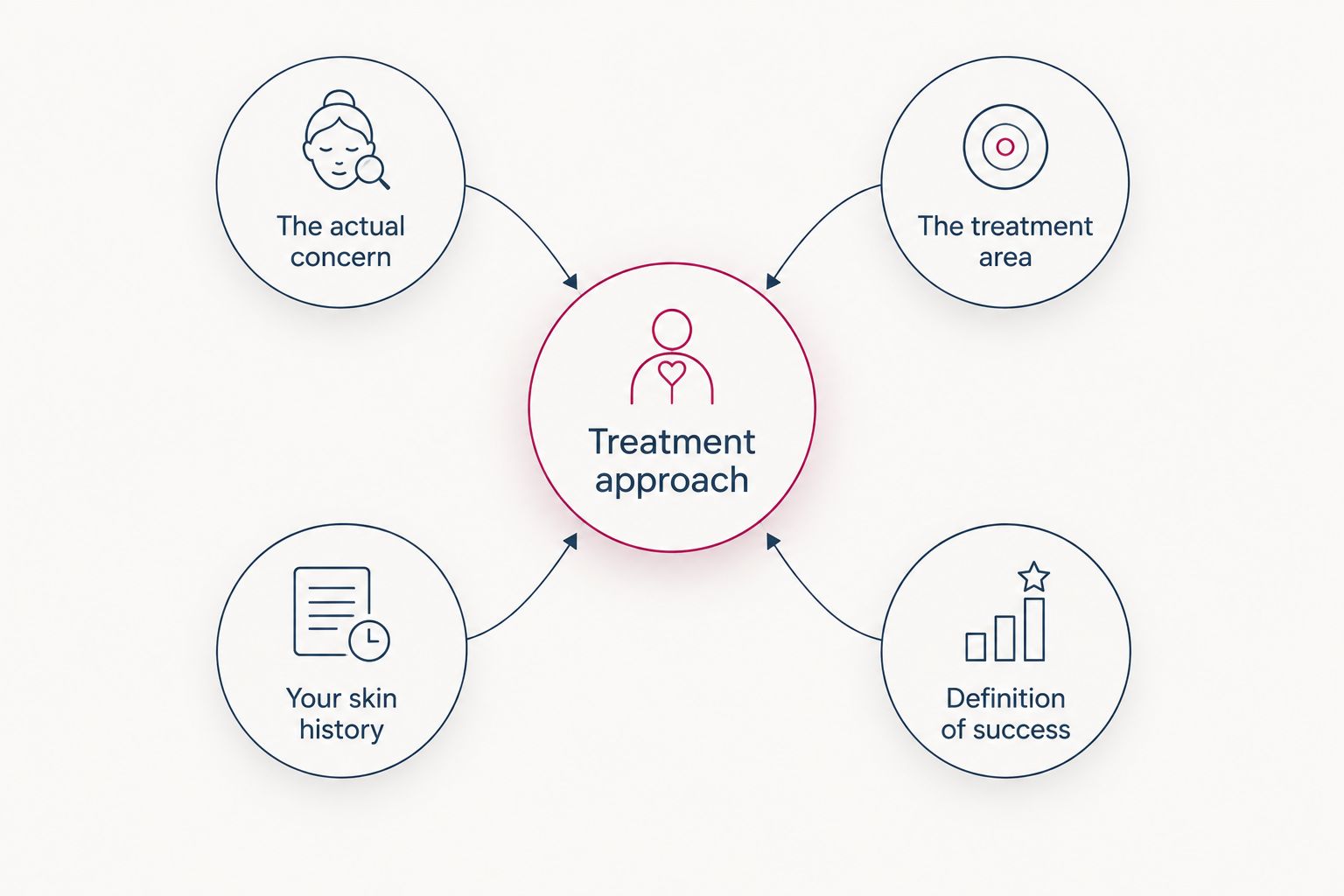
Variation is not just about the device. These factors belong in your consultation:
- The actual concern. Mild laxity, surface texture, scarring, and volume loss require different assessments. A treatment chosen for the wrong concern has a built-in limitation.
- The treatment area. Facial and body areas differ in skin thickness and underlying structures. Ask why the proposed approach fits the specific area you want treated.
- Your skin and medical history. Pigmentation changes, healing problems, medications, active skin conditions, and previous procedures can affect suitability and risk.
- The treatment approach. Needle depth, energy delivery, and technique matter. Settings should follow an individual assessment, not a trend or a request for the strongest treatment.
- Your definition of success. A subtle texture change and a visible lift are different endpoints. Agree on the intended outcome before deciding whether treatment is worthwhile.
A useful consultation connects each of these factors to your plan. If the explanation stays at the level of brand names and impressive photos, ask for more detail before agreeing.
What risks should you understand before treatment?
Radiofrequency microneedling is a medical procedure, not simply a facial with a little extra warmth. The FDA’s safety communication on radiofrequency microneedling identifies reports of serious complications, including burns, scarring, fat loss, disfigurement, and nerve damage. Those reports deserve discussion even when your intended treatment area is small.
That warning does not establish that every patient will experience a complication. It does mean that dismissing the procedure as risk-free is inaccurate. Ask the treating clinician to explain both the expected skin response and the complications they want you to watch for.
Temporary redness, swelling, tenderness, and surface changes can occur after microneedling procedures. Infection and changes in pigmentation are additional concerns. The American Academy of Dermatology’s patient guidance on microneedling emphasizes assessment, appropriate care, and the importance of the person performing the procedure.
Ask about pigmentation without accepting blanket reassurance
A history of dark marks after acne, irritation, or procedures matters. Tell the clinician about it, even if the marks eventually faded. Also discuss melasma, recent tanning, and previous reactions to aesthetic treatments.
Do not accept a universal claim that a treatment is safe for every skin tone or cannot affect pigment. Suitability depends on your skin, the procedure, and the treatment approach. Ask what precautions apply to you and how an unwanted pigment change would be managed.
Know what requires a call
Get written aftercare instructions and a clear route to clinical help before treatment day. Ask which changes are expected, which require a prompt call, and what to do outside office hours.
Blistering, worsening pain, spreading redness, drainage, or a new change in sensation deserves medical attention rather than reassurance from social media. If you develop an urgent or severe reaction, seek urgent medical care. Do not wait for a cosmetic follow-up appointment to address an escalating problem.
What should you ask at a consultation?
Bring your questions before you bring your calendar. A reassuring consultation makes room for uncertainty and gives you permission to decline. You should leave understanding the proposed plan, not simply feeling excited about it.
Use this checklist for a 2026 consultation:
- Name the concern. Ask whether the visible change is mainly laxity, texture, pigment, scarring, or loss of volume. Request an explanation in plain language.
- Define the goal. Describe the change you would consider worthwhile. Ask which part is realistic and which part the proposed treatment will not address.
- Review your history. Share medications, skin conditions, healing concerns, previous procedures, and any tendency to develop dark marks or raised scars. Do not stop prescribed medication without the prescribing clinician’s guidance.
- Discuss the approach. Ask who performs the procedure, what training they have, and how they select the treatment approach for your anatomy.
- Plan for recovery. Get instructions for skin care, exercise, makeup, sun exposure, and contacting the practice if something feels wrong.
- Agree on reassessment. Ask when results will be evaluated and what happens if improvement is limited. Do not treat additional sessions as automatic.
Oasisbeauty is best suited to Henderson-area readers seeking a conversation about cosmetic skin care before choosing a treatment. Ask the team which services fit your concern and whether you need a different assessment first. Listening should come before choosing a procedure.
Discuss your skin concerns
Ask which treatments are offered and what suitability questions to discuss before choosing care.
How should you plan recovery and sun protection?
There is no single recovery schedule that applies to every radiofrequency microneedling treatment. The area treated, treatment approach, and individual response all matter. Ask for a plan specific to your procedure instead of borrowing a timeline from someone else’s review.
Clarify what downtime means in practical terms. Being able to work from home is different from feeling comfortable at a public-facing job. Ask about visible redness, swelling, skin sensitivity, makeup, exercise, and when to restart products that can irritate healing skin.
For Henderson and Las Vegas readers, sun exposure deserves an actual plan—not just a reminder to be careful. Consider your commute, outdoor work, walks, and weekend activities. Follow the treating clinician’s instructions about when and how to apply products to recently treated skin.
For routine protection on healed skin, American Academy of Dermatology guidance recommends broad-spectrum, water-resistant sunscreen with SPF 30 or higher. Apply it 15 minutes before going outdoors and reapply approximately every 2 hours while outside, as well as after swimming or sweating. These are general sun-protection recommendations, not permission to ignore procedure-specific aftercare.
Your 2026 recovery plan should also include shade and protective clothing. Sunscreen is not a way to make prolonged sun exposure harmless. If your usual routine makes aftercare impractical, change the timing of treatment rather than improvising afterward.
How can you tell whether the result was worthwhile?
Decide what you will assess before treatment. Otherwise, it is easy to chase a changing goal or mistake temporary swelling for lasting improvement. Ask the clinician when your skin should be reassessed and what changes are reasonable to evaluate then.
Take photographs with consistent lighting, distance, head position, and expression. Keep makeup and filters out of the comparison. A repeatable photograph is more useful than a flattering one when you are trying to judge a subtle change.
Evaluate texture, firmness, and contour separately. Improvement in one does not prove improvement in the others. Also consider the experience: discomfort, recovery, and any unwanted effects belong in your judgment of value.
If the result is limited, request a reassessment before repeating treatment. More treatment is not automatically the right answer. The original concern, the treatment choice, and your expectations all deserve another look.
Is Morpheus8 better than microneedling without radiofrequency?
Morpheus8 is not automatically better than microneedling without radiofrequency; it adds energy delivery and a different risk discussion. If texture is your main concern, ask why radiofrequency is needed rather than assuming an added technology means a better fit.
The American Academy of Dermatology describes microneedling as a procedure used for selected skin concerns, including some scars and wrinkles. That does not make every microneedling method interchangeable or establish that either approach will lift loose skin.
Can Morpheus8 replace a facelift?
Morpheus8 does not replace a facelift when the goal requires removing excess skin or repositioning tissues. A modest improvement in skin appearance is a different outcome from a surgical change in contour.
If your desired result looks surgical, say so during the consultation. An honest discussion should establish that mismatch before you commit to a nonsurgical treatment.
Should you choose Morpheus8 if you are mainly concerned about sunspots?
Sunspots call for a pigment assessment, not an automatic skin-tightening treatment. A clinician should first determine what the spots are and whether cosmetic care is appropriate.
A new, changing, bleeding, or otherwise concerning spot needs medical evaluation before cosmetic treatment. Improving appearance is not the same as diagnosing or treating skin disease.
FAQ
Is Morpheus8 worth it if I only have a little loose skin?
Morpheus8 is worth considering for mild laxity if a modest improvement would satisfy you and you accept the risks. An assessment should distinguish loose skin from texture changes and volume loss before treatment is recommended.
Will Morpheus8 definitely tighten my jawline?
Morpheus8 does not guarantee a tighter jawline. Skin laxity, underlying anatomy, volume, and the treatment approach all affect whether a visible change is realistic.
Can Morpheus8 cause unwanted facial fat loss?
Unwanted fat loss is among the serious complications reported with radiofrequency microneedling in the FDA’s safety communication. Discuss this directly if you already have facial hollowing or are concerned about preserving fullness.
How long will I need to hide at home after Morpheus8?
There is no universal stay-at-home period after Morpheus8. Ask for a recovery plan that accounts for your treatment area, expected skin response, work, social plans, and access to follow-up care.
Is Morpheus8 safe if my skin develops dark marks easily?
A tendency to develop dark marks requires an individual risk assessment before Morpheus8. Tell the clinician about previous pigmentation changes and ask how the proposed approach accounts for them.
Does Oasisbeauty offer Morpheus8 in Henderson?
Contact Oasisbeauty directly to confirm whether Morpheus8 is offered. Describe your skin concern and ask which available services are appropriate rather than assuming a specific device is part of the practice.
What sources should I read before radiofrequency microneedling?
Read the FDA’s safety communication on radiofrequency microneedling and the American Academy of Dermatology’s patient guidance on microneedling. These sources help frame risks and consultation questions, but they do not replace an individual assessment.
One last thing
A consultation that ends with “not this treatment” can still be a good result. Avoiding a procedure that does not fit your anatomy, expectations, or recovery needs is a useful decision—not a missed opportunity.
For a 2026 skin-tightening decision, ask one final question: What would make you advise against treating me? A clear answer tells you more than another polished photograph. You deserve a plan that leaves room for your questions, your comfort, and the option to wait.