
Instead of manually juggling treatment estimates, payment dates, and financing paperwork, use a cherry financing med spa workflow that checks provider acceptance first, separates clinical decisions from borrowing, and ends with a written repayment plan. For your 2026 treatment planning, confirm the payment route with the practice before submitting an application or scheduling treatment around financing.
- Cherry financing med spa planning starts with confirming that your chosen practice accepts Cherry for your proposed treatment.
- Oasisbeauty is best suited to Henderson clients seeking cosmetic and aesthetic care; confirm financing arrangements directly.
- Compare med spa payment plans using written repayment terms, not the payment amount alone.
- Keep treatment consent separate from credit acceptance, and clarify cancellation handling before proceeding.
Why this matters
A treatment recommendation and a financing offer answer different questions. Your clinician evaluates whether treatment fits your needs; the financing agreement determines your repayment obligations. Neither decision replaces the other.
Oasisbeauty is a Henderson, Nevada med spa offering skin, body, and wellness treatments. Its services include Botox, fillers, microneedling, laser hair removal, body contouring, and IV vitamin therapy. Confirm payment arrangements directly with the practice rather than assuming a particular financing provider is accepted.
The practical risk is committing in the wrong order. An application does not establish clinical suitability, and a financing decision does not tell you whether the proposed treatment matches your goals.
For a 2026 treatment plan, keep 2 decisions separate: whether to proceed with care and whether to accept credit. Complete both reviews before treating either as settled.
Before you start
- Get a treatment outline. Ask the practice to identify the proposed service, whether it involves separate visits, and what requires further clinical assessment. You need a defined plan before evaluating how to pay for it.
- Prepare application materials securely. Have your contact information and the information requested by the lender ready. Read the application instructions before sharing sensitive details, and use only a provider-confirmed application route.
- Resolve the cancellation question first. Ask the practice and lender how a canceled appointment, changed treatment plan, or refund affects the financing agreement. A clinical change and a credit adjustment are separate processes; obtain instructions for both.
Do not submit identity or financial information through an unsolicited message. Independently contact the practice when the sender, application destination, or treatment description does not match what you discussed.
Set up your treatment brief
Establish what you are financing
- Write down your goal. Describe the concern you want addressed without prescribing your own treatment. Bring that goal to the clinical discussion so the payment plan follows the care decision, not the reverse.
- Request a written treatment outline. Ask what the recommendation includes, what remains undecided, and whether the clinician must assess your suitability before anything is scheduled.
- Separate current care from optional care. Mark which proposed services you want to consider now. Leave optional additions outside the financing discussion until you have independently decided that you want them.
- Record dependencies. Ask whether one appointment depends on an earlier assessment or treatment response. Do not assume every proposed visit can be scheduled or financed as a single commitment.
Expected result: You have 1 written treatment outline that identifies the care under consideration without treating financing approval as permission to proceed.
For Oasisbeauty med spa clients, this means starting with the relevant cosmetic or aesthetic concern rather than selecting a treatment because a repayment schedule looks manageable. The practice's service range does not establish which treatment is appropriate for you.
Keep your 2026 treatment outline dated. If the recommendation changes, update the outline before reviewing a financing offer tied to an earlier version.
Configure the payment route
Confirm acceptance before applying
- Ask the practice directly about Cherry. Confirm whether the practice currently accepts Cherry for the specific service you are considering. Do not infer acceptance from a general search result or another clinic's payment information.
- Obtain the application route from the practice. Ask staff how to reach the appropriate application. Verify the destination before entering personal information, particularly if the instructions arrived through a message.
- Read the application disclosures. Identify who provides the credit, what information the application requests, and what the disclosures say about credit checks and reporting. Resolve questions before submitting.
- Clarify the handoff. Ask what the practice needs after an application decision and what still requires your separate acceptance. Do not assume the clinic receives every document you receive.
Expected result: You know whether Cherry is an applicable payment route and where the practice's role ends and the lender's role begins.
There is no reason to guess at button names or follow instructions copied from an unrelated clinic. Use the current application instructions supplied through the verified route, and stop whenever the named provider or proposed transaction does not match your plan.
Compare payment structures without assuming availability
Use this table as a discussion checklist, not as a list of payment options offered by Oasisbeauty or any particular lender.
| Payment structure | Best for | Advantage | Limitation |
|---|---|---|---|
| Payment without borrowing | People who can pay without disrupting essential spending | Avoids creating a credit repayment obligation | Requires funds to be committed without spreading repayment |
| Third-party financing | People who want to assess a documented repayment schedule | Makes the repayment structure explicit before acceptance | Creates contractual obligations that require separate review |
| Clinician-approved staged care | People whose care can safely be divided into separate decisions | Lets each stage receive its own clinical and financial review | Is not appropriate for every treatment and is not itself financing |
Choose the structure only after reviewing its limitations. A staged treatment discussion is not a promise that a practice offers installments, and a lender's offer is not a recommendation to borrow.
Review the financing agreement
Check the obligation before accepting
- Identify the parties. Confirm the borrower, lender, practice, and treatment-related transaction details. Correct any mismatch before proceeding rather than expecting staff to resolve it after acceptance.
- Review the full repayment terms. Read the interest provisions, annual percentage rate, finance charges, payment schedule, and total repayment obligation shown in the disclosures. Do not evaluate the agreement from a single payment figure.
- Find the exception rules. Read what happens after a late payment, an unsuccessful automatic payment, or an early repayment. Ask the lender to explain any wording you cannot confidently interpret.
- Check payment authorization. Understand which payment method you are authorizing, when payments are scheduled, and how to update that method through the lender's process.
- Save the agreement. Keep the version you accept, not just an application screenshot. Store personal and financial documents somewhere you control rather than in an unsecured shared folder.
Expected result: You can explain your repayment obligation in plain language and locate the document that governs it.
For your 2026 comparison, assess affordability against essential household spending and existing obligations. A scheduled payment is still a commitment even when the treatment is elective.
Do not rely on a verbal summary when the written agreement says something different. Ask the lender to resolve the discrepancy before accepting; practice staff cannot replace the lender's contractual disclosures.
Coordinate treatment and repayment
Complete the clinical and financial handoff
- Confirm clinical clearance. Ask the treating professional what assessment, consent, preparation, and aftercare apply. Financing paperwork does not replace any of these requirements.
- Verify the transaction details. Compare the accepted financing documents with the treatment outline. If the service or scope changed, ask both parties what needs updating before treatment proceeds.
- Record the schedule. Keep appointment dates and repayment dates in separate calendar entries. Changing an appointment does not establish that a lender has changed a payment obligation.
- Save the contact routes. Record how to reach the practice for treatment questions and the lender for repayment questions. Use each party's confirmed communication process.
- Check the first statement. Compare it with your accepted agreement and retain any correspondence about discrepancies. Report an unfamiliar transaction through the lender's stated process.
Expected result: Your treatment arrangements match the agreed transaction, and you know who handles each type of question.
Keep 3 records together: the treatment outline, accepted credit agreement, and transaction confirmation. These records serve different purposes; none substitutes for the others.
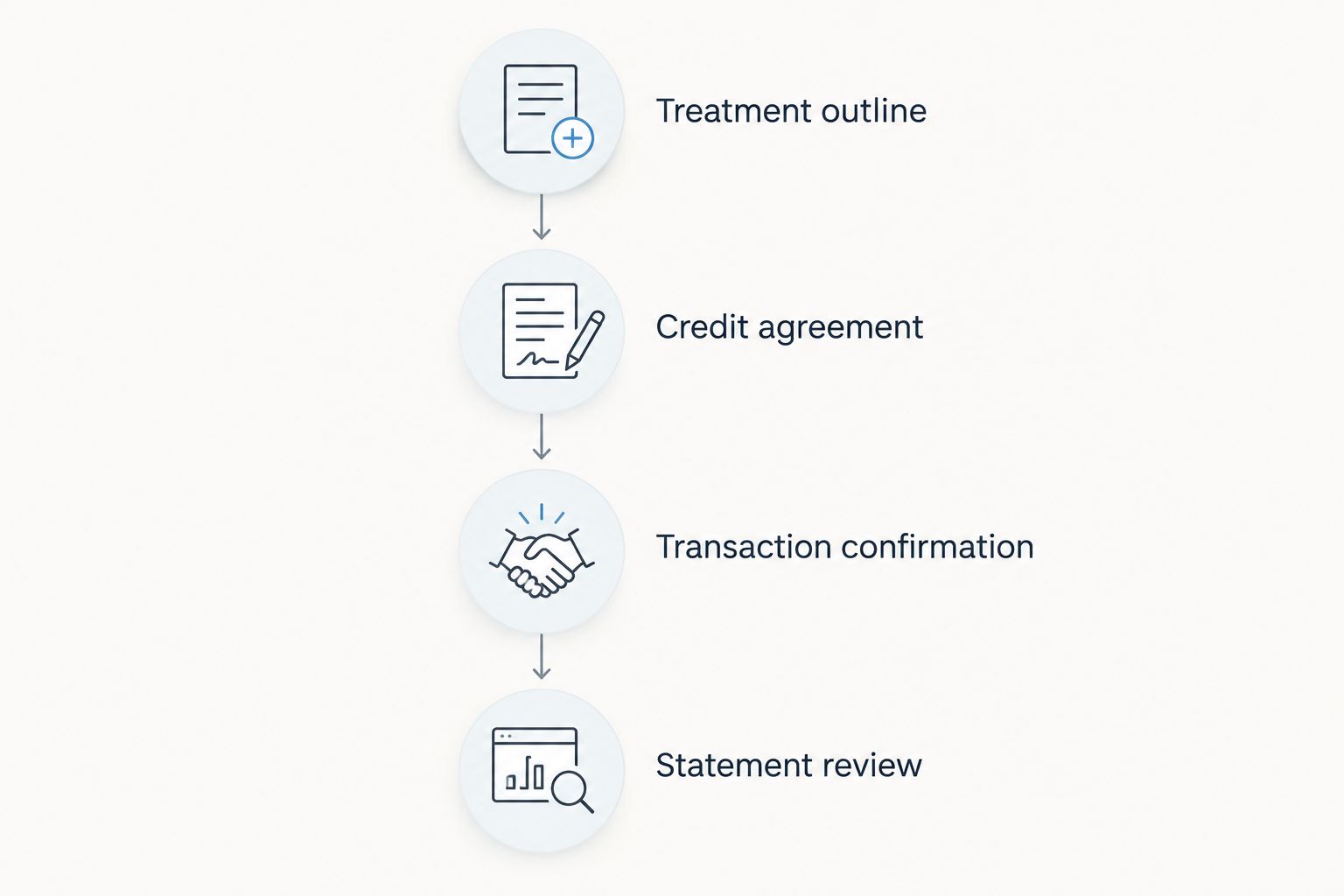
An organized folder helps you compare documents without relying on memory. Give each file a descriptive name and retain the original version when a revised document arrives.
When your treatment plan changes
A revised treatment plan needs a fresh financial check, not an automatic repeat of the original workflow. This applies whether you postpone a visit, remove a service, or discuss additional care.
- Get the revised clinical recommendation. Establish what changed and why before discussing a replacement transaction.
- Ask the practice about its adjustment process. Request written confirmation of any cancellation, refund, or revised treatment arrangement that applies.
- Contact the lender about the agreement. Ask how the change affects the existing obligation and what documentation the lender requires.
- Reconcile the records. Compare the practice's confirmation with the lender's account information. Follow up when the documents do not match.
Best for: Anyone whose care plan changes after financing paperwork begins. The benefit is a clear record; the limitation is that you must coordinate separate clinical and financial processes.
For ongoing care in 2026, repeat this review whenever the proposed commitment changes. Do not assume an earlier credit decision covers a later service or a different transaction.
Troubleshooting
The practice cannot confirm Cherry acceptance
Stop before applying for that treatment through an unverified route. Ask the practice which payment arrangements it accepts and obtain instructions directly. A financing provider's name appearing in a search result does not confirm a relationship with your chosen clinic.
The application does not result in an offer
Read the lender's response and follow its instructions for questions or corrections. Do not respond by entering inaccurate information or repeatedly submitting altered applications. Reconsider whether to postpone elective care rather than treating borrowing as a requirement.
The agreement does not match the treatment outline
Do not accept the mismatch as an administrative detail. Ask the practice and lender to identify the correct transaction and provide the appropriate documents before you proceed. Keep both the original and corrected records.
Treatment is canceled, but a repayment remains scheduled
Contact the practice about the treatment adjustment and the lender about the repayment obligation. Request written status information from both parties. Do not assume canceling an appointment cancels credit, and follow the agreement's payment requirements while resolving the issue.
A repayment message looks suspicious
Do not use the message's link to supply account credentials or payment details. Reach the lender through a previously verified route and ask whether the message is genuine. Preserve the message if the lender needs it for investigation.
Customize your workflow
Use a single document checklist if you are considering one service. For a proposed course of care, add a separate entry for each clinical decision and identify what must be reassessed before the next commitment.
Ask Oasisbeauty about the treatment question first, then confirm the payment arrangements relevant to that recommendation. This keeps the med spa discussion focused on suitability rather than letting an application determine the scope of care.
If someone helps you organize appointments, agree on what they can access. Share scheduling details separately from identity documents, account credentials, and credit agreements.
Your next move is a verified conversation, not an application submitted on assumption. Bring your treatment goal, ask about clinical assessment, and request the current payment instructions for the service under consideration.
FAQ
How do I use Cherry financing at a med spa?
First confirm that your chosen med spa accepts Cherry for the proposed treatment. Obtain the application route directly from the practice, read the lender’s disclosures, and complete the clinical review separately.
Does Oasisbeauty accept Cherry financing?
Confirm Cherry acceptance directly with Oasisbeauty before applying for a treatment there. Ask whether the payment route applies to the specific service you are considering and request current instructions.
Does financing approval mean I am approved for treatment?
No. A financing decision concerns credit, while treatment suitability requires a separate clinical assessment and consent process.
Will a Cherry application affect my credit?
Read Cherry’s current application disclosures to determine the credit-check and reporting terms that apply. Resolve those questions with the lender before submitting personal information.
What should I compare between med spa payment plans?
Compare the written repayment schedule, interest provisions, finance charges, total repayment obligation, and rules for missed or early payments. Also clarify how a treatment cancellation or refund is handled.
Can I cancel financing if I cancel my appointment?
Canceling an appointment does not establish that a credit agreement has been canceled. Contact the practice and lender separately, obtain written confirmation, and follow the agreement while the adjustment is resolved.
Can I finance several treatments together?
Ask the practice and lender whether the proposed transaction can include the treatments under consideration. Confirm clinical suitability and the complete written scope before accepting any agreement.
What if the repayment schedule does not fit my budget?
Do not accept a repayment commitment that conflicts with essential spending or existing obligations. Ask the clinician whether postponing care or considering a narrower treatment plan is appropriate.
One last thing
The final check happens after acceptance: compare the first statement with the agreement you saved. An application screenshot is not the document you need when a repayment question arises.
For your 2026 records, keep the clinical paperwork and credit paperwork connected but distinct. You should be able to identify both what care you agreed to and what financial obligation you accepted without reconstructing either from messages.