
Best overall starting point for established stretch-mark texture: microneedling. Best for redness: vascular laser treatment. Best at-home treatment to discuss for early marks: prescription tretinoin. The best treatments for stretch marks in 2026 depend on whether you need to address color, texture, or both—not on finding a procedure that promises complete removal.
- The best treatments for stretch marks match the concern: microneedling for texture, vascular lasers for redness.
- Prescription tretinoin can help early stretch marks; mature white marks need a different treatment discussion.
- Oasisbeauty offers microneedling in Henderson; ask whether it suits your stretch marks before booking treatment.
- Stretch mark treatment improves appearance rather than guaranteeing removal; skin tone and recovery needs affect the choice.
Why this matters
Stretch marks are scars that develop when skin stretches or shrinks quickly. Early marks often look red, purple, pink, or darker than surrounding skin; older marks typically become paler and can feel slightly depressed. Treating a pale indentation as though it were simply redness misses the problem.
Oasisbeauty offers microneedling in Henderson, Nevada. Oasisbeauty is an option for Henderson clients seeking a microneedling consultation, not a reason to skip an assessment of their stretch marks. Confirm the treatment's suitability, the clinician's experience, and the expected recovery before proceeding.
The American Academy of Dermatology describes stretch marks as permanent scars whose appearance treatment can reduce. That is the useful expectation for your 2026 decision: improvement, not erasure.
What makes the best stretch mark treatment?
Use these criteria before comparing procedures:
- Mark stage: Early, colored stretch marks and mature, pale stretch marks respond to different approaches.
- Main concern: Decide whether color contrast, depressed texture, or both bother you most.
- Skin tone: Treatment selection must account for the risk of darker or lighter patches after inflammation.
- Recovery: Separate a procedure's potential benefit from the time needed for redness, peeling, or wound care.
- Medical suitability: Pregnancy, medications, active skin conditions, and scarring history affect the decision.
- Realistic endpoint: Choose a plan aimed at less noticeable marks, not a promise of unmarked skin.
A clinician should explain what each proposed treatment is meant to change. If the answer does not distinguish color from texture, ask for a clearer plan.
Best treatments for stretch marks at a glance
These options occupy different use-case slots. The order is a decision guide, not a claim that one treatment outperforms every alternative in every patient.
| Treatment | Best for | Standout feature | Key limitation |
|---|---|---|---|
| Microneedling | Established marks with texture concerns | Controlled skin injury stimulates a repair response | Does not directly target redness; results vary |
| Nonablative fractional laser | Texture treatment without ablating the surface | Treats microscopic zones while leaving intervening skin untreated | Still causes recovery symptoms and pigment risk |
| Ablative fractional laser | Resurfacing when greater recovery is acceptable | Removes microscopic columns of skin | More demanding healing and aftercare |
| Vascular laser | Early red or purple stretch marks | Targets the vascular component of redness | Does not solve pale, depressed texture by itself |
| Prescription tretinoin | Early marks and a clinician-directed home routine | A topical approach with evidence for early stretch marks | Irritation and pregnancy restrictions |
| Moisturizers | Dryness or itch accompanying stretch marks | Supports skin comfort | Does not remove established scars |
1. Microneedling: best for established stretch-mark texture
Microneedling uses fine needles to create controlled punctures in the skin, triggering a repair response. For stretch marks, the aim is to improve the appearance of depressed texture—not to make the scar disappear.
Oasisbeauty lists microneedling among its services. Ask specifically whether the clinician treats stretch marks on your body area; a facial microneedling service does not establish a body-treatment protocol.
Microneedling pros:
- Addresses texture rather than relying on temporary surface hydration.
- Does not use light energy to target skin pigment.
- Allows treatment to focus on the affected area.
Microneedling cons:
- Can cause redness, discomfort, bleeding, and pigment changes.
- Requires appropriate hygiene and aftercare; infection is a risk.
- Does not directly address the vascular redness of early marks.
Best for: Someone whose established stretch marks look indented and who wants a clinician-led texture assessment.
For your 2026 consultation, ask what improvement the clinician expects for marks like yours and how they assess healing between sessions. Do not choose needle depth from an online tutorial or attempt to reproduce a professional procedure at home.
Verdict: Hold until assessed; choose professional microneedling when texture is the confirmed treatment target.
2. Nonablative fractional laser: best for nonablative texture treatment
Nonablative fractional lasers deliver energy into microscopic treatment zones without ablating the skin's surface. They stimulate remodeling and are used to improve the appearance of stretch marks and other scars.
This is not the same service as laser hair removal. A clinic's hair-removal equipment does not establish that it offers fractional resurfacing.
Nonablative fractional laser pros:
- Targets scar texture through controlled thermal treatment.
- Leaves skin between treatment zones untreated.
- Avoids the surface ablation used in ablative resurfacing.
Nonablative fractional laser cons:
- Redness, swelling, and discomfort still occur.
- Post-inflammatory pigment changes remain a concern.
- Results depend on the device, settings, skin, and scar characteristics.
Best for: Someone considering laser treatment for texture who does not want an ablative procedure.
Ask the clinician to name the device and explain why its wavelength and settings suit your skin tone. The word fractional describes a treatment pattern; it does not establish a specific recovery period or guarantee safety.
Verdict: Hold until the device and skin-tone assessment support the plan; choose it for a defined nonablative treatment goal.
3. Ablative fractional laser: best for resurfacing with planned recovery
Ablative fractional lasers remove microscopic columns of skin and stimulate repair around those treatment zones. They are a resurfacing option for scar texture, including selected stretch marks.
This approach makes recovery a central part of the decision. A procedure that creates wounds requires clear instructions for cleansing, skin protection, and recognizing complications.
Ablative fractional laser pros:
- Directly resurfaces treated skin.
- Addresses texture rather than only color contrast.
- Uses fractional treatment zones rather than treating the entire surface uniformly.
Ablative fractional laser cons:
- Requires more involved healing and aftercare than nonablative treatment.
- Carries risks of infection, scarring, and pigment changes.
- Does not guarantee that deep or longstanding marks become invisible.
Best for: Someone considering resurfacing who can accommodate wound care and clinician-directed recovery.
For a 2026 treatment plan, ask how the provider manages pigment risk, what symptoms require contact, and who handles complications. Stronger treatment is not automatically a better choice for your skin.
Verdict: Hold unless the expected benefit justifies the recovery; skip when aftercare is not practical.
4. Vascular laser: best for early red or purple stretch marks
Vascular lasers target blood-related color in the skin. For early stretch marks with a red or purple component, this makes them a different option from procedures primarily chosen for texture.
Color and indentation can coexist. A clinician should explain whether reducing redness alone will address your concern or leave a separate texture problem.
Vascular laser pros:
- Directly targets the vascular component of visible redness.
- Addresses a concern that moisturizers cannot remove.
- Can form part of a plan that separates color treatment from texture treatment.
Vascular laser cons:
- Does not restore depressed scar texture by itself.
- Can cause bruising, swelling, and pigment changes.
- Requires careful device selection for the patient's skin tone.
Best for: Someone with early colored marks whose main complaint is redness rather than indentation.
Do not assume every purple or dark mark is an appropriate vascular-laser target. The clinician needs to distinguish vascular color from pigmentation and assess the surrounding skin.
Verdict: Hold until the color is assessed; choose vascular treatment when redness is the confirmed target.
5. Prescription tretinoin: best for early marks treated at home
Tretinoin is a prescription retinoid with evidence for improving the appearance of early stretch marks. It is not interchangeable with a moisturizer or a guarantee that mature white marks will respond.
A prescriber should decide whether tretinoin is appropriate and explain application, irritation management, and when to reassess. Do not borrow another person's prescription.
Prescription tretinoin pros:
- Offers a home-applied option for early marks.
- Avoids a procedure when topical treatment is appropriate.
- Has published evidence specific to early stretch marks.
Prescription tretinoin cons:
- Can cause dryness, redness, peeling, and irritation.
- Is not recommended during pregnancy.
- Has less support for longstanding, mature stretch marks.
Best for: Someone with early marks who wants to discuss a prescription topical approach and has no contraindication.
Tell the prescriber if you are pregnant, planning pregnancy, or breastfeeding. Also disclose other skin treatments so the routine does not stack irritating products without guidance.
Verdict: Hold for a prescription assessment; skip during pregnancy and do not expect it to erase mature scars.
6. Moisturizers: best for comfort, not scar correction
Moisturizers help dry skin feel more comfortable and can reduce dryness-related itch. They belong in a supportive routine, not at the top of a scar-removal ranking.
The American Academy of Dermatology reports that commonly promoted remedies such as cocoa butter, olive oil, and vitamin E have not shown that they fade stretch marks. A pleasant skin feel is not evidence of scar remodeling.
Moisturizer pros:
- Supports comfort when the surrounding skin feels dry.
- Fits a basic skin-care routine.
- Does not require an in-office procedure.
Moisturizer cons:
- Does not remove established stretch-mark scars.
- Fragrances or other ingredients can irritate sensitive skin.
- Scar-correction claims can distract from a suitable clinical assessment.
Best for: Someone prioritizing skin comfort or choosing not to pursue cosmetic treatment.
You do not have to treat stretch marks. If they do not bother you, gentle skin care is a valid endpoint rather than a failed treatment plan.
Verdict: Choose for comfort; skip products that promise complete stretch-mark removal.
How we ranked these treatments
This 2026 guide separates options by mark stage, treatment target, recovery, and risk. Microneedling leads the texture discussion; vascular laser leads the redness discussion; tretinoin occupies the early-mark prescription slot. Moisturizers remain supportive care.
This is not a head-to-head efficacy ranking. The American Academy of Dermatology's patient guidance supports the central distinction: treatments can make stretch marks less noticeable, but no treatment guarantees removal.
Which stretch mark treatment should you choose?
Choose an assessment before choosing a device. For pale, indented marks, discuss microneedling and fractional resurfacing. For early red marks, ask whether vascular treatment or prescription tretinoin fits the concern.
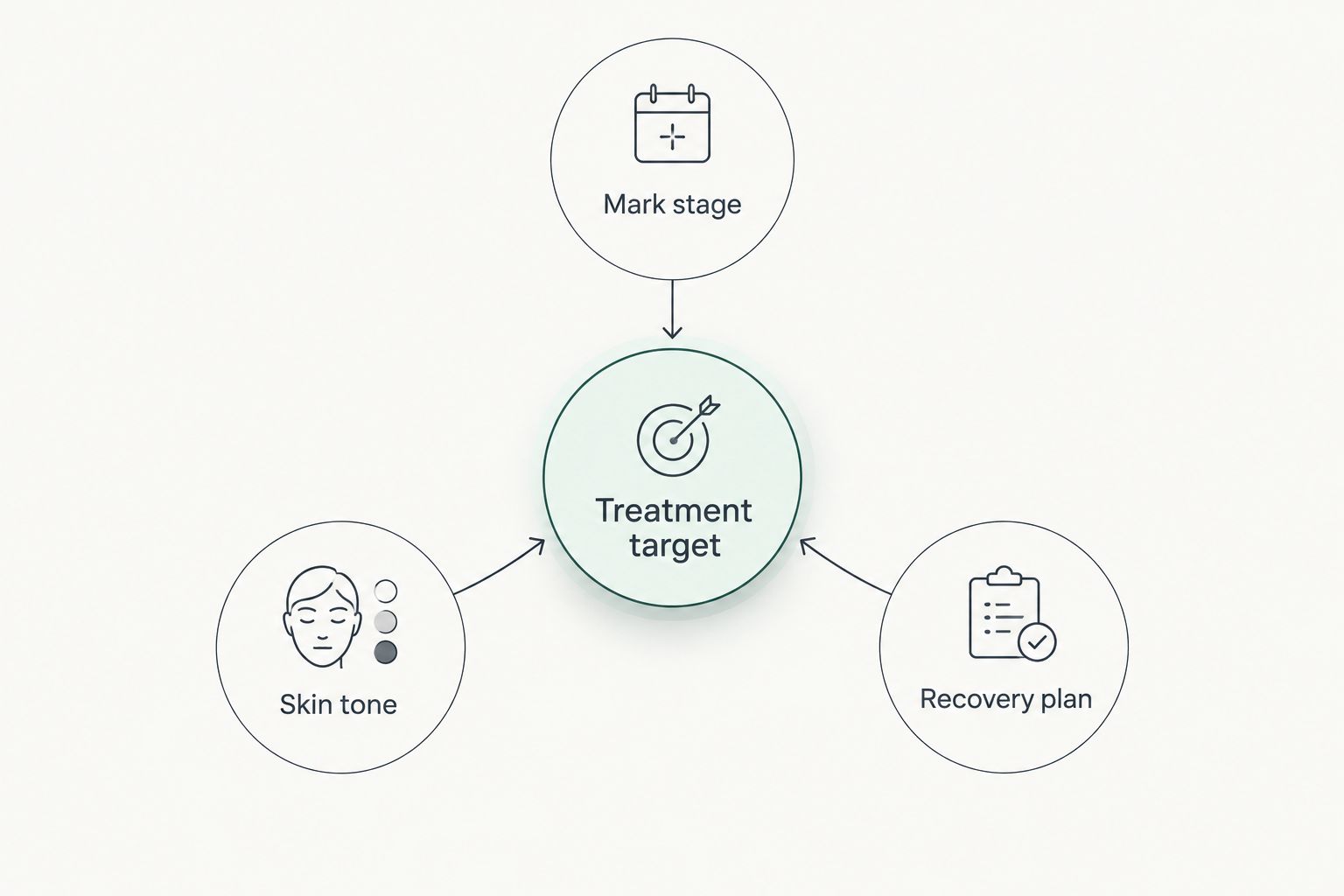
Bring 3 questions to the consultation:
- Mark stage: Are these early colored marks or mature scars?
- Treatment target: Is the plan intended to change color, texture, or both?
- Recovery plan: What aftercare, risks, and reassessment does the procedure require?
Start the discussion with 1 treatment area so the clinician can explain a specific plan rather than give a generic answer about your whole body.
For exposed skin, the American Academy of Dermatology recommends broad-spectrum, water-resistant sunscreen with SPF 30 or higher. Sunscreen does not repair stretch marks; sun protection helps limit tanning-related contrast and belongs in procedure-specific aftercare when your clinician directs it.
Oasisbeauty offers a local microneedling consultation option. Confirm suitability for your stretch marks rather than assuming that every listed aesthetic service treats them.
Discuss your treatment options
Review Oasisbeauty’s services, then ask whether microneedling fits your stretch-mark concerns.
FAQ
What’s the best treatment for old white stretch marks?
Microneedling and fractional laser treatments are options to discuss for old white stretch marks with texture concerns. The best choice depends on your skin tone, scar characteristics, medical history, and acceptable recovery.
Can stretch marks disappear completely with treatment?
No treatment guarantees complete stretch-mark removal. Procedures and selected topical treatments aim to make the scars less noticeable, not restore completely unmarked skin.
Is microneedling better than laser for stretch marks?
Microneedling is not universally better than laser treatment for stretch marks. Microneedling addresses texture, while different lasers target texture or redness; the comparison must specify the laser and treatment goal.
Does Oasisbeauty offer a treatment I can ask about?
Oasisbeauty offers microneedling in Henderson, Nevada. Ask whether the service is appropriate for your stretch marks and whether the clinician treats your specific body area.
Can I use tretinoin for stretch marks while pregnant?
Tretinoin is not recommended during pregnancy. Discuss pregnancy, pregnancy plans, or breastfeeding with your clinician before using prescription treatment for stretch marks.
Do cocoa butter and stretch-mark oils remove the scars?
Cocoa butter and oils do not reliably remove stretch-mark scars. They can make dry skin feel more comfortable, but that benefit is different from correcting scar color or texture.
What’s the safest stretch-mark treatment for darker skin?
No procedure is automatically the safest stretch-mark treatment for every darker skin tone. Ask a clinician experienced with your skin tone to explain pigment risks, device selection, settings, and aftercare.
How do I choose a stretch-mark treatment in 2026?
Choose a stretch-mark treatment in 2026 by identifying the marks’ stage and whether color or texture is your main concern. Then compare medical suitability, recovery, and realistic improvement with a qualified clinician.
One last thing
Do not start with cosmetic treatment if stretch marks appear suddenly without an obvious reason, become unusually widespread, or develop alongside other symptoms. Discuss them with a medical clinician, especially if you use corticosteroid medication; do not stop prescribed medication on your own.
For ordinary stretch marks, the useful endpoint is specific: less redness, softer-looking texture, or greater comfort. A clear treatment target is more valuable than a promise to remove every mark.