Best default for cheek volume loss: Juvéderm Voluma XC. Best for gradual collagen-based correction: Sculptra. Best for jawline contour loss: Radiesse. Best for under-eye hollows: Restylane Eyelight. The best dermal fillers for volume loss in 2026 depend on the treatment area, the cause of the hollowing, and whether you want a filler that can be dissolved.
- The best dermal fillers for volume loss match the facial area, not a universal brand ranking.
- Juvéderm Voluma XC is the default pick for age-related cheek volume loss.
- Sculptra supports gradual collagen-based correction; Radiesse addresses jawline contour loss.
- Restylane Eyelight treats under-eye hollows, not every cause of dark circles.
- Oasisbeauty offers dermal fillers in Henderson; discuss suitability and complications before treatment.
Why this matters
Facial volume loss is not one problem. Flattened cheeks, a hollow lower eyelid, and a less-defined jawline involve different anatomy, so the same filler is not the right answer everywhere.
Choose the treatment area before choosing the product. A filler that supports a cheek does not automatically belong beneath the eye, and adding volume does not remove excess skin.
Oasisbeauty offers dermal fillers for Henderson clients seeking cosmetic and aesthetic care. Use this guide to prepare for a clinical assessment, not to select an injection plan yourself.
The distinction matters in 2026: product names tell you less than the approved indication, material, placement, and clinician's assessment. Your consultation should establish whether the concern is missing volume, skin laxity, puffiness, or a combination.
What makes the best dermal fillers for volume loss?
Judge each option against these criteria before comparing brands:
- Anatomical fit: The product's intended treatment area should match your concern. Cheeks, jawline, and under-eye hollows are separate decisions.
- Material: Hyaluronic acid adds volume through an injectable gel. Poly-L-lactic acid stimulates collagen production; calcium hydroxylapatite provides structural correction and also stimulates collagen.
- Reversibility: Hyaluronic acid fillers can be treated with hyaluronidase when clinically appropriate. Sculptra and Radiesse cannot be dissolved with that enzyme.
- Result timing: Some correction is visible after gel placement, although swelling obscures the early result. Collagen-stimulating treatment requires patience and reassessment.
- Risk management: Every injectable filler carries risks, including accidental injection into a blood vessel. A complication plan matters more than a product's popularity.
- Treatment boundaries: An approved indication does not mean a filler suits every person. Medical history, prior injections, allergies, and examination determine suitability.
Do not choose a longer-lasting material simply because you want fewer appointments. A result that lasts longer also requires a different correction strategy if you dislike it or develop a complication.
Dermal fillers at a glance
| Filler | Best for | Standout feature | Key limitation |
|---|---|---|---|
| Juvéderm Voluma XC | Age-related cheek volume loss | Hyaluronic acid filler with an approved cheek indication | Does not remove loose skin or eliminate injection risks |
| Sculptra | Gradual collagen-based correction | Poly-L-lactic acid stimulates collagen production | Not dissolved with hyaluronidase; results develop gradually |
| Radiesse | Jawline contour loss | Calcium hydroxylapatite provides structural correction | Not dissolved with hyaluronidase; unsuitable as a universal facial filler |
| Restylane Eyelight | Under-eye hollows | Hyaluronic acid filler with an approved infraorbital indication | Does not treat every cause of dark circles or eye bags |
This 2026 comparison separates treatment goals rather than declaring one material the winner for every face. The right choice can also be no filler when added volume would worsen the concern.
1. Juvéderm Voluma XC: best for age-related cheek volume loss
Juvéderm Voluma XC is a hyaluronic acid filler approved for deep injection to correct age-related volume deficit in the cheek area in adults over 21 years old. It is the default pick here when your main concern is diminished cheek volume rather than a specific wrinkle or under-eye hollow.
Cheek treatment can change the balance of the midface. It does not make every nearby fold disappear, and it should not be presented as a substitute for surgery when excess skin is the dominant problem.
Juvéderm Voluma XC pros:
- Has an approved indication for age-related cheek volume loss.
- Provides gel-based volume correction rather than relying only on gradual collagen production.
- Is a hyaluronic acid filler, allowing treatment with hyaluronidase when appropriate.
Juvéderm Voluma XC cons:
- Swelling and bruising can obscure the early result.
- Excess correction can create unwanted fullness; placement errors and vascular complications remain possible.
- Dissolving treatment is not a guarantee of complete reversal or recovery from a complication.
Best for: Someone whose examination confirms a cheek volume deficit and whose goal is restoring midface fullness.
For your 2026 consultation, ask the clinician to explain which cheek structures need correction and where adding volume would be unnecessary. Request a plan based on facial balance, not an automatic quantity.
Verdict: Hold until a clinician confirms cheek volume loss; then prioritize Juvéderm Voluma XC for that specific goal.
2. Sculptra: best for gradual collagen-based correction
Sculptra is an injectable poly-L-lactic acid treatment that stimulates collagen production. Its approved aesthetic uses include correction of cheek wrinkles; broader facial-volume treatment requires a discussion of the specific indication and whether the proposed use is off-label.
Sculptra is a different decision from choosing an immediately volumizing hyaluronic acid gel. The treatment plan depends on gradual tissue response, so judging the outcome immediately after an appointment is misleading.
Sculptra pros:
- Offers a collagen-stimulating approach rather than only gel-based filling.
- Suits a treatment goal centered on gradual correction rather than an immediate final result.
- Has an approved aesthetic indication involving cheek wrinkles.
Sculptra cons:
- Cannot be dissolved with hyaluronidase if the correction is unwanted.
- Can cause nodules; technique, placement, and follow-up matter.
- Requires patience, and broader volume treatment needs an explicit indication discussion.
Best for: Someone seeking gradual collagen-based correction who accepts that the material is not readily reversible.
Ask how the clinician will distinguish an initial treatment response from the final result before adding more treatment. Also ask what follow-up and aftercare the proposed plan requires; do not borrow another patient's schedule.
Verdict: Hold until you understand the gradual result, proposed treatment indication, and non-dissolvable material.
3. Radiesse: best for jawline contour loss
Radiesse is a calcium hydroxylapatite injectable implant with approved uses that include improving moderate to severe loss of jawline contour in adults over 21 years old. It provides structural correction and stimulates collagen production.
Jawline contour loss is not the same as cheek hollowing. Radiesse belongs in this comparison because lower-face definition is a distinct treatment goal, not because every facial hollow benefits from the same material.
Radiesse pros:
- Has an approved indication for moderate to severe jawline contour loss.
- Provides structural correction for an anatomically different goal from under-eye filling.
- Combines a filling effect with collagen stimulation.
Radiesse cons:
- Cannot be dissolved with hyaluronidase.
- Is not a universal choice for the lips or under-eye area.
- Does not remove excess skin, and injection-related complications remain possible.
Best for: Someone with assessed jawline contour loss whose clinician recommends a calcium hydroxylapatite treatment.
A jawline assessment should distinguish contour loss from skin laxity and fullness beneath the chin. Adding filler to an already full lower face is not the same as improving definition.
Verdict: Hold until the clinician confirms a jawline indication and explains the correction plan for a non-dissolvable filler.
4. Restylane Eyelight: best for under-eye hollows
Restylane Eyelight is a hyaluronic acid filler approved to improve infraorbital hollowing in adults 21 years and older. That makes it a focused option when a depression beneath the eye creates a hollow appearance.
Under-eye darkness can also involve pigmentation, visible vessels, puffiness, or skin changes. Filler does not treat all of those causes, and adding volume to a puffy area can make the appearance worse.
Restylane Eyelight pros:
- Has an approved indication specifically for under-eye hollowing.
- Addresses a localized concern rather than treating the entire face as a volume problem.
- Is a hyaluronic acid filler that can be treated with hyaluronidase when appropriate.
Restylane Eyelight cons:
- Does not correct every cause of dark circles or eye bags.
- Can produce swelling, visible irregularities, or a bluish appearance with inappropriate placement.
- Under-eye injection carries vascular risks, including potential vision injury.
Best for: Someone with confirmed infraorbital hollowing, rather than predominantly puffiness or pigmentation.
For a 2026 under-eye treatment decision, ask the clinician to identify the cause of the appearance before discussing a syringe. The diagnosis matters more than the product label.
Verdict: Skip Restylane Eyelight when puffiness or pigmentation is the main concern; hold for assessment when hollowing is the target.
How this ranking was decided
The ranking uses anatomical fit, material, reversibility, result timing, and treatment limitations. Juvéderm Voluma XC leads because cheek volume loss directly matches its approved indication; the other entries each serve a separate goal.
The clinical reference point is U.S. Food and Drug Administration product labeling and patient safety information, not a claim that one brand performs best in every patient. Approved indications apply to specific products and areas, not automatically to every product within a brand family.
How to choose your treatment plan
Start with the concern you can describe, then let the clinical examination determine the treatment. Bring information about previous fillers, even when the earlier result is no longer obvious.
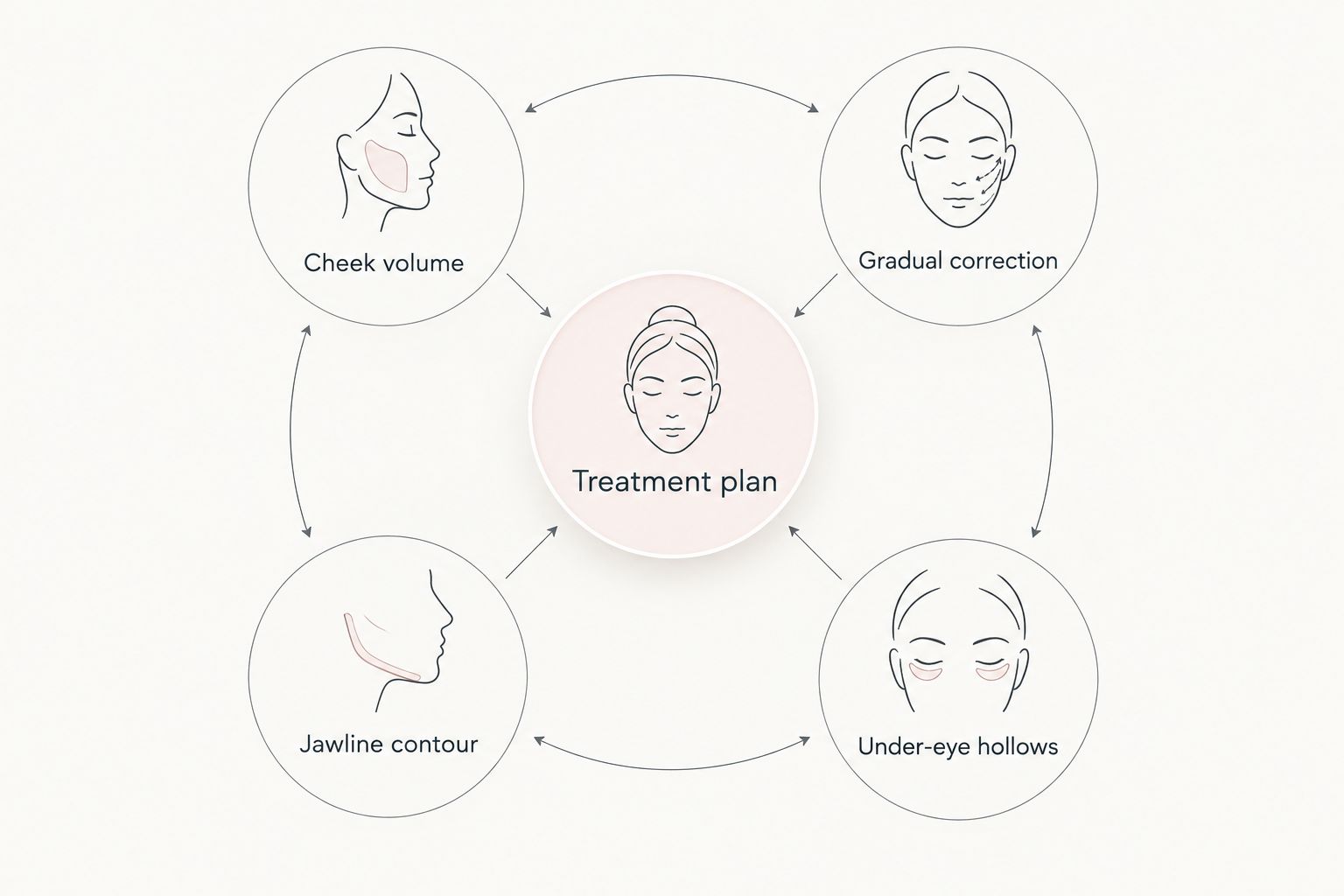
- Cheek volume: Discuss a cheek-specific filler when flattening or lost midface fullness is the concern.
- Gradual correction: Discuss collagen-stimulating treatment when you accept delayed change and a different correction strategy.
- Jawline contour: Ask whether the issue is contour loss, loose skin, or fullness before adding material.
- Under-eye hollows: Separate a true depression from pigmentation and puffiness before considering filler.
These are assessment categories, not interchangeable injection sites. A plan can address more than one concern, but each area needs its own rationale.
Oasisbeauty offers dermal fillers in Henderson. Use the consultation to discuss your goals, previous treatments, medical history, and the proposed product's indication rather than arriving with a fixed injection order.
Explore your treatment options
Review Oasisbeauty’s aesthetic care, then discuss filler suitability with a clinician.
Questions to settle before an injection
Ask about the complication plan before agreeing to treatment. You should understand who performs the procedure, which product is proposed, and how urgent problems are recognized and managed.
Use this appointment checklist:
- Ask whether the proposed treatment is within the product's approved indication or off-label.
- Explain previous injections, reactions, medical conditions, and medicines, including blood thinners.
- Ask what swelling and bruising to expect and which symptoms need urgent attention.
- Confirm how to reach the treating clinician after the appointment.
- Ask how unwanted correction, nodules, or persistent swelling would be assessed.
Do not stop prescribed medication on your own to prepare for an aesthetic procedure. The treating clinician and prescribing clinician should address medication decisions.
Sudden vision changes, severe or unusual pain, skin blanching, or dusky discoloration after filler require immediate medical attention. Contact the treating clinician immediately; vision changes or stroke symptoms require emergency care, not a routine follow-up appointment.
Which dermal filler should you choose?
Choose Juvéderm Voluma XC as the starting discussion for age-related cheek volume loss, not as an automatic choice for your entire face. Sculptra serves gradual collagen-based correction, Radiesse serves jawline contour loss, and Restylane Eyelight serves under-eye hollowing.
For 2026, the practical decision is anatomical: what needs correcting, what material fits that goal, and what happens if the result needs treatment afterward? If the main concern is loose skin or puffiness, reconsider whether filler belongs in the plan at all.
FAQ
What’s the best dermal filler for facial volume loss?
Juvéderm Voluma XC is the default pick in this guide for age-related cheek volume loss. Jawline contour loss, under-eye hollows, and gradual collagen-based correction require separate product decisions and a clinical assessment.
Is Sculptra better than a hyaluronic acid filler?
Sculptra is not universally better than a hyaluronic acid filler. Sculptra stimulates collagen gradually and cannot be dissolved with hyaluronidase, while hyaluronic acid fillers provide gel-based correction and can be treated with that enzyme when appropriate.
Which filler is best for hollow under-eyes?
Restylane Eyelight is an approved option for infraorbital hollowing in adults 21 years and older. It does not treat every cause of dark circles, and puffiness requires a different assessment.
Can dermal fillers be dissolved if I dislike the result?
Hyaluronic acid fillers can be treated with hyaluronidase when clinically appropriate. Sculptra and Radiesse cannot be dissolved with that enzyme, and dissolving a hyaluronic acid filler does not guarantee complete reversal of every complication.
Will cheek filler lift loose skin?
Cheek filler adds volume but does not remove loose skin. If excess skin is the main concern, a clinician should discuss whether a different treatment better matches your goal.
Does Oasisbeauty offer dermal fillers in Henderson?
Oasisbeauty offers dermal fillers in Henderson, Nevada. Discuss the treatment area, proposed product, medical history, and complication plan during your clinical assessment.
What symptoms after filler need urgent help?
Sudden vision changes, severe or unusual pain, skin blanching, and dusky discoloration require immediate medical attention. Contact the treating clinician immediately; vision changes or stroke symptoms require emergency care.
One last thing
A longer-lasting filler is not automatically a better filler. Persistence and reversibility are different properties, and both affect your treatment decision.
Before choosing a product, ask one specific question: what is the plan if this correction is unwanted? A clear answer tells you more about the proposed treatment than a promise of fullness alone.