
Sculptra results develop gradually over several weeks to months; the manufacturer's patient information describes visible improvement as early as 1 month, not an immediate finished result. Early fullness can include swelling and the fluid used to prepare the injection, so it does not show how much lasting correction you will get. This 2026 guide explains how to read that timeline without mistaking normal settling for treatment failure.
- How long for Sculptra results? Manufacturer information describes visible improvement as early as 1 month; individual timing varies.
- Sculptra builds gradual correction; early swelling is not your finished result.
- Sculptra is best suited to people comfortable waiting for gradual change, after an individual suitability assessment.
- Oasisbeauty is a Henderson medical-spa option for discussing skin-rejuvenation goals; confirm treatment availability before booking.
How long does it take to see Sculptra results?
Think weeks to months, not the day you leave your appointment. Sculptra's manufacturer describes results appearing as early as 1 month and lasting up to 2 years. Those statements describe possible onset and duration, not a promise that every person will see the same change on the same schedule.
Your timeline also depends on whether you are evaluating an initial treatment or a completed treatment plan. Ask your injector which milestone your follow-up is meant to assess. For local questions, you can contact Oasisbeauty to discuss your concerns and confirm which services are available.
| Stage | What you might notice | What it tells you |
|---|---|---|
| Immediately after treatment | Fullness, swelling, tenderness, or bruising | The appearance includes treatment-related effects, not just lasting correction |
| As swelling settles | Some initial fullness fades | A less full appearance does not automatically mean the treatment failed |
| Over the following weeks and months | Gradual changes in the treated area | Compare consistent photographs and attend the planned review |
| After the planned treatment course | Your provider evaluates the overall response | Further treatment decisions require an assessment, not a calendar alone |
The evidence distinction matters: manufacturer patient information describes expected treatment behavior, while FDA labeling addresses approved uses, warnings, and clinical-study findings. Neither gives an individualized prediction for your face.
Why this matters before you book
If you are comparing treatments in Henderson or the nearby Las Vegas area, the biggest question is not simply how soon something works. It is whether the treatment addresses the concern you actually have. Facial hollowing, surface dryness, uneven pigment, and loose skin are different concerns, even when they all make you feel less refreshed.
Sculptra is an injectable cosmetic treatment, not a facial and not treatment for a skin disease. Its gradual approach means patience belongs in the decision before you book, rather than becoming an unpleasant surprise afterward.
The best timing question is: when can my provider fairly assess my response? That is more useful than asking when you should look like someone else's photograph. For your 2026 treatment planning, build in room for assessment instead of treating an event date as a deadline your skin must meet.
Early fullness: why your first look is not the final result
Sculptra contains poly-L-lactic acid, a material used to stimulate collagen production. It is prepared with fluid before injection. Immediately afterward, that fluid and treatment-related swelling can contribute to the fuller appearance you see in the mirror.
As those temporary effects settle, you can look closer to your starting point. That change can feel discouraging if no one explained it beforehand. It does not, by itself, establish whether the treatment will ultimately give you a meaningful improvement.
Try not to label every mirror check as progress or regression. Lighting, facial expression, makeup, and camera distance change how shadows and contours appear. A scheduled assessment gives your provider a better basis for interpreting changes than a collection of differently lit selfies.
Before leaving your appointment, ask what changes are expected in your treated area and what symptoms need a call. Get the instructions in writing. Your individual aftercare plan takes priority over a social-media routine or advice given to someone with a different treatment plan.
Around 1 month: an early checkpoint, not a finish line
The manufacturer's description of improvement as early as 1 month is an early-results reference. It does not mean your treatment course is complete or that every treated area will change visibly by then. Some people notice subtle differences rather than a dramatic before-and-after moment.
An early review can help separate normal recovery from questions about treatment response. Your provider should consider the area treated, your starting anatomy, the treatment delivered, and whether additional sessions were already part of the plan.
For a 2026 appointment, ask how your provider defines an early response. A useful answer explains what will be assessed and when, without guaranteeing a specific amount of fullness. You should leave understanding the plan, not feeling responsible for spotting tiny changes every morning.
Do not use an early checkpoint as permission to add more treatment elsewhere. First discuss what has already been done and what still needs time to develop. Gradual treatment needs a clear record as much as it needs patience.
Over the following months: assess the treatment course
Sculptra treatment can involve a series rather than an isolated appointment. The number of sessions and spacing should follow an individualized plan and the product's instructions for use. There is no responsible universal schedule that can be assigned from a blog article.
Ask whether your provider is discussing time from the initial injection, time between visits, or time after the last planned treatment. Those are different clocks. Mixing them together is one reason online answers about Sculptra timing seem inconsistent.
The same distinction applies to before-and-after images. A photograph taken after a completed course does not show what you should expect after an initial session. Useful examples identify the treatment history and follow-up timing rather than presenting an unexplained transformation.
If the outcome feels subtle, say so at your review. Your provider should assess your concern and discuss whether more observation, an adjustment to the plan, or a different approach makes sense. More injections are not automatically the right answer to uncertainty.
Why Sculptra results vary
Several factors affect what you see and when it becomes reasonable to judge the result. These are discussion points for an assessment, not a checklist that predicts your outcome at home.
- Starting anatomy: The location and degree of volume loss influence the correction needed and how noticeable a change appears.
- Treatment plan: The treated areas, amount administered, and planned sessions affect how the overall course is evaluated.
- Individual response: Sculptra depends on a tissue response, so the same appointment schedule does not produce an identical result for everyone.
- Recovery effects: Swelling and bruising can temporarily obscure the underlying appearance and complicate early comparisons.
- The concern being treated: Volume loss is not the same as pigmentation, dryness, or significant skin laxity. A mismatch between concern and treatment can leave expectations unmet.
Age alone is not a personalized treatment plan. Nor does having a friend who responded quickly establish your likely timeline. Your medical history, examination, and goals belong in the conversation before anyone recommends an injectable.
When someone offers a precise result date without examining you, pause. A good consultation explains the limits of prediction while still giving you a clear follow-up plan. Honest uncertainty is different from vague care.
Is Sculptra faster than hyaluronic acid filler?
Hyaluronic acid filler generally provides visible volume at treatment, while Sculptra is chosen for gradual correction. Swelling can affect the early appearance of either treatment, so immediate volume and a settled result are not interchangeable.
These categories also differ in how unwanted results are managed. Hyaluronic acid filler can sometimes be treated with hyaluronidase when clinically appropriate. Sculptra cannot be dissolved with that enzyme, which makes careful selection and treatment planning especially important.
| Option | Best for discussing | Main advantage | Main limitation |
|---|---|---|---|
| Sculptra | People seeking gradual correction of appropriate facial volume concerns | Change develops progressively rather than relying on immediate filling alone | Requires patience; it cannot be dissolved with hyaluronidase |
| Hyaluronic acid filler | People seeking more immediate correction in suitable areas | Visible volume is generally apparent at treatment | Swelling affects early appearance, and serious injection complications remain possible |
| No injectable treatment | People who are unsure, have a different concern, or are not suitable candidates | Avoids injection-related risks while allowing time to decide | Does not provide an injectable volume correction |
Neither injectable category is a substitute for diagnosing an unexplained skin change or medical symptom. If your concern is mainly discoloration or surface texture, ask whether skin care or another treatment category fits better before discussing volume correction.
There is also no obligation to choose a procedure at your consultation. Taking time to understand the trade-offs is a valid decision, especially when you are unsure what change would actually make you feel more comfortable.
How should I track Sculptra results without overchecking?
Use a simple, repeatable approach rather than taking photographs whenever the bathroom lighting feels unkind. Consistency helps you and your provider discuss the same evidence. It does not turn home photographs into a medical assessment.
- Record your baseline. Take photographs before treatment without filters, using a relaxed facial expression.
- Match the lighting. Use the same room and light direction so shadows do not create an artificial improvement or setback.
- Match the angle. Keep your camera position, distance, and head position consistent.
- Follow the plan. Compare photographs at the intervals your provider recommends instead of judging the result every day.
- Bring your questions. Record concerns about symptoms, asymmetry, or expectations and discuss them at the appropriate time.
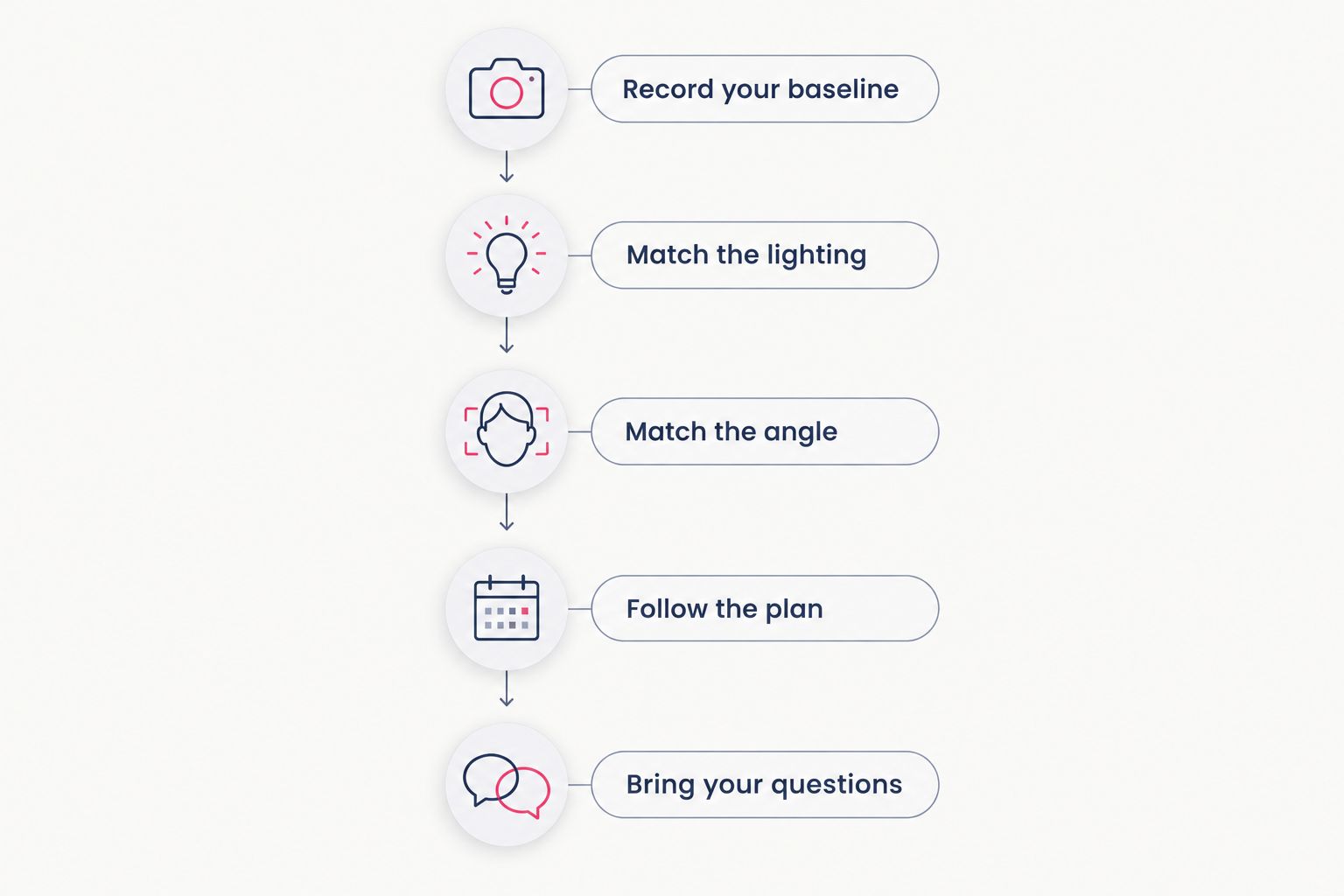
If photographs make you more anxious rather than better informed, ask your provider to handle progress documentation at visits. You do not need to monitor your face constantly to participate thoughtfully in your care.
Can I combine Sculptra with other treatments while I wait?
A slow result is not a reason to fill the waiting period with extra procedures. Tell your provider about recent injections, energy-based treatments, peels, and any upcoming appointments. The safe order depends on the specific procedure, treatment area, skin condition, and recovery status.
The planning question behind combining HIFU and dermal fillers is coordination, not whether stacking appointments produces a faster result. Energy-based procedures and injectable treatments need an individualized sequencing discussion; an online workflow does not establish that a particular combination is right for you.
That distinction matters if you are also interested in facials, chemical peels, or IPL. Those treatments address different concerns and have their own suitability considerations. They should not be presented as shortcuts to a faster Sculptra response.
For your 2026 calendar, put a treatment review ahead of any new procedure. Ask the providers involved to account for what has already been treated. Do not assume a treatment is compatible just because it is described as gentle or has little expected downtime.
What should I ask before deciding whether Sculptra fits?
Start with the concern, not the product name. Explain whether you are bothered by hollowing, facial shadows, skin texture, or another change. Then ask your provider to identify which part a proposed treatment can realistically address.
Bring these questions to the conversation:
- What concern are you treating, and why does Sculptra fit it?
- What would make me an unsuitable candidate?
- When will you assess an early response and the overall result?
- What is the plan if the change is less noticeable than I expected?
- Which symptoms require an urgent call, and how do I reach you?
- What should I avoid before and after treatment?
Oasisbeauty offers medical-spa skin rejuvenation in Henderson. Confirm whether Sculptra is currently offered rather than assuming an educational article establishes availability. You can also ask whether your goals are better suited to a different approach or to no procedure at all.
Your consultation should leave room for a clear no. If the risks, waiting period, or limits do not fit your comfort level, you can stop there. Feeling informed matters more than committing to treatment on the day you ask about it.
What downtime and symptoms should I understand?
Expected injection-site reactions can include swelling, bruising, redness, tenderness, and discomfort. These reactions are different from the gradual cosmetic response you are waiting to assess. Follow your injector's written instructions rather than using an online timeline to decide when symptoms should disappear.
FDA filler safety information also describes uncommon but serious risks when injected material enters a blood vessel, including tissue injury, vision problems, and stroke. Sudden vision changes, stroke-like symptoms, or severe unusual pain need immediate medical attention. Do not wait for a routine follow-up to report them.
Lumps or nodules can occur after Sculptra, including delayed reactions. Contact your treating provider about a persistent lump, increasing redness, warmth, drainage, or worsening discomfort. A photograph cannot reliably establish the cause or the right treatment.
Disclose your health history, allergies, medications, and prior cosmetic procedures before treatment. Do not stop prescribed medication on your own to reduce bruising. Your treating clinician should explain which precautions apply to you and how to get help after the appointment.
How long do Sculptra results last once they appear?
Up to 2 years is the duration described in the manufacturer's patient information, not a guaranteed lifespan for your result. Onset, completion of a treatment course, and duration are separate questions. Ask which starting point your provider uses when discussing follow-up or maintenance.
Do not schedule repeat treatment solely because a date arrives. A reassessment should consider your current appearance, satisfaction, health history, and previous response. A treatment that suited an earlier concern does not automatically remain the right choice indefinitely.
For everyday skin care in 2026, the American Academy of Dermatology recommends broad-spectrum, water-resistant sunscreen with SPF 30 or higher. Sun protection supports skin health, but it is not evidence that you can accelerate Sculptra's response or guarantee its duration. Cosmetic care and basic skin protection serve different purposes.
FAQ
How long for Sculptra results if I have only had an initial session?
Sculptra results develop over weeks to months, with manufacturer information describing visible improvement as early as 1 month. An initial session does not necessarily represent a completed treatment course; ask when your provider plans to assess your response.
Why did my face look fuller right after Sculptra and then look less full?
Early fullness can include injection fluid and swelling that settle before gradual correction becomes visible. That change alone does not establish whether the treatment has worked; discuss progress at your planned review.
Can I judge my final Sculptra result after 1 month?
At 1 month, you may be at an early-results checkpoint rather than your final assessment. Your provider should account for the treatment delivered and any remaining planned sessions.
Is Sculptra better than hyaluronic acid filler if I want an immediate change?
Sculptra is not the immediate-volume option; hyaluronic acid filler generally provides visible volume at treatment. Both require an individual assessment and carry injection-related risks.
Can Sculptra be dissolved if I do not like the result?
Sculptra cannot be dissolved with hyaluronidase, the enzyme used for certain hyaluronic acid filler concerns. An unwanted result or lump needs assessment by your treating provider rather than a home remedy.
How long can Sculptra results last?
Up to 2 years is described in the manufacturer’s patient information, but individual duration varies. Reassessment should guide further treatment rather than an automatic repeat appointment.
Does Oasisbeauty offer Sculptra in Henderson?
Confirm Sculptra availability directly with Oasisbeauty before booking. The practice offers medical-spa skin rejuvenation, but an educational article does not establish that a specific product is available.
One last thing
Before you leave a treatment appointment, ask your provider to write down when to judge recovery, when to assess early change, and when to evaluate the overall course. Those milestones are not interchangeable. Knowing the difference can save you from chasing temporary swelling with another procedure.
This 2026 guide draws on Sculptra manufacturer patient information for onset and duration, FDA Sculptra labeling and dermal-filler safety information for risks, and American Academy of Dermatology guidance for sun protection. It is general education, not an individualized treatment recommendation. Call your treating team when your symptoms or progress do not match the instructions you received.
Related guides
- Is Sculptra worth it for facial volume loss?
- Best dermal fillers for facial volume loss
- Best treatments for sun damage and dark spots