
Microneedling downtime usually lasts a few days, although redness, swelling, dryness, or flaking can take up to a week to settle, according to the American Academy of Dermatology. Looking ready for work does not mean your skin is ready for makeup, strong skin care, or another procedure. This 2026 guide explains how to plan your recovery, recognize warning signs, and ask the right questions before booking.
- Microneedling downtime how long? Usually a few days, with redness or swelling sometimes lasting up to a week.
- Oasisbeauty offers Henderson skin rejuvenation consultations; confirm the specific treatment and your suitability before booking.
- The American Academy of Dermatology advises waiting at least 24 hours before applying makeup after microneedling.
- Worsening pain, spreading redness, drainage, or blistering needs prompt medical advice, not extra skin care.
How long does microneedling downtime last?
Expect a few days of visible recovery, with some effects lasting up to a week. The American Academy of Dermatology’s patient guidance, “Microneedling: FAQs,” describes redness or darker-looking skin, swelling, and discomfort that generally clear within a few days to a week. That is a planning window, not a promise about your face.
Three timelines matter: when you feel comfortable, when your skin looks settled, and when you can restart your normal routine. Those milestones do not necessarily happen together. A face that looks almost normal can still sting when you apply a product.
For Henderson and Las Vegas readers exploring Oasisbeauty, the useful starting point is your actual schedule. Tell the team about outdoor work, a public-facing job, an upcoming celebration, and the skin care you currently use before discussing a procedure.
| Recovery milestone | What it means | What it does not mean |
|---|---|---|
| Comfortable at home | Tightness or tenderness feels manageable | Your skin is ready for active ingredients |
| Ready to be seen | Visible redness or swelling has settled enough for your comfort | Makeup is automatically appropriate |
| Ready for your routine | Your treating clinician has cleared products and activities | Every future session will heal identically |
| Ready to judge results | Enough time has passed to assess the treatment’s intended effect | Early swelling proves lasting improvement |
The table is a scheduling tool, not a substitute for aftercare instructions. Use your clinician’s written plan rather than a calendar alone.
Why this matters: downtime is more than looking pink
If you are comparing treatments in 2026, “minimal downtime” sounds convenient. It does not tell you whether you can wear foundation, take a sweaty class, or spend the afternoon outside. Ask what restrictions sit behind that phrase.
Microneedling creates controlled punctures in the skin. The US Food and Drug Administration’s patient information, “Microneedling Devices,” lists risks including bleeding, bruising, redness, tightness, itching, peeling, and changes in skin pigmentation. Infection and scarring are also possible.
That does not mean every patient experiences every problem. It means your recovery plan should cover more than a little blush. Cosmetic care is elective, and postponing a treatment that does not fit your health or calendar is a reasonable choice.
Also separate downtime from results. Less redness does not establish that a scar or texture concern has improved. Early swelling can temporarily change how skin looks, so assess progress on the timetable your clinician recommends rather than in the first post-treatment selfie.
What recovery can look like as your skin settles
Recovery is not a rigid sequence with a deadline for each symptom. The following phases describe common experiences, not a schedule everyone must follow. If symptoms become more intense instead of easing, contact your treating clinician.
Treatment day
Your skin can look red or darker than usual and feel warm, tight, or tender. Pinpoint bleeding can occur during the procedure; your clinician should explain what is expected afterward and what needs a call.
Keep your plans simple. Follow the cleansing and product instructions you receive, avoid unnecessary touching, and resist trying a new serum because your skin feels thirsty. A freshly treated face is not the place for a skin-care experiment.
Early recovery
Redness, swelling, and sensitivity should be monitored for improvement rather than judged against someone else’s photos. You might feel comfortable answering emails while still preferring to skip an in-person meeting.
Do not scrub away roughness or use makeup to cover skin that your clinician has told you to leave alone. If a recommended product burns or causes a new reaction, stop using it and ask the treating team what to do next.
Settling skin
Dryness, roughness, or light flaking can become more noticeable as the initial redness settles. Leave flakes alone. Picking and rubbing add irritation when the goal is to let the skin recover.
This is also when people are tempted to restart everything at once. Get clearance for your usual routine, especially retinoids, exfoliating acids, scrubs, and prescription products. Instructions should reflect what you actually use, not a generic list.
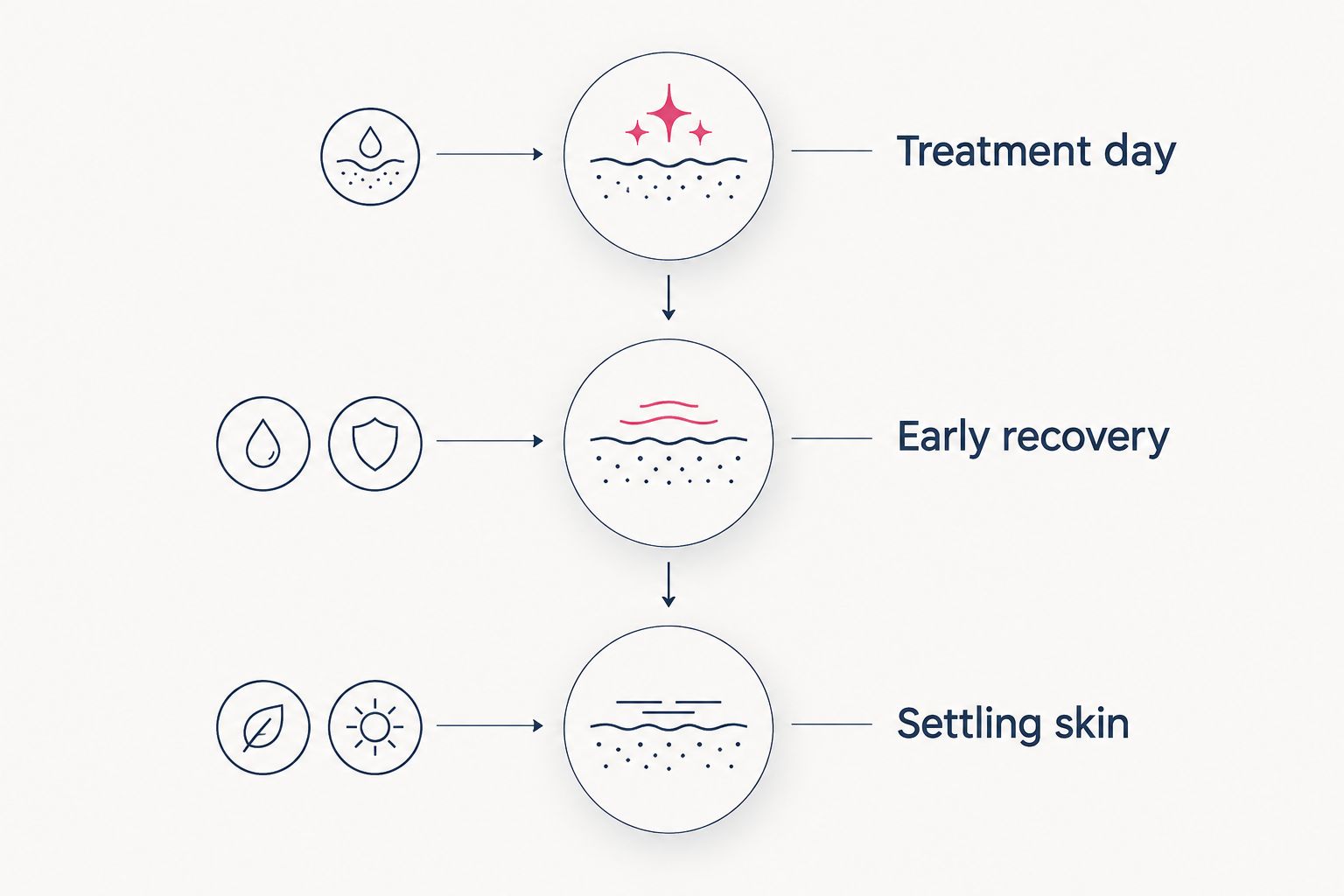
These phases can overlap. Skin that feels dry can still be visibly red, and skin that looks settled can remain sensitive. Give your clinician both pieces of information when asking whether to restart a product.
Why microneedling downtime varies
Your friend’s easy recovery is useful conversation, not a medical forecast. The FDA and American Academy of Dermatology emphasize treatment suitability, technique, and individual risks. Discuss these factors before choosing a date:
- Treatment intensity. Needle depth, treatment area, and the planned approach affect the amount of injury created. Ask how the clinician’s proposed settings relate to your concern and recovery expectations.
- Procedure type. Conventional microneedling and radiofrequency microneedling are not interchangeable. Radiofrequency adds energy, so its risk discussion must address more than needle punctures.
- Your skin’s current condition. Active infection, irritated skin, and certain inflammatory skin problems can change whether treatment is appropriate. A concern that looks cosmetic can need medical evaluation first.
- Your medical history. Tell the clinician about poor wound healing, unusual scarring, cold sores, immune-system conditions, and medications. Do not decide on your own that a prescription is irrelevant.
- Your aftercare and exposure. Picking, irritating products, and sun exposure can complicate recovery. An outdoor job requires a different practical discussion from a week spent mostly indoors.
Ask which factors apply to you, not just whether the procedure is popular. Personalization should produce clear instructions you can follow, including what would make the clinician delay treatment.
Conventional microneedling and radiofrequency need separate discussions
Conventional microneedling uses needles to create controlled skin punctures. Radiofrequency microneedling combines needles with radiofrequency energy. Both require a suitability assessment, but they should not be presented as the same procedure with different names.
FDA safety information about radiofrequency microneedling identifies reports of serious complications, including burns, scarring, fat loss, disfigurement, and nerve damage. That is a separate safety conversation from the temporary redness commonly associated with conventional microneedling.
| Procedure | Best suited to this discussion | Potential advantage | Limitation or risk |
|---|---|---|---|
| Conventional microneedling | Patients asking about an appropriate approach to texture or certain scars | Can improve selected concerns in suitable patients | Recovery, pigment changes, infection, and scarring remain possible |
| Radiofrequency microneedling | Patients specifically evaluating a procedure that also delivers energy | Addresses concerns through a different treatment mechanism | Adds energy-related risks, including burns and deeper tissue injury |
These are discussion categories, not recommendations to undergo either procedure. The exact device, indication, operator, and your skin history matter. A device’s regulatory status also does not mean every proposed use or every patient is appropriate.
For your 2026 consultation, ask the clinician to name the procedure and device clearly. Do not accept “microneedling facial” as the entire explanation. Confirm which treatments are actually offered rather than assuming a general skin-rejuvenation menu includes either option.
Can I wear makeup after microneedling?
Wait at least 24 hours before applying makeup, according to the American Academy of Dermatology’s microneedling guidance. Your treating clinician can recommend a longer pause based on your procedure and skin condition. The minimum is not permission to cover actively irritated skin.
If foundation is essential for your job, discuss that before treatment day. Ask whether your planned appointment leaves enough room for both visible recovery and makeup restrictions. Trying to solve that conflict afterward is much less comfortable.
Once makeup is cleared, use clean tools and avoid sharing products. Stop if application stings or worsens irritation. Gentle removal matters too; a long-wear product that requires rubbing is not a helpful comeback choice for sensitive skin.
When can I exercise or spend time outside?
There is no single exercise restart time that fits every microneedling procedure. Ask your clinician specifically about strenuous workouts, hot yoga, saunas, swimming, and your normal work environment. “Back to normal activities” needs a definition that matches your life.
Henderson and Las Vegas schedules often involve time outdoors, even when you are not planning a pool day. Tell the team about commuting, outdoor shifts, sports, and upcoming travel. Build the appointment around restrictions you can realistically follow.
The American Academy of Dermatology recommends broad-spectrum, water-resistant sunscreen with SPF 30 or higher for general sun protection. After microneedling, ask when to apply sunscreen and which formulation fits your aftercare instructions. Shade and protective clothing also matter; sunscreen is not a reason to extend sun exposure.
How should I care for my skin during downtime?
Keep aftercare simple and specific to your treatment. A long shopping list is not proof of better recovery. Ask for written directions that identify what to use, what to pause, and when to check back.
Follow the cleansing instructions
Use the cleansing method your clinician recommends and avoid scrubbing. Ask when the first wash should happen rather than assuming your usual evening routine applies. Patting and gentle handling are better goals than making the skin feel squeaky clean.
Use only approved skin care
Confirm which moisturizer or other products belong in your plan. Do not add essential oils, exfoliating toners, or an unfamiliar treatment because an online post recommends them. Even a familiar product deserves a pause if it conflicts with your instructions.
Get a restart plan for active ingredients
Ask about retinoids, exfoliating acids, acne treatments, and prescription creams by name. Do not stop a prescribed medicine without instructions from the appropriate clinician. Your plan should explain both the pause and the restart.
Leave peeling skin alone
Do not pick, buff, or pull at flakes. If peeling feels excessive, painful, or different from what you were told to expect, contact the treating team. More exfoliation is not the answer to irritation.
Know how to get help
Before leaving, ask whom to contact during office hours and after hours. Keep the instructions somewhere easy to find. A clear contact plan is more useful than trying to compare your symptoms with strangers’ recovery videos.
What is normal, and when should I call?
Mild redness, tightness, swelling, and flaking can occur after microneedling. The important question is whether symptoms fit the instructions you received and are improving. A worsening pattern deserves attention even if someone online calls it normal.
| Symptom pattern | What to do |
|---|---|
| Mild redness or tightness that gradually improves | Continue the prescribed aftercare and monitor |
| Dryness or light flaking without worsening discomfort | Avoid picking and follow the approved moisturizing plan |
| Increasing pain, spreading redness, warmth, or drainage | Contact the treating clinician promptly for assessment |
| Blisters, open areas, or unexpected skin discoloration | Seek prompt medical advice rather than adding products |
| Trouble breathing or swelling affecting breathing | Seek emergency medical care immediately |
This table cannot diagnose a complication. If something feels wrong, contact a qualified medical professional rather than waiting for an online recovery window to expire. Fever with worsening skin symptoms also needs prompt assessment.
For people prone to dark marks after inflammation, discuss that history before treatment. The FDA identifies pigmentation changes as a possible risk. Do not assume a darker or lighter patch is simply part of getting a glow.
How should I schedule microneedling around work or an event?
Leave room for uncertainty, especially before an event you cannot move. The usual few-days-to-a-week recovery description is not a guarantee that your first session will fit neatly before a wedding, presentation, or photo shoot.
For a 2026 event, work backward from the event date with your clinician rather than choosing the closest available appointment. Explain whether you need makeup, will be outdoors, or cannot comfortably appear with redness. Those details help define what “ready” means for you.
Use this planning sequence:
- Name your goal. Explain whether you are asking about acne scars, texture, or another concern. Confirm that the proposed treatment addresses that concern appropriately.
- Describe your calendar. Include work, exercise, travel, and important events, not just the procedure date.
- Review your skin history. Bring your current product and medication list and mention previous reactions or healing problems.
- Get written aftercare. Make sure you understand activity restrictions, product instructions, and warning signs.
- Agree on follow-up. Know when progress will be assessed and whom to contact if recovery differs from expectations.
Avoid booking another facial, peel, or energy-based treatment into the recovery period without explicit approval. Combining appointments for convenience does not establish that the combination is suitable.
What should I ask before choosing a treatment?
The best consultation makes the decision less confusing, not more urgent. Ask what improvement is realistic for your concern, what the procedure will not address, and what happens if you decide to wait. You do not owe anyone a same-day decision.
Oasisbeauty is best for Henderson readers who want to discuss skin rejuvenation before choosing a treatment. Confirm whether microneedling is available, who would perform it, and how suitability is assessed. A general service description does not answer those treatment-specific questions.
Use the contact page to find the team’s current contact details and call with your questions. Mention your concern and your recovery constraints together: wanting smoother-looking skin and needing to be camera-ready are both relevant.
Before committing, ask these questions in plain language:
- What exact procedure are you proposing, and why does it fit my concern?
- What benefits are realistic, and what limitations should I expect?
- What risks matter for my skin tone, health history, and medications?
- What should improve during recovery, and what symptoms mean I should call?
- Who handles follow-up or complications if I need help?
Oasisbeauty offers skin rejuvenation services, but that does not establish that any particular procedure suits you. A clear explanation of risks and alternatives is part of a useful treatment conversation, not a reason to feel rushed into booking.
Ask about your recovery plan
Discuss your skin concerns, treatment suitability, and schedule before choosing a procedure.
FAQ
How long does microneedling downtime usually last?
Microneedling downtime usually lasts a few days, with redness, swelling, or discomfort sometimes lasting up to a week, according to the American Academy of Dermatology. Your procedure and skin history affect your individual recovery.
Can I go to work the day after microneedling?
Returning to work depends on your symptoms, job duties, and aftercare restrictions. Discuss public-facing work, makeup, outdoor exposure, and physical activity before booking rather than assuming the next day will suit you.
How soon can I wear makeup after microneedling?
Wait at least 24 hours before applying makeup, according to the American Academy of Dermatology. Follow a longer restriction if your treating clinician recommends one, and do not cover actively irritated skin without advice.
Is peeling after microneedling normal?
Peeling or flaking can occur after microneedling, but painful, worsening, or unexpected skin changes need medical advice. Do not pick flakes or use exfoliants to remove them.
Does radiofrequency microneedling have the same recovery as regular microneedling?
Radiofrequency microneedling requires a separate recovery and risk discussion because it adds energy to the procedure. FDA safety information identifies serious reported complications including burns, scarring, fat loss, and nerve damage.
When should I call about redness after microneedling?
Call promptly if redness spreads or worsens, especially with increasing pain, warmth, drainage, or fever. Do not wait for a typical recovery window to end when symptoms suggest a complication.
What sunscreen should I use after microneedling?
Ask your treating clinician when to start sunscreen and which formulation fits your aftercare plan. For general sun protection, the American Academy of Dermatology recommends broad-spectrum, water-resistant SPF 30 or higher, alongside shade and protective clothing.
One last thing: take your product list to the appointment
Before your 2026 treatment discussion, photograph the products you actually use, including prescription creams and occasional exfoliants. Names and ingredient lists are more useful than saying you follow a gentle routine. Bring your medication list too.
Then ask for a written keep, pause, and restart plan. It is a small preparation step that turns vague aftercare into something you can follow when your skin feels sensitive. Your recovery does not need to be glamorous; it needs to be understood.
Related guides
- Is microneedling worth it for acne scars?
- Best treatments for enlarged pores
- Best treatments for sun damage and dark spots