
How long does lip filler last? It lasts for months, not permanently, and the exact timeline depends on the product, your lip anatomy, and how much visible fullness you want to maintain. Early swelling can make your lips look fuller than the settled result, so that first-day appearance is not a reliable measure of longevity. If you are planning treatment in 2026, ask about the specific filler’s published duration and when your provider recommends reassessing—not automatically adding more.
- How long does lip filler last? Months, with product-specific differences; early swelling is not the settled result.
- Oasisbeauty offers dermal fillers in Henderson; a suitability discussion comes before choosing treatment.
- Lip filler maintenance should follow an assessment of remaining fullness, shape, and your goals.
- Severe pain, unusual skin discoloration, or vision changes after filler require immediate medical attention.
Why this matters
You want a result that still feels like you—not an appointment calendar that keeps adding volume whether you need it or not. Understanding the difference between swelling, settled fullness, and gradual fading helps you judge your result more fairly. It also makes your consultation more useful.
Oasisbeauty is best for Henderson patients seeking a local dermal filler discussion rather than a promised timeline. Oasisbeauty offers dermal fillers, but a consultation still needs to establish whether a particular treatment fits your goals and medical history.
For your 2026 treatment plans, separate two questions: how long the product’s effect can last, and when you personally would want another appointment. Those are not necessarily the same date. A subtle change can feel finished to one person and too understated to another.
How long does lip filler last?
Lip filler provides temporary fullness that changes gradually over months. The most useful estimate comes from the exact product’s patient information, paired with an assessment of your lips. A broad answer about facial fillers cannot predict your individual lip result.
Cleveland Clinic’s patient guidance on lip fillers describes their temporary nature and explains that longevity varies. The U.S. Food and Drug Administration also distinguishes between filler materials, approved uses, and product-specific risks. These sources support discussing the actual injectable—not treating every filler as interchangeable.
Your visible result also has stages. The fullness you see immediately after treatment includes swelling, while the later appearance reflects a more settled result. Gradual fading happens after that, without a universal day when the effect suddenly switches off.
| Stage | What you might notice | What it means for longevity |
|---|---|---|
| Early recovery | Swelling, tenderness, or bruising | Immediate fullness does not establish the final result |
| Settled appearance | A clearer view of shape and volume | This is the more useful baseline for comparison |
| Gradual fading | Less visible fullness or definition | A reassessment can determine whether treatment is appropriate |
| Persistent concern | Unwanted shape, a lump, or symptoms | Evaluation matters more than a maintenance schedule |
Ask your provider to distinguish a product’s published study endpoint from an individual prediction. A result observed in a clinical study is not a guarantee that your lips will look unchanged for that entire period.
Why lip filler duration varies
The question is not just how quickly filler breaks down. It is also what was placed, what your lips looked like beforehand, and what you consider a noticeable result.
- Filler formulation: Products differ in their composition and physical properties. Ask why the proposed product suits the lips and your specific concern.
- Treatment location: Lips and other facial areas differ in anatomy and movement. A duration quoted for another area does not automatically apply to your lips.
- Amount and placement: The amount injected and where it sits affect the visible change. More filler is not automatically a better maintenance strategy.
- Individual response: Your body’s response and the treated tissue influence how the result changes. A provider cannot calculate an exact expiration date from your appearance alone.
- Your starting point and goal: A small refinement and a more noticeable volume change create different expectations. Your preferred level of fullness affects when fading becomes important to you.
Be cautious about explanations that blame everything on a “fast metabolism.” That phrase does not replace a product history, examination, or comparison with your settled photographs.
Likewise, do not choose a larger amount simply to chase longevity. The appropriate amount is the amount that suits your anatomy and goals—not the amount that promises the longest interval between visits.
How do you tell swelling from the settled result?
Early fullness is not a preview you can count on keeping. Injection-related swelling can temporarily exaggerate size, make the sides look different, or change how your lip border appears. Bruising can also draw attention to an area that looks less noticeable once recovery progresses.
Follow the treating provider’s recovery instructions and recommended review timing. Avoid judging the outcome from one close-up photograph or repeatedly pressing the lips to check every difference. Those habits do not give you a dependable comparison.
When your provider says the result has settled, take photographs in consistent lighting, at the same angle, with your lips relaxed. Keep makeup, camera distance, and facial expression similar. The goal is a fair comparison, not a perfect selfie.
For a 2026 event, discuss the event date before treatment rather than assuming your lips will be photo-ready immediately. Recovery varies, and an important occasion is not the right moment to discover how you personally bruise or swell.
A persistent lump, worsening asymmetry, or an uncomfortable area deserves an assessment. Do not assume every change is ordinary swelling or try to massage it away without instructions.
When should you book a maintenance assessment?
Book an assessment because something needs evaluating, not because a calendar reminder says you need more filler. If you still like your shape and fullness, an automatic top-up can add volume you did not actually want.
A useful review considers your appearance at rest, your smile, your existing filler history, and any symptoms. Your provider should also ask whether your goal has changed. Wanting less fullness is just as valid as wanting more.
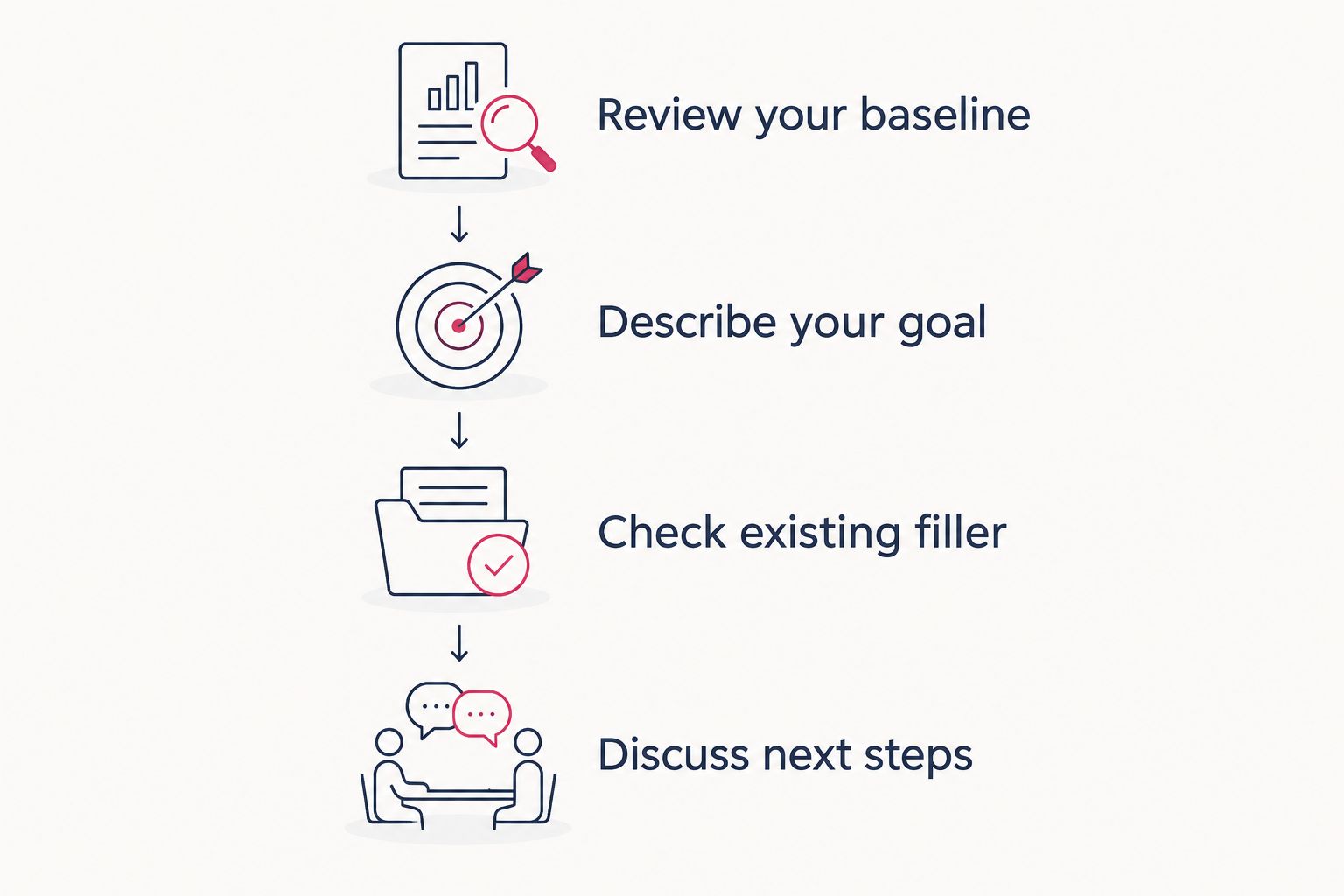
Use this sequence before deciding on another treatment:
- Review your baseline. Compare your current lips with settled photographs rather than immediate post-treatment pictures.
- Describe your goal. Identify whether you want volume, border definition, improved balance, or simply reassurance about a change.
- Check existing filler. Tell the provider what you previously received, where, and when, including treatment elsewhere.
- Discuss next steps. Consider monitoring, further assessment, or treatment only after the examination.
Bring treatment records if you have them. Knowing the product name and treatment history is more useful than describing an injectable only by its packaging or where a friend had it done.
If you are unsure what is already present, say so. Uncertainty is a reason for a more careful assessment, not a reason to add filler and see what happens.
Which symptoms need prompt or emergency attention?
Most discussions about longevity focus on appearance, but safety comes first. The FDA identifies risks including swelling, bruising, infection, lumps, and accidental injection into a blood vessel. Blood-vessel complications can cause tissue injury and, in rare cases, vision problems or stroke.
Severe or worsening pain, pale or dusky skin, unusual discoloration, or vision changes need immediate medical attention. Do not wait for a routine follow-up appointment or assume a concerning symptom will disappear as swelling settles.
Contact the treating clinician immediately if you suspect a complication. For sudden vision loss, stroke symptoms, or another medical emergency, call 911. Tell emergency personnel that you recently received dermal filler and identify the treatment area.
Ask about emergency instructions before treatment. You should know whom to contact during office hours, what to do after hours, and which symptoms mean you should seek emergency care instead of leaving a message.
A social media comment or photograph cannot reliably rule out a vascular complication. Even an apparently small area of discoloration needs the right clinical assessment when it occurs with concerning symptoms.
This is cosmetic care, not treatment for a disease. If your lip concern involves a sore, unexplained swelling, persistent pain, or another health change, seek an appropriate medical evaluation before considering an appearance-focused procedure.
Why do lip fillers and other facial fillers last differently?
A friend’s cheek filler timeline is not a reliable forecast for your lips. Different facial areas have different structures and treatment goals, and different products have different approved uses. Even the same broad material category includes formulations that are not interchangeable.
When comparing how long dermal fillers last, separate the treatment area and filler material before applying any duration claim to your lips. Otherwise, you are comparing a broad category with a specific procedure.
For your 2026 consultation, ask the provider to name the exact product and explain why it fits the intended area. FDA approval for one use does not automatically establish approval for every facial location. If a proposed use is off-label, ask what that means and why it is being considered.
Also distinguish filler from treatments that work differently. A procedure that changes muscle movement is not doing the same job as an injectable intended to add volume. Similar-looking social media results do not make the treatments substitutes.
Choose the treatment for the concern first; compare duration second. A longer-lasting option is not a better choice if it does not address what you actually want to change.
Can aftercare make lip filler last longer?
Aftercare supports recovery, but it cannot promise a longer-lasting cosmetic result. Follow your treating provider’s instructions about touching the area, activity, makeup, and when to resume your usual routine. Product choice and clinical assessment still matter more than a supposed filler-preserving trick.
Drinking enough water supports general health, but extra water does not guarantee that injected filler will last longer. Lip balm can help dry lips feel more comfortable; it does not replace lost volume or prevent filler breakdown.
For Henderson and Las Vegas residents, lip sun protection remains sensible skin care. The American Academy of Dermatology recommends a lip balm with SPF 30 or higher and reapplication every 2 hours outdoors. That advice protects exposed skin; it is not evidence that sunscreen extends filler duration.
Do not stop prescribed medication to reduce bruising without the prescribing clinician’s guidance. Tell your injector about medications, supplements, allergies, and relevant health conditions before treatment so the advice fits your situation.
Be equally cautious about home massage tutorials and devices promoted as ways to redistribute filler. If something feels uneven, ask for an examination. Attempting to fix the shape yourself can delay appropriate care and make the situation harder to assess.
Should you maintain, wait, or discuss correction?
These are different decisions, and none should be automatic. The right next step depends on whether you like your result, whether you have symptoms, and what an examination shows.
| Option | Best for | Potential benefit | Limitation or concern |
|---|---|---|---|
| Monitor without adding filler | People comfortable with their current appearance | Avoids an unnecessary procedure | Does not address a concern that needs evaluation |
| Discuss additional filler | People seeking a specific change after assessment | Allows a goal-focused treatment discussion | Adds procedural risks and can create unwanted fullness |
| Discuss correction | People unhappy with shape or experiencing a complication | Opens a discussion about the cause and suitable management | Correction is not a guaranteed reset and requires clinical judgment |
Monitoring is an active choice, not a failure to maintain yourself. You do not owe a recurring procedure to your previous appointment, a trend, or someone else’s preferred lip shape.
For hyaluronic acid filler, a clinician may consider an enzyme called hyaluronidase in appropriate circumstances. The American Society of Plastic Surgeons discusses its role in dissolving this type of filler. It is not applicable to every filler material, and its use carries risks, including allergic reactions.
Do not treat dissolving as an effortless undo button. The reason for the concern, the product involved, and your clinical findings determine the plan. Urgent complications also require a different response from a routine discussion about an unwanted cosmetic result.
What should you ask before choosing lip filler?
You do not need to arrive knowing which injectable you want. Bring a description of the change you are hoping for, along with what you definitely do not want. “I want a little more definition, but not a noticeably larger upper lip” is a useful starting point.
At Oasisbeauty, ask the team about suitability before choosing a dermal filler treatment. The practice’s local offering does not establish that every filler product or technique is available, so confirm the proposed plan directly.
Questions worth asking include:
- What exact product are you proposing, and why does it fit my concern?
- What does its patient information say about duration and risks?
- How will you assess my existing filler and treatment history?
- What changes are realistic for my anatomy, and what would you advise against?
- What recovery instructions and emergency contacts will I receive?
- How will we decide whether another appointment is actually necessary?
Call the team if you feel unsure. A conversation should leave you clearer about your choices—not rushed into choosing an amount or agreeing to repeat treatment.
You can also contact the team to discuss a consultation. In 2026, the useful goal is still personal: a decision you understand, with expectations that fit your own lips.
Does lip filler disappear all at once?
Lip filler generally changes gradually rather than disappearing on a single date. Visible fullness and the presence of remaining filler are not identical measurements, so a photograph alone cannot establish exactly how much material remains.
If your lips look less full, start by comparing them with your settled baseline. If the shape has changed in a way you dislike, ask for an assessment rather than assuming the answer is another injection. Less visible fullness does not automatically mean that adding more is appropriate.
Will my lips go back to normal after filler fades?
Your lips can look less full as the cosmetic effect fades, but an exact return to a previous photograph is not guaranteed. Aging, previous treatments, your anatomy, and any complications can affect appearance over time.
A provider can discuss what is realistic for your treatment history. If your priority is keeping your natural proportions, say that before treatment and at each review. You are allowed to pause, choose less change, or decide that maintenance is not for you.
FAQ
How long does lip filler last the first time?
First-time lip filler is temporary, and its duration depends on the product and your individual response. Ask for the proposed product’s published duration and judge your result after early swelling has settled.
Does lip filler last longer after repeat appointments?
Repeat appointments do not guarantee a longer-lasting result. Existing filler and your current appearance need assessment before deciding whether more treatment is appropriate.
Is lip filler swelling the same as the final result?
No, early swelling can make lips look fuller or less even than the settled result. Follow your provider’s recovery guidance and seek prompt assessment for worsening pain or unusual discoloration.
Can drinking more water make lip filler last longer?
Drinking extra water does not guarantee longer-lasting lip filler. Hydration supports general health, but it is not a substitute for appropriate product selection or a clinical assessment.
Should I get more filler as soon as my lips look smaller?
Smaller-looking lips do not automatically need more filler. Compare your appearance with settled photographs and have the remaining shape and fullness assessed first.
Can lip filler be dissolved if I do not like it?
A clinician can consider hyaluronidase for certain concerns involving hyaluronic acid filler. It does not dissolve every filler type, carries risks, and is not a guaranteed return to your previous appearance.
What symptoms after lip filler are an emergency?
Vision changes, severe pain, or unusual pale or dusky skin after filler need immediate medical attention. Call 911 for sudden vision loss, stroke symptoms, or another medical emergency.
One last thing
You do not need to keep topping up lips that you already like. The most useful maintenance question is not “Has enough time passed?” It is “What would another treatment improve, and what are the downsides?”
Before your Oasisbeauty consultation, write down your goal and bring any previous treatment records. Include a photograph of your own lips that you like, if you have one, rather than relying only on someone else’s face for direction.
That gives the conversation a practical starting point: your proportions, your preferences, and your comfort with uncertainty. A good decision can be treatment, a later review, or leaving things as they are. Refreshed should still feel like you.
Related guides
- Is lip filler worth it?
- Lip filler treatments for natural-looking results
- Dermal fillers for facial volume loss