
You can start noticing laser hair removal results over the days to weeks after your first treatment, as treated hairs shed; more lasting reduction takes a series of appointments. Hair does not disappear immediately, and a smooth patch after one visit does not mean treatment is complete. Your hair color, skin tone, treatment area, and growth cycle all affect the timeline.
- How long to see laser hair removal results: shedding develops over days to weeks, not immediately after treatment.
- The American Academy of Dermatology describes treatment courses of 2–6 sessions, with individual plans varying.
- Laser hair removal reduces regrowth; maintenance appointments can still be necessary.
- Oasisbeauty helps Henderson patients discuss aesthetic treatment suitability before choosing a procedure.
Why this matters
If you are planning laser hair removal in Henderson or the nearby Las Vegas area in 2026, separate your first visible change from your longer-term goal. Shedding, slower regrowth, and sustained reduction are different milestones. Judging everything by how your skin looks the next morning can leave you worried unnecessarily.
Start with a suitability conversation, not a deadline. Oasisbeauty offers aesthetic care in Henderson; ask the team about your goals and the available treatment options before committing. A useful plan explains what you should notice, what requires patience, and when your response needs reassessment.
How long does it take to see laser hair removal results?
Expect shedding over days to weeks, then assess reduced regrowth across multiple treatment appointments. Mayo Clinic's patient guidance explains that treated hair sheds over several days to weeks rather than falling out immediately. The American Academy of Dermatology, or AAD, describes a course of 2–6 treatments in its patient FAQ, while your actual plan depends on your response.
Use this 2026 timeline as a planning framework, not a promise that your skin will follow a calendar exactly.
| Stage | What you might notice | What it means | What it does not establish |
|---|---|---|---|
| Immediately afterward | Redness, swelling around follicles, or warmth | Your skin is reacting to treatment | That every visible hair has been permanently removed |
| Days to weeks afterward | Treated hairs loosen and shed | Hair is leaving the treated follicles | That every follicle was in a responsive growth phase |
| Between appointments | Changes in growth speed, density, or thickness | Your response is becoming easier to assess | That another appointment is unnecessary |
| Across the treatment course | Less regrowth in responsive areas | Repeated treatments are addressing different growth cycles | That all future hair growth is prevented |
| After the initial course | A longer interval with less unwanted hair | You can assess whether maintenance is needed | That future touch-ups will never be required |
Bring concerns to your provider rather than deciding from a single patch. Your treatment record, skin reaction, and hair characteristics help explain whether the plan needs adjusting.
First-treatment results: shedding over days to weeks
After treatment, some hairs can look as though they are still growing. Mayo Clinic explains that treated hairs shed over a period of days to weeks, so visible stubble shortly afterward is not enough to judge the result. Resist the urge to pull hairs out to check whether treatment worked.
Your first useful observation is a change in how hair returns once shedding has occurred. You might notice less frequent shaving, a patchier pattern, or finer regrowth. None of those observations alone proves that the whole treatment course is finished.
Do not confuse temporary smoothness with lasting reduction. Shaving before treatment also changes how the area looks, making an immediate before-and-after comparison misleading. Compare regrowth under similar conditions instead: similar lighting, a similar interval since shaving, and the same treatment area.
If you see no change, tell your provider what you observed and when. A discussion about hair color, treatment settings, and timing is more useful than booking extra appointments without understanding the response.
A treatment course: 2–6 sessions in AAD guidance
The AAD's laser hair removal FAQ describes 2–6 treatments for most patients. That is general patient guidance, not an individualized prescription or a guarantee. Some people need a different course or later maintenance, particularly when ongoing hair growth remains a concern.
Laser treatment works best on follicles in an active growth phase, and your hairs do not all reach that phase together. Repeated appointments address hairs as they become suitable targets. This is why scheduling treatments closer together does not automatically get you to the finish line sooner.
The AAD also describes intervals of 4–6 weeks between treatments as common, with timing determined individually. Ask your provider how the treatment area and your actual regrowth affect the next appointment. A calendar should support the treatment plan, not replace assessment.
For a wedding, vacation, or other 2026 event, work backward from the date with your provider. Allow for the treatment course, skin recovery, sun exposure, and the possibility that your response will require a revised plan. Avoid treating an event date as a guarantee of hair-free skin.
Does the treatment area change the timeline?
Yes. Hair growth cycles differ by body area, so your face, underarms, bikini area, and legs should not automatically share the same appointment schedule. Mayo Clinic notes that treatment intervals depend on the location being treated.
| Area or concern | Best for assessing progress | Potential benefit | Limitation to discuss |
|---|---|---|---|
| Facial hair | Changes in regrowth between visits | Less unwanted regrowth when the hair is suitable | Hormonal influences can make ongoing management necessary |
| Underarms or bikini area | Comparable photos and shaving records | Reduced grooming burden in responsive areas | Skin irritation and pigment changes remain possible |
| Legs or other larger areas | Density changes across the whole treated area | Reduction across a broader area | Patchy regrowth can make isolated spots misleading |
| Fine or lightly colored hair | An honest suitability assessment | Avoiding treatment that does not match the hair | Laser generally responds poorly to hair with little pigment |
These are assessment priorities, not recommendations to treat every area. The best area to start with is one where your concern, hair characteristics, and safety assessment support treatment.
For facial hair that appears suddenly or changes substantially, ask a healthcare professional whether medical assessment is appropriate. Cosmetic hair reduction does not diagnose or treat an underlying hormonal disorder.
Why laser hair removal results vary
Your friend's timeline is not a reliable forecast for your skin. The factors below explain why two people can have different experiences without either treatment course necessarily being wrong.
- Hair pigment and thickness. Laser targets pigment in hair. Darker, coarser hairs generally respond better than very fine, white, gray, red, or blond hairs.
- Skin tone and recent tanning. Your provider must account for pigment in the skin as well as the hair. Recent tanning changes the safety assessment and can require postponement.
- Treatment area. Hair growth cycles vary by location. The timing used for one area is not automatically appropriate for another.
- Hormonal influences. Conditions that promote ongoing hair growth can affect maintenance needs. Hair removal does not resolve the underlying condition.
- Treatment method and settings. Device choice, settings, cooling, and the provider's experience with your skin tone affect safety and response.
- Preparation and appointment timing. Removing hairs at the root or treating without an appropriate interval can interfere with the plan. Follow your provider's instructions rather than improvising.
The AAD and Mayo Clinic discuss these suitability and treatment considerations in their patient guidance. None supports predicting your exact finish date from a photograph alone.
How to prepare without interrupting your treatment plan
Preparation is not about earning a better result through a complicated routine. It is about giving your provider accurate information and keeping your skin suitable for treatment. Ask for written instructions specific to the area and device before your appointment.
Share your skin and medication history
Tell your provider about prescription medicines, nonprescription products, supplements, recent tanning, previous reactions, and a history of scarring. Mention active irritation or infection in the treatment area. Do not stop prescribed medication on your own; ask the prescribing clinician and treatment provider how to proceed.
Avoid removing hair at the root
Mayo Clinic advises avoiding plucking, waxing, and electrolysis before laser treatment because those methods disturb the follicle. Ask your provider exactly when to stop and how to manage hair between visits. Shaving is commonly used instead, but follow the timing and technique in your own instructions.
Protect the area from sun exposure
A tan is not a helpful head start for laser treatment. Tell your provider about sun exposure and self-tanning products, even if the color looks faint to you. The AAD recommends broad-spectrum, water-resistant sunscreen with SPF 30 or higher, alongside other sun-protection measures.
Arrive ready to postpone if necessary
If your skin is sunburned, unusually irritated, or otherwise different from the consultation, speak up before treatment begins. Rescheduling can be the safer choice. Your 2026 calendar should leave room for that possibility rather than pressure you into proceeding with unsuitable skin.
What downtime and risks should you expect?
Redness and swelling are common short-term reactions. The AAD describes common side effects as generally lasting 1–3 days, although your reaction can differ. Ask what is expected for your skin and which symptoms require a call.
Laser hair removal also carries risks beyond temporary redness, including burns, blistering, pigment changes, infection, and scarring. These are not signs that treatment is working especially well. Mayo Clinic also notes that hair can rarely grow excessively around treated areas.
More discomfort does not mean better results. Report pain during treatment and follow the aftercare instructions you receive. Ask specifically about cooling, skin products, exercise, friction, and sun exposure rather than applying a generic recovery routine from social media.
Contact your provider promptly for blistering, worsening pain, spreading redness, drainage, or another concerning reaction. Seek urgent medical care for severe symptoms. Do not wait until the next cosmetic appointment to have a possible complication assessed.
How to track progress without checking every day
Daily checking makes small changes difficult to interpret. A simple record gives you and your provider a clearer picture, especially when different areas respond at different speeds. Use observations to support a conversation, not to diagnose a failed treatment yourself.
- Baseline photos. Photograph the treatment area before the course, using consistent lighting and positioning. Keep the images private and avoid filters that hide texture or hair.
- Shedding notes. Note when you first notice hairs loosening, along with any skin reaction. Do not scrub or pull hairs to create a more dramatic comparison.
- Regrowth notes. Record whether shaving frequency, hair thickness, or density changes. Compare similar intervals after shaving so the observation means something.
- Treatment review. Bring your notes to the next appointment. Ask whether the response supports the current plan or calls for reassessment.
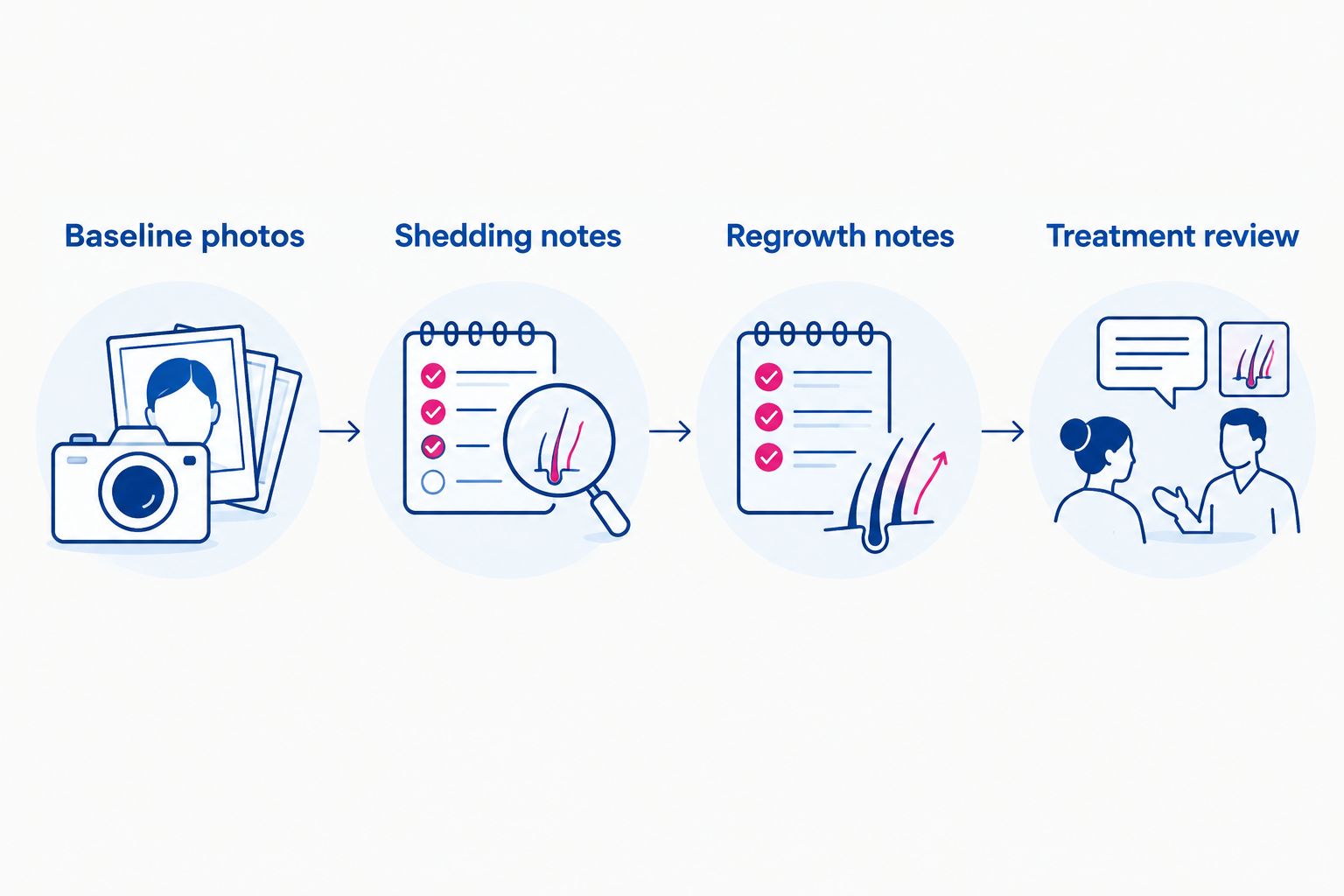
A useful progress conversation includes both benefits and drawbacks. Less regrowth matters, but so do persistent irritation, changes in skin color, and whether the appointment schedule fits your life. Keep those observations together rather than treating hair reduction as the only measure of success.
Can I shave between laser hair removal appointments?
Shaving is generally compatible with a laser hair removal plan because it does not pull the hair out at the root. Ask when you can resume after treatment, particularly if the area remains tender or irritated. Avoid waxing or plucking unless your provider explicitly changes your plan.
Shaving does not tell you whether treatment failed. You can still have hair between appointments because follicles cycle at different times. Judge the longer-term pattern with your provider rather than expecting every razor to disappear from your bathroom immediately.
Will laser hair removal make me permanently hair-free?
Laser hair removal does not guarantee permanent removal of every hair. Mayo Clinic explains that results vary, regrowth can occur, and maintenance treatments can be necessary. Regrown hair is often finer or lighter, but that is not a promised outcome for every person.
Think in terms of a manageable reduction rather than an absolute finish line. Ask what successful treatment would look like for your particular area and hair type. A clear answer should include limitations, not just a description of the best possible outcome.
When should I ask whether treatment is working?
Ask at each scheduled review, especially if you see no change after the expected shedding period or notice an unexpected reaction. Bring the date of treatment, your observations, and photos if you have them. Your provider can assess whether the issue is timing, suitability, or a need to reconsider the plan.
Do not respond to uncertainty by requesting stronger settings or shorter intervals. Those choices require a safety assessment. If your concerns are dismissed without an explanation, seek an appropriately qualified healthcare professional's opinion before continuing.
Questions to ask before choosing treatment in Henderson
Oasisbeauty is best for Henderson readers seeking a conversation about aesthetic treatment suitability before choosing a procedure. That conversation should leave you understanding your options and their limitations, without feeling rushed into a course of treatment.
Call the team with questions, or use the contact page to start the discussion. Ask these questions before setting your 2026 treatment calendar:
- Am I a suitable candidate given my hair color, skin tone, and recent sun exposure?
- Which treatment is being proposed, and why does it fit my concern?
- What experience does the person treating me have with my skin tone?
- What changes should I expect after the first appointment and across the course?
- What would make you postpone treatment or reassess my response?
- Who should I contact if I develop an unexpected reaction?
The benefit of starting with questions is a clearer decision. The limitation is that a general conversation cannot replace an individual assessment. Do not assume any particular device, technique, or appointment schedule is available or suitable until the team confirms it.
Medical sources behind this 2026 guide
This guide uses the American Academy of Dermatology's Laser hair removal: FAQs for treatment-course guidance, common intervals, and short-term reactions. Its Laser hair removal: Preparation guidance supports the discussion of consultation, medical history, and sun protection.
Mayo Clinic's Laser hair removal patient guidance supports the explanation of shedding over days to weeks, growth-cycle differences, preparation, risks, and maintenance. These sources describe general expectations, not outcomes measured at Oasisbeauty. This article provides cosmetic-treatment information and does not replace individualized medical advice.
FAQ
How long to see laser hair removal results after my first appointment?
Treated hairs shed over days to weeks after laser hair removal, according to Mayo Clinic. Longer-term reduction is assessed across a treatment course rather than immediately after one appointment.
Why does my hair look like it is still growing after laser?
Hair can remain visible while treated hairs work their way out during shedding. Do not pull or scrub hairs out; ask your provider if you are unsure whether your response is expected.
How many laser hair removal sessions will I need?
The American Academy of Dermatology describes 2–6 treatments in its patient FAQ, but your individual course can differ. Hair characteristics, treatment area, response, and maintenance needs affect the plan.
How far apart should laser hair removal appointments be?
The American Academy of Dermatology describes 4–6 weeks between treatments as common, with timing individualized. Your provider should account for the treatment area and your regrowth rather than use the same interval for everyone.
Can I wax between laser hair removal sessions?
Avoid waxing or plucking during a laser hair removal course unless your provider instructs otherwise. These methods remove hair at the root and can interfere with treatment preparation.
Does laser hair removal work on blond or gray hair?
Laser hair removal generally works poorly on hair with little pigment, including blond, gray, and white hair. Ask for an honest suitability assessment before committing to treatment.
Is redness after laser hair removal normal?
Temporary redness and swelling are common after laser hair removal. Blistering, worsening pain, spreading redness, or other concerning changes need prompt advice rather than an assumption that they are normal.
Can I get laser hair removal before a Las Vegas vacation?
Plan laser hair removal around sun exposure, recovery instructions, and the full treatment course rather than expecting an immediate result. Tell your provider about travel and outdoor plans before scheduling.
One last thing
A smooth day is not the same as a successful treatment course. The more useful question is whether unwanted regrowth is decreasing without unacceptable skin reactions. That keeps your attention on both the result and your skin's health.
Before your next appointment, write down what changed and what bothered you. Bring both to the conversation. You deserve a plan that makes sense for your skin, your schedule, and your comfort—not pressure to chase somebody else's timeline.
Related guides
- Laser hair removal for sensitive skin
- Laser hair removal for athletes and gym-goers
- Treatments for sun damage and dark spots