
Best overall for gradual facial volume restoration: Sculptra. Best for targeted contour correction: hyaluronic acid fillers. Best for expression lines: Botox. The best Sculptra treatments in 2026 start with the right diagnosis—not a promise that one injectable fixes every sign of aging.
- The best Sculptra treatments address suitable facial volume loss through gradual collagen stimulation, not immediate correction.
- Hyaluronic acid fillers suit focal contour goals; Botox addresses expression lines; microneedling targets skin texture.
- Oasisbeauty serves Henderson clients seeking aesthetic care; confirm Sculptra service details directly before planning treatment.
- Choose a qualified medical injector who explains treatment areas, alternatives, contraindications, and complication management.
Why this matters
Facial rejuvenation involves different problems: lost volume, muscle-driven wrinkles, surface texture, and skin laxity. Treating the wrong problem produces the wrong result. Sculptra stimulates collagen production; it does not work like a muscle-relaxing injectable or a surface treatment.
Oasisbeauty is a Henderson, Nevada med spa offering cosmetic and aesthetic care, including Botox, fillers, and microneedling. Oasisbeauty is a local option for Henderson clients seeking facial rejuvenation consultation. Confirm whether Sculptra is offered and who performs the procedure before choosing a treatment plan.
This 2026 guide ranks treatment approaches by the concern they address. It is not a ranking of clinics, injector credentials, or patient outcomes, and it does not replace an individual medical assessment.
What makes the best Sculptra treatments?
A good treatment plan answers these questions before an injection:
- Correct diagnosis: Is the concern volume loss, expression lines, texture, or laxity? These require different tools.
- Appropriate treatment area: The proposed injection site must suit the product, your anatomy, and its approved labeling.
- Medical suitability: Review allergies, skin inflammation, scarring history, medications, and relevant medical conditions.
- Injector qualifications: Confirm the clinician's license, facial anatomy knowledge, product-specific training, and emergency procedures.
- Realistic timing: Sculptra produces gradual improvement. A same-day volume change is not the final collagen response.
- Follow-up plan: Know how the clinician evaluates results, handles concerns, and decides whether additional treatment is appropriate.
Choose the treatment that matches your concern, not the treatment with the most persuasive before-and-after photograph. Lighting, expression, camera position, and follow-up timing affect what those photographs show.
Facial rejuvenation options at a glance
There is one Sculptra product in this comparison, not several competing versions. The other entries are alternatives or a planning approach for different facial concerns.
| Rank | Treatment approach | Best for | Standout feature | Key limitation |
|---|---|---|---|---|
| 1 | Sculptra | Gradual volume | Stimulates collagen production over time | Delayed results; not dissolved with hyaluronidase |
| 2 | Hyaluronic acid fillers | Focal contour | Places gel where targeted correction is needed | Vascular complications are possible |
| 3 | Botox | Expression lines | Reduces activity in selected facial muscles | Does not replace lost facial volume |
| 4 | Microneedling | Skin texture | Creates controlled skin injury to support remodeling | Does not replace an injectable's volume effect |
| 5 | Staged combination treatment | Mixed concerns | Assigns a separate treatment to each diagnosed concern | Adds procedures and requires careful sequencing |
Treatment planning
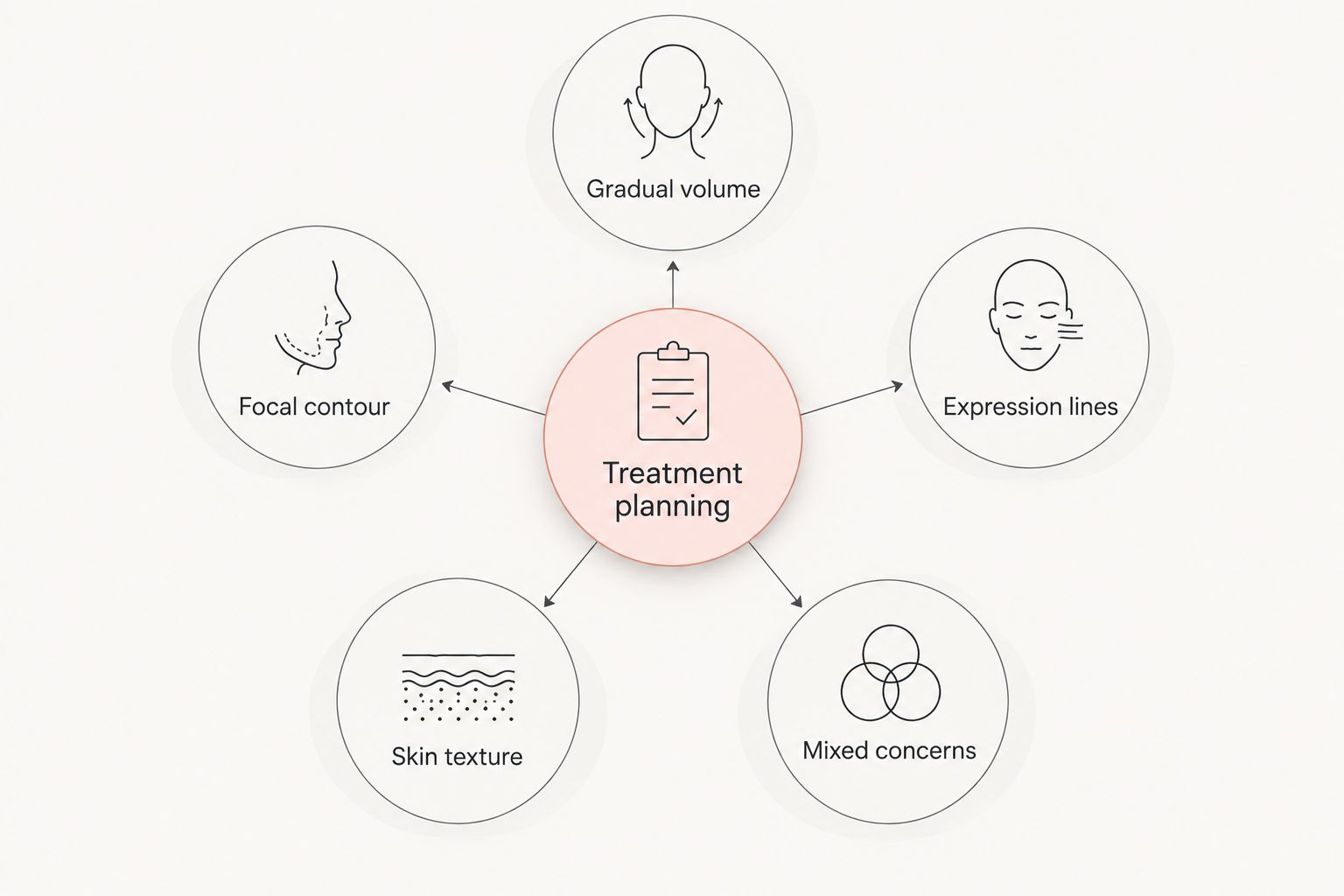
Start with the visible concern, then discuss the matching treatment category. Gradual volume, focal contour, expression lines, skin texture, and mixed concerns are different starting points—not interchangeable reasons to request Sculptra.
1. Sculptra: best for gradual facial volume restoration
Sculptra is an injectable containing poly-L-lactic acid, commonly shortened to PLLA. It stimulates collagen production and provides gradual correction rather than the immediate gel-based volume effect of a hyaluronic acid filler.
Its FDA-approved uses include correction of certain facial wrinkles and contour deficiencies; cheek wrinkle treatment has specific labeling and eligibility requirements. Your clinician must connect the proposed treatment area to the applicable indication and explain any off-label use.
Sculptra pros:
- Addresses suitable facial volume and wrinkle concerns through collagen stimulation.
- Supports gradual change rather than requiring an immediate finished result.
- Allows reassessment between treatment sessions.
- Has published FDA labeling that defines indications, risks, and treatment guidance.
Sculptra cons:
- Results develop gradually, so it is a poor match for an imminent event.
- Papules, nodules, swelling, bruising, and other injection-related complications can occur.
- Hyaluronidase does not dissolve PLLA as it does hyaluronic acid filler.
For cheek wrinkles, FDA patient information describes up to 4 treatment sessions, spaced at least 3 weeks apart, with results lasting up to 2 years. Those figures describe the labeled treatment framework and potential duration—not a guaranteed schedule or outcome for you.
In 2026, use that timeline to ask practical questions: What result is realistic? When will it be assessed? What would justify another session? Do not equate more product with a better outcome.
Best for: Adults seeking gradual correction of appropriate facial volume or wrinkle concerns after medical assessment.
Verdict: Consider Sculptra when gradual improvement matches your goal; skip it as an immediate-fix treatment.
2. Hyaluronic acid fillers: best for targeted contour correction
Hyaluronic acid fillers place a gel into selected areas to address a specific contour or volume concern. Different products have different properties and approved uses, so the category name alone does not establish suitability.
Compared with Sculptra, hyaluronic acid fillers provide a more immediate volume effect. Early swelling can obscure the final appearance, and the clinician still needs to evaluate tissue, anatomy, and treatment goals.
Hyaluronic acid filler pros:
- Supports localized correction rather than a broad collagen-stimulation goal.
- Provides an immediate volume effect, although settling takes time.
- Offers product choices for different approved treatment areas.
- Can be broken down with hyaluronidase when clinically appropriate.
Hyaluronic acid filler cons:
- Injection into or compression of a blood vessel can cause serious injury.
- Swelling, bruising, asymmetry, and lumps can occur.
- Dissolving treatment is not a guarantee of complete reversal or a risk-free rescue.
Ask the clinician to name the exact product, identify its approved use, and explain why its properties fit the area. A familiar filler name is not a substitute for a sound anatomical plan.
Best for: A defined contour concern where a clinician recommends localized gel-based correction.
Verdict: Consider hyaluronic acid filler for focal correction; skip it when the primary concern is muscle-driven wrinkling.
3. Botox: best for expression-related facial lines
Botox is a botulinum toxin treatment that reduces activity in selected muscles. Its cosmetic uses include certain expression-related lines, with treatment sites and dosing governed by the product's labeling and clinical assessment.
Sculptra and Botox perform different jobs. Botox does not restore lost facial volume, and Sculptra does not relax the muscles responsible for expression lines.
Botox pros:
- Directly addresses selected muscle-driven wrinkles.
- Offers a treatment category distinct from volume replacement.
- Allows the clinician to tailor treatment to facial muscle activity.
Botox cons:
- Does not correct volume loss or provide a filler-like contour change.
- Can cause unwanted weakness, asymmetry, or eyelid or brow drooping.
- Requires reassessment because its effects are temporary.
Ask how the proposed treatment will affect your expression, not just whether it will soften a line. Discuss prior responses to botulinum toxin and any relevant neuromuscular conditions or medications.
Oasisbeauty lists Botox among its aesthetic services. For a 2026 consultation, describe whether your lines appear mainly during movement or remain visible at rest; the clinician must assess the distinction rather than relying on that description alone.
Best for: Suitable expression-related wrinkles caused by activity in treatable facial muscles.
Verdict: Consider Botox for expression lines; skip it as a substitute for facial volume restoration.
4. Microneedling: best for skin texture concerns
Microneedling creates controlled skin injury to support remodeling. Depending on the device and indication, it is used for concerns such as certain acne scars and facial wrinkles.
It belongs in a facial rejuvenation discussion when the concern is the skin's surface rather than a deeper contour deficit. Microneedling does not produce the same volume effect as a filler or replace Sculptra's treatment role.
Microneedling pros:
- Targets appropriate texture and scar concerns.
- Provides a non-filler approach to selected skin problems.
- Keeps surface treatment separate from decisions about injectable volume.
Microneedling cons:
- Can cause irritation, bleeding, infection, and pigment changes.
- Requires screening for active skin problems and healing risks.
- Standard microneedling and radiofrequency microneedling are not interchangeable procedures.
Ask which device is proposed and what indication supports its use. Radiofrequency devices add energy delivery and a different risk discussion; do not assume that a more intensive procedure is the better choice.
Oasisbeauty lists microneedling among its services. Explain whether your priority is scarring, rough texture, or facial hollowing so the consultation starts with the concern instead of a predetermined procedure.
Best for: Clinically suitable skin texture or scar concerns, rather than structural volume loss.
Verdict: Consider microneedling for texture; skip it as a replacement for contour correction.
5. Staged combination treatment: best for mixed facial concerns
A staged plan assigns different treatments to different diagnosed problems. For example, a clinician can assess volume loss separately from expression lines and surface texture without treating everything at the same appointment.
This is a planning approach, not a branded bundle or a claim that everyone needs multiple procedures. A single appropriate treatment remains the better choice when it addresses your main concern.
Staged combination treatment pros:
- Separates volume, muscle activity, and texture goals.
- Creates opportunities to reassess before adding another procedure.
- Helps identify which treatment produced an effect or an adverse reaction.
Staged combination treatment cons:
- Adds appointments, aftercare requirements, and procedural exposure.
- Requires coordination of healing periods and follow-up assessments.
- Creates unnecessary treatment if every concern becomes a procedure recommendation.
Ask the clinician to identify the primary concern, explain the first treatment, and define what would make a second treatment unnecessary. A useful plan includes a stopping point.
Best for: More than one distinct concern that remains after a clinician prioritizes treatment goals.
Verdict: Consider a staged plan for mixed concerns; skip automatic multi-procedure packages.
How these treatment approaches are ranked
This ranking prioritizes diagnostic fit, treatment mechanism, timing, medical suitability, and limitations. Sculptra ranks first for the query because it directly addresses suitable gradual facial rejuvenation goals—not because it outperforms every alternative on every concern.
Botox wins its expression-line category. Microneedling serves a different texture-focused role. Neither becomes an inferior treatment simply because it does not replace volume.
Which facial rejuvenation treatment should you choose?
Choose Sculptra when gradual correction of an appropriate volume or wrinkle concern is your main goal and your clinician confirms suitability. Choose an alternative when the diagnosis points elsewhere.
Before consenting in 2026, get clear answers to these questions:
- What exactly are you treating, and what will remain unchanged?
- Which product or device will you use, and is the proposed use approved or off-label?
- What makes me a suitable candidate?
- What complications require urgent attention, and how will you respond?
- When will you assess the result before deciding on further treatment?
Facial injections carry medical risks. Sudden vision changes, unusual severe pain, or pale or mottled skin during or after filler treatment require immediate medical attention. Do not wait for a routine follow-up.
FAQ
What’s the best Sculptra treatment for facial rejuvenation?
The best Sculptra treatment is an individualized plan for a suitable facial volume or wrinkle concern. A qualified medical clinician must assess your anatomy, medical history, treatment area, and expectations before recommending it.
Is Sculptra better than hyaluronic acid filler?
Sculptra is better suited to gradual collagen stimulation, while hyaluronic acid filler suits selected localized contour goals. Neither is the best choice for every face, and hyaluronidase does not dissolve Sculptra.
How many Sculptra sessions will I need?
Your clinician determines the number of sessions after assessment. FDA patient information for cheek wrinkles describes up to 4 sessions at least 3 weeks apart; that is not a prescription for every patient or treatment area.
How long do Sculptra results last?
FDA patient information describes cheek wrinkle results lasting up to 2 years. This is not a guarantee, and your clinician must explain how the treatment indication and your response affect expectations.
Can Sculptra replace Botox?
Sculptra does not replace Botox for muscle-driven expression lines. Sculptra stimulates collagen production, while Botox reduces activity in selected facial muscles.
Who should avoid Sculptra?
People with contraindications in Sculptra’s labeling should not receive it. These include certain allergies and susceptibility to keloid or hypertrophic scarring; a clinician must also assess skin conditions, medical history, and eligibility for the proposed indication.
Does Oasisbeauty offer Sculptra in Henderson?
Confirm Sculptra service details directly with Oasisbeauty before arranging treatment. The practice offers aesthetic care including Botox, fillers, and microneedling, but those service descriptions do not establish Sculptra availability.
One last thing
The fullness immediately after Sculptra injections is not proof that collagen has already formed. The injected suspension and swelling can temporarily change appearance before the gradual treatment response develops.
For your 2026 treatment plan, agree on an assessment schedule before judging results. Ask for consistent photography and a clear threshold for additional treatment—not a decision based on the mirror immediately after the appointment.