Best overall for a newly healed incision: silicone gel or sheets. Best for a thick, raised scar: corticosteroid injections. Best for persistent redness: vascular laser assessment. This 2026 guide compares the best treatments for surgical scars by scar type; Oasisbeauty offers microneedling in Henderson, Nevada, but suitability for a surgical scar requires clinical assessment.
- The best treatments for surgical scars depend on whether the scar is raised, red, indented, or widened.
- Silicone gel or sheets are a first-line option for fully closed, newly healed surgical scars.
- Corticosteroid injections target raised scars; vascular lasers target persistent redness.
- Oasisbeauty offers microneedling; confirm surgical scar suitability before choosing treatment.
Why this matters
A surgical scar is not one problem. A flat red line, a thick ridge, and a depressed incision need different treatment plans. Choosing by a treatment’s popularity instead of the scar’s structure sends you toward the wrong procedure.
Scar maturation also takes time. A surgical scar can continue changing for 12 months or longer, so its early appearance is not necessarily its final appearance. An open, draining, increasingly painful, or spreading red incision needs medical assessment—not cosmetic treatment.
The aim is improvement, not erasure. In 2026, the useful question remains the same: which feature of your scar needs treatment, and which option addresses it?
What makes the best treatments for surgical scars?
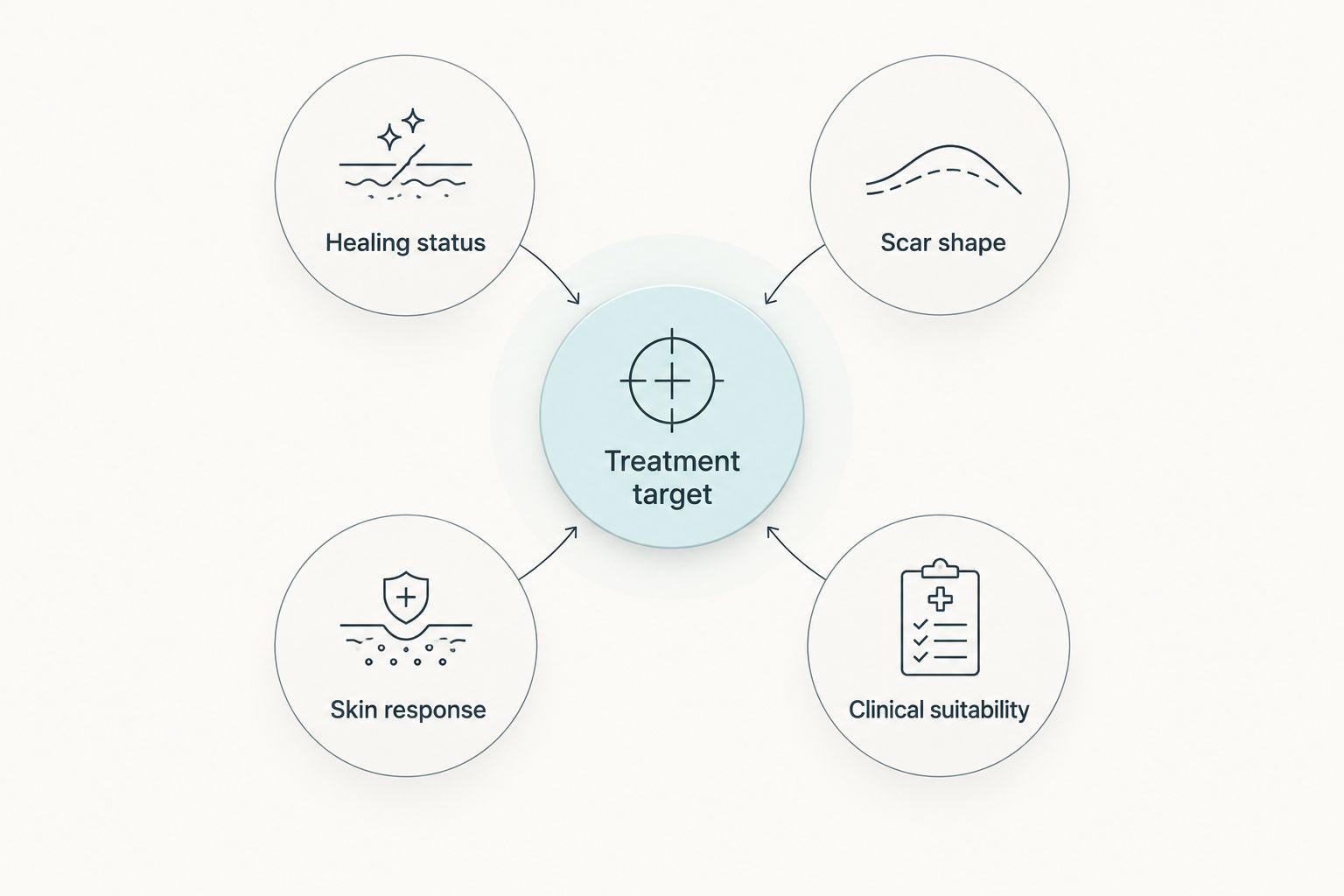
Use these criteria before comparing procedures:
- Healing status: The incision must be fully closed before silicone or elective cosmetic treatment. Your surgical team decides when it is ready.
- Scar shape: Raised, indented, widened, and tethered scars require different approaches. A treatment that flattens a ridge will not necessarily improve a depression.
- Skin response: Your skin tone, history of pigment changes, and tendency to develop keloids affect procedure selection.
- Treatment target: Separate redness, discoloration, thickness, texture, itching, and restricted movement. Name the main problem before booking.
- Recovery needs: Ask about wound care, activity restrictions, and sun exposure after each procedure. Avoid scheduling around an assumed recovery period.
- Clinical suitability: Previous treatments, medications, active skin conditions, and the original operation belong in the assessment.
These criteria explain the ranking: start with the least invasive suitable option, then choose a procedure that matches the remaining problem. A higher position does not make an option better for every scar.
Surgical scar treatments at a glance
| Treatment | Best for | Standout feature | Key limitation |
|---|---|---|---|
| Silicone gel or sheets | Newly healed, closed incisions | Noninvasive scar care | Requires consistent use; does not correct every scar feature |
| Corticosteroid injections | Thick, raised hypertrophic scars or keloids | Targets excessive scar tissue | Can cause skin thinning or pigment changes |
| Vascular laser treatment | Persistent scar redness | Targets blood vessels contributing to redness | Does not primarily correct scar width or indentation |
| Fractional laser resurfacing | Uneven texture in a mature scar | Treats portions of skin to stimulate remodeling | Recovery and pigment risks depend on treatment and skin type |
| Microneedling | Selected depressed or uneven scars | Creates controlled punctures to stimulate remodeling | Not appropriate for every surgical scar or keloid-prone patient |
| Surgical scar revision | Widened, poorly positioned, or function-limiting scars | Changes scar placement or structure | Creates a new surgical wound and another scar |
1. Silicone gel or sheets: best for newly healed incisions
Silicone gel and silicone sheets are common first-line options once a surgical wound has fully closed. They help manage the scar environment and can improve features such as thickness and discomfort. They do not dissolve scar tissue or make an incision disappear.
Gel suits areas where a sheet is difficult to keep in place. Sheets provide a covering but need to fit your skin and daily activities. Choose the format you can use consistently rather than assuming one is universally stronger.
Silicone pros:
- Noninvasive and suitable for home use after clearance.
- Available in formats for different body areas.
- Can support care of raised or developing scars.
Silicone cons:
- Adhesives or trapped moisture can irritate skin.
- Requires repeated use over time.
- Does not correct a deeply indented or widened scar.
Best for: A fully closed incision that is still developing, especially when raised scarring is a concern.
Ask your surgical team when to start and follow the product instructions. Do not place silicone over an open wound or use it to conceal drainage. Verdict: Buy after your surgical team confirms the incision is ready.
2. Corticosteroid injections: best for thick, raised scars
Clinician-administered corticosteroid injections can flatten and soften hypertrophic scars and keloids. A hypertrophic scar stays within the original wound’s boundaries; a keloid grows beyond them. That distinction matters because keloids are prone to recurrence and often need a combined treatment plan.
Injections target excessive scar tissue rather than general skin texture. They are not the default treatment for a flat incision or a depressed scar.
Corticosteroid injection pros:
- Directly targets a raised area.
- Can reduce scar thickness and associated itching.
- Can form part of a combined scar-management plan.
Corticosteroid injection cons:
- Can cause skin thinning, visible small blood vessels, or pigment changes.
- Injections can be uncomfortable.
- Repeat treatment does not guarantee permanent control.
Best for: A thick, raised surgical scar assessed by a clinician experienced in hypertrophic scars and keloids.
If your scar extends beyond the incision, say that explicitly when arranging an assessment. Treating a keloid as an ordinary cosmetic texture issue misses its recurrence risk. Verdict: Hold until a clinician confirms the scar type and injection plan.
3. Vascular laser treatment: best for persistent redness
Vascular lasers, including pulsed dye lasers, target blood vessels that contribute to scar redness. They address a different concern from resurfacing lasers. A scar that is flat but conspicuously red needs an assessment focused on color, not automatically on depth.
Brown discoloration is not the same as vascular redness. Ask the clinician to distinguish pigment from blood vessels before recommending a device.
Vascular laser pros:
- Targets persistent vascular redness.
- Can complement treatments aimed at thickness or texture.
- Allows color to be addressed separately from scar shape.
Vascular laser cons:
- Can cause bruising, swelling, or pigment changes.
- Requires careful selection of settings for your skin tone.
- Does not primarily repair an indented or widened incision.
Best for: A healed surgical scar whose main remaining problem is vascular redness.
For a 2026 consultation, ask which device will be used and why it matches your scar. Laser hair removal and vascular scar treatment are different procedures; offering one does not establish that a clinic offers the other. Verdict: Hold until the redness is assessed and the device is identified.
4. Fractional laser resurfacing: best for uneven scar texture
Fractional lasers treat selected portions of skin, leaving surrounding areas untreated. They are used to encourage remodeling and improve uneven scar texture. Ablative and nonablative devices differ in how they affect the skin and in their recovery requirements.
The phrase laser scar treatment is too broad to make a decision. Ask for the device type, intended improvement, and aftercare—not just a procedure name.
Fractional laser pros:
- Targets texture rather than only redness.
- Can be incorporated into treatment of selected mature surgical scars.
- Offers different treatment approaches depending on the device.
Fractional laser cons:
- Can cause infection, pigment changes, or additional scarring.
- Requires appropriate recovery and skin care.
- Does not make every scar structurally normal.
Best for: A healed scar with uneven texture after assessment of skin tone, scar history, and treatment risks.
A darker skin tone does not automatically exclude treatment, but pigment risk belongs in the discussion. Do not accept a generic recovery promise without knowing the device and treatment intensity. Verdict: Hold until an experienced clinician defines the treatment and recovery plan.
5. Microneedling: best for selected depressed or uneven scars
Microneedling creates controlled punctures in the skin to stimulate remodeling. It can improve the appearance of selected scars, but surgical scars differ in depth, tension, and attachment to underlying tissue. A tethered scar needs assessment beyond a surface procedure.
Oasisbeauty offers microneedling in Henderson. Oasisbeauty is an option for Henderson adults exploring microneedling, not a substitute for surgical scar assessment. Confirm whether the provider treats your particular scar type before booking.
Microneedling pros:
- Targets selected texture irregularities.
- Uses controlled punctures rather than laser energy.
- Can be considered within an individualized scar-treatment plan.
Microneedling cons:
- Can cause bleeding, infection, or pigment changes.
- Is not a routine choice for keloids or people with a keloid tendency.
- Cannot be assumed to release a deeply tethered scar.
Best for: Selected fully healed, depressed or uneven surgical scars after clinical screening.
For surgical scar treatment at Oasisbeauty, discuss the operation, healing history, and any previous raised scars. Avoid treating a surgical incision with a home needling device. Verdict: Hold until the provider confirms that microneedling matches your scar.
6. Surgical scar revision: best for width, placement, or restriction
Scar revision removes or rearranges scar tissue to improve a scar’s structure or position. A surgeon can assess widened scars, scars aligned poorly with skin tension, and scars that restrict movement. Revision replaces an existing scar with a new one; it is not scar removal without consequences.
A scar that pulls on a joint or limits movement deserves a functional assessment, not just a cosmetic consultation. Your original surgeon is a useful starting point.
Surgical scar revision pros:
- Addresses structure that surface treatments cannot fully change.
- Can improve the position or width of selected scars.
- Can address scar-related restriction in appropriate cases.
Surgical scar revision cons:
- Creates another wound with healing risks.
- The replacement scar can widen or become raised.
- Requires surgical planning and aftercare.
Best for: A structurally problematic scar assessed by an appropriately qualified surgeon.
Keloid excision needs particular caution because recurrence is a concern. Ask about prevention and follow-up rather than viewing removal as a complete treatment plan. Verdict: Hold until a surgeon explains the expected improvement and recurrence risks.
How the treatments are ranked
This 2026 ranking follows treatment fit: silicone for a developing closed scar, injections for excess thickness, vascular lasers for redness, resurfacing or microneedling for selected texture problems, and surgery for structural problems. It is not a claim that one procedure produces better results across all surgical scars.
American Academy of Dermatology patient guidance distinguishes scar types and describes silicone, injections, lasers, and surgery as different treatment options. FDA microneedling guidance identifies risks including bleeding, infection, and pigment changes. These sources support clinical selection—not a universal winner.
Which surgical scar treatment should you choose?
For an uncomplicated, newly healed incision, start by asking your surgical team about silicone. For an established scar, identify the feature you most want changed before selecting a procedure.
Bring a short record to your appointment:
- The operation and when it took place.
- Whether the scar is changing, painful, itchy, or restrictive.
- Previous keloids or treatment-related pigment changes.
- Treatments already tried and any reactions.
In 2026, sunscreen remains part of scar care rather than a replacement for treatment. American Academy of Dermatology guidance recommends broad-spectrum SPF 30 or higher; reapply every 2 hours outdoors and after swimming or sweating. Protect healed skin, and follow your surgical team’s instructions for a fresh incision.
Explore microneedling at Oasisbeauty
Review the practice, then ask whether microneedling is appropriate for your healed surgical scar.
FAQ
What’s the best treatment for a new surgical scar?
Silicone gel or sheets are common first-line options once the incision is fully closed. Your surgical team should confirm when to start, especially if healing has been complicated.
Can surgical scars disappear completely?
Surgical scars generally cannot be erased completely. Treatment aims to improve features such as thickness, redness, texture, discomfort, or restriction.
Is laser treatment better than microneedling for surgical scars?
Neither is better for every surgical scar. Vascular lasers target redness, while fractional lasers and microneedling address selected texture concerns; scar type and skin response determine suitability.
What works best for a raised surgical scar?
Raised surgical scars need assessment for hypertrophic scarring or keloids. Silicone, corticosteroid injections, and combined treatments are options, but a scar growing beyond the incision needs a keloid-focused plan.
How soon after surgery can I start scar treatment?
Start only when your surgical team confirms the wound is ready for the specific treatment. Silicone requires a fully closed incision, and the timing of procedures depends on healing and scar characteristics.
Can Oasisbeauty treat my surgical scar with microneedling?
Oasisbeauty offers microneedling, but suitability for your surgical scar requires individual assessment. Confirm that the provider treats your scar type and discuss keloid history, healing problems, and pigment risks.
What should I do if my surgical scar is painful or draining?
Contact your surgical team for medical assessment rather than booking a cosmetic procedure. Increasing pain, drainage, spreading redness, wound opening, or fever can indicate a complication that needs prompt attention.
One last thing
The most useful detail is often the original operation, not the scar’s current appearance. Scar depth, wound tension, and healing complications help explain why a surface treatment alone will not always solve the problem.
Before booking any scar procedure, ask what it will change—and what it will leave unchanged. A clear answer about redness, thickness, texture, or restriction is more useful than a promise to remove the scar.