
Botox for brides is a cosmetic injectable treatment that temporarily reduces targeted facial muscle activity, with the aim of softening expression lines before a wedding. This guide explains how to distinguish Botox from fillers, plan around wedding events, and choose between treatment and leaving your face unchanged.
- Botox for brides targets expression lines; dermal fillers add volume. Choose by concern, not by wedding trends.
- Oasisbeauty offers Botox and fillers in Henderson for brides seeking local aesthetic care.
- Build your wedding timeline around assessment, recovery, and review—not the injection appointment alone.
- First-time treatment near the wedding leaves little room to assess an unfamiliar result.
- No injections is a valid choice when your preferred appearance or medical assessment favors it.
Why Botox and fillers matter for brides
A wedding creates a fixed deadline for an elective treatment. Your calendar includes more than the ceremony: engagement photographs, showers, travel, rehearsal events, and makeup trials all affect when you want your face to look and feel settled.
That deadline changes the decision. Bruising, swelling, an unfamiliar expression, or dissatisfaction matters differently when you have an important event approaching and cannot move it.
Oasisbeauty is best for Henderson brides seeking local Botox and filler services. Oasisbeauty offers both treatments, but choosing a local provider does not replace an individual medical assessment or guarantee a particular result.
For a 2026 wedding, the useful question is not which injectable is most popular. It is whether a specific treatment addresses your concern, carries risks you accept, and fits the time available. You do not need injectables to look prepared for your wedding.
Plan Botox and fillers around your wedding
Define your goal
Start with the appearance you want to preserve, not a list of areas to inject. Describe a concern in ordinary language: forehead lines during expression, reduced lip volume, or a feature you prefer to leave alone. The clinician can then assess whether that concern is related to muscle movement, volume, skin quality, or something else.
Bring photographs that show your own face in different expressions. A reference photograph of another person does not establish what treatment will suit your anatomy.
Your treatment goal should include what must stay unchanged. If you value your smile, eyebrow movement, or familiar lip shape, say so explicitly. A bridal appointment should not become an open-ended attempt to correct every visible feature.
- Identify the concern that prompted your appointment.
- Describe the change you want in your own words.
- Name the expressions and features you want to preserve.
- Bring clear photographs of yourself, without filters.
- Treat another person's photograph as a discussion aid, not a promised outcome.
Separate movement from volume
Botox and dermal fillers do different jobs. Botox temporarily reduces activity in selected muscles. Dermal fillers are injected to add volume or change contour, depending on the product, treatment area, and clinical indication.
A line visible during expression is not automatically a filler problem. Likewise, a volume concern is not automatically something Botox can address. Some concerns are unsuitable for either treatment, and a clinician should explain that distinction before discussing an injection plan.
Oasisbeauty offers Botox and fillers, giving Henderson brides a place to discuss these different treatment categories. The useful shortcut is a focused assessment—not choosing both because both are available.
For your 2026 plan, ask the clinician to connect each proposed treatment to a stated concern. An injection without a clear purpose does not belong in the plan.
- Ask whether the concern involves movement, volume, or skin quality.
- Confirm the exact injectable being proposed.
- Ask whether the proposed use is FDA-approved or off-label.
- Request the expected benefit and the meaningful limitations.
- Remove treatments that do not address your stated goal.
Map your calendar
Work backward from every event where your appearance matters. Include travel, because being away can complicate access to the treating clinician if you need an assessment.
The FDA-approved Botox Cosmetic labeling describes an effect lasting approximately 3–4 months for glabellar lines, the lines between the eyebrows. That duration is not a promise for every person or treatment area, and it does not tell you how close to the wedding you should schedule an appointment.
For a 2026 wedding, ask for separate dates for assessment, treatment, and review. Keep room for recovery rather than treating the procedure date as the date your final appearance is established. If the available calendar does not support follow-up, postponing treatment is a practical option.
- List the ceremony, photographs, rehearsal, and travel dates.
- Tell the clinician which event is your earliest appearance deadline.
- Allow time for an assessment before deciding on treatment.
- Ask when the clinician wants to review the result.
- Confirm how travel affects follow-up arrangements.
Check medical suitability
A cosmetic goal does not override medical suitability. Provide your health history, previous injectable experience, medications, supplements, allergies, and any reactions to prior procedures. Do not stop prescribed medication to reduce bruising unless the prescribing clinician directs you to do so.
Botox Cosmetic is approved for specified cosmetic uses in adults 18 years and older; age eligibility alone does not establish suitability. Its labeling includes contraindications and a boxed warning about the spread of toxin effect. Filler risks differ and need their own discussion.
Tell the clinician if you are pregnant, breastfeeding, planning pregnancy, or have a relevant neurological or muscle condition. Ask the clinician to explain how your circumstances affect the decision rather than relying on a bridal checklist.
- Share your complete medication and supplement list.
- Disclose pregnancy, breastfeeding, and relevant medical conditions.
- Describe previous reactions to injections or anesthetics.
- Ask who performs the procedure and what qualifications they hold.
- Confirm who assesses complications and how to reach them.
Choose the smallest plan
Choose the least treatment that addresses the concern you actually brought to the appointment. That does not mean requesting a particular dose yourself; dosing and placement require clinical judgment. It means declining extra areas or procedures that do not serve your goal.
A combination of Botox and fillers involves distinct decisions and distinct risks. Each component should have a reason, an explanation, and your informed agreement. An approaching wedding is not a reason to accept a broader plan than you wanted.
Keep familiar results separate from first-time experiments. A treatment you previously tolerated still requires assessment, but it gives you a different starting point from an unfamiliar procedure. Make that distinction explicit in your 2026 consultation.
- Ask what the plan accomplishes without adding another treatment.
- Discuss the consequences of leaving each concern untreated.
- Separate previously tolerated procedures from new ones.
- Agree on boundaries before the appointment begins.
- Decline additions that you do not understand or want.
Protect your recovery
Get written aftercare instructions for the exact procedure performed. Botox and fillers should not be treated as interchangeable, and advice for one procedure does not automatically apply to another.
Discuss your makeup trial, exercise plans, facials, massage, and other aesthetic appointments before treatment. The clinician should explain what to pause, what to continue, and when to resume it. Do not build your schedule from conflicting social-media instructions.
Keep your usual skin-care routine predictable unless the treating clinician advises otherwise. The American Academy of Dermatology recommends broad-spectrum sunscreen with SPF 30 or higher; ask your clinician how to apply skin care to recently treated areas. Adding unfamiliar products during recovery introduces another variable without answering your original concern.
- Collect procedure-specific written aftercare instructions.
- Disclose upcoming facials, makeup trials, and other treatments.
- Ask when to resume exercise and your usual skin-care routine.
- Keep the clinic's routine and urgent contact details accessible.
- Avoid changing several skin-care products during recovery.
Review before adding
Attend the review at the time the clinician recommends. Describe what you notice at rest and during expression, including anything that feels unfamiliar. Use comparable photographs rather than switching between filters, lighting, and camera angles.
A review is an assessment, not an automatic invitation to add more treatment. The clinician should distinguish expected recovery from a concern requiring examination and explain whether further treatment is appropriate.
For a 2026 wedding, make the final decision with the remaining calendar in view. Do not chase a moving target as the event approaches. If you like your appearance and the clinician identifies no issue requiring care, another procedure needs a new reason—not simply another available appointment.
- Follow the clinician's recommended review schedule.
- Compare photographs taken in similar lighting and expressions.
- Report discomfort, functional changes, and appearance concerns clearly.
- Ask whether a concern needs assessment before any additional injection.
- Recheck the wedding calendar before accepting another procedure.
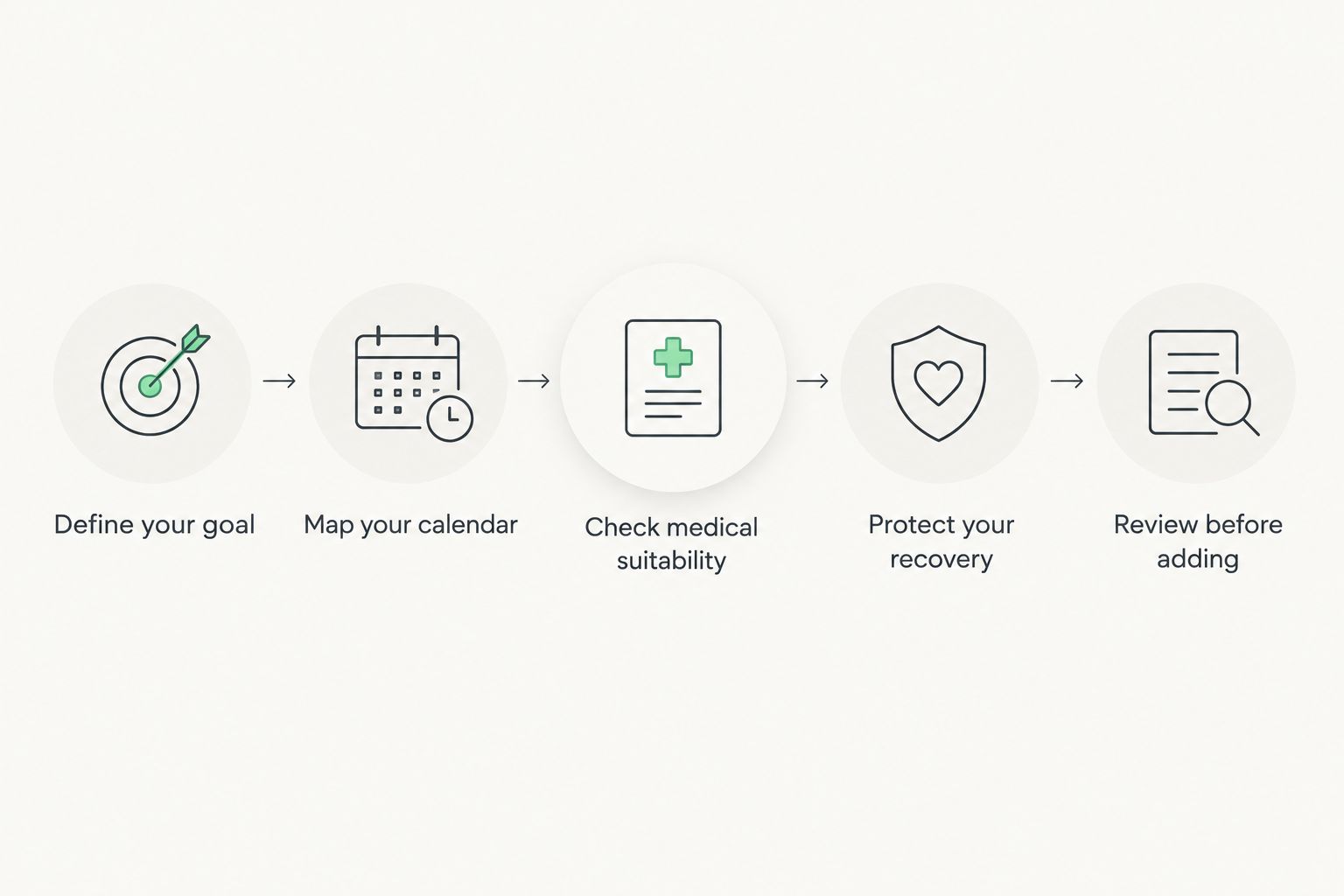
The planning sequence is simple: establish the goal, distinguish the treatment categories, check the calendar, assess suitability, and review the result. Keep those decisions separate so a wedding deadline does not substitute for clinical judgment.
Compare your bridal treatment options
The best option matches the concern and the time available. This comparison distinguishes treatment purposes, not individual suitability. A clinician must assess the proposed product, treatment area, and your medical history before recommending an injection.
| Option | Best for | Main advantage | Key limitation |
|---|---|---|---|
| No injections | Brides who want their current appearance or prefer to avoid injectable risks | Avoids injection-related recovery and complications | Does not create the changes sought from Botox or fillers |
| Botox | Brides whose assessed concern involves suitable expression lines | Targets selected muscle activity without adding volume | Does not replace lost volume; unwanted effects can include eyelid or brow drooping |
| Hyaluronic acid filler | Brides with a suitable volume or contour concern | Adds volume in an assessed treatment area | Can cause swelling, bruising, lumps, and rare serious vascular complications |
| Botox plus filler | Brides with separate, clinically suitable movement and volume concerns | Addresses different concerns within a coordinated plan | Adds procedures and requires separate risk discussions for each |
Hyaluronic acid filler is one filler category, not a description of every dermal filler. Ask what product the clinician proposes rather than assuming all fillers have the same properties. None of these options guarantees a particular photographic result.
Common mistakes brides make
Treating the wedding as a reason to start
A milestone is not a medical indication. If you were comfortable with your face before wedding planning, distinguish your own concern from pressure created by edited photographs or another person's treatment choices. Doing nothing remains a complete decision.
Scheduling around the ceremony only
Your earliest important event sets the practical deadline, not necessarily the wedding itself. Engagement photographs or travel can arrive first. Share the full calendar so the clinician can discuss recovery and review in the context of your actual plans.
Assuming filler is easily reversible
Some hyaluronic acid fillers can be treated with hyaluronidase, but that does not make reversal immediate, simple, or guaranteed. Other filler types are different. Do not use the possibility of reversal as permission to accept a result you are unsure about.
Hiding treatments from other providers
Your injector needs to know about recent and planned procedures, including treatments performed elsewhere. Separate appointments are still part of the same medical history. Bring the product names and treatment dates you have rather than relying on memory or the appearance of the result.
Waiting for a routine review despite warning signs
Unexpected severe pain, skin blanching or unusual discoloration, and vision changes after filler require urgent assessment. Vision changes are an emergency. Difficulty breathing, swallowing, or speaking after botulinum toxin treatment also requires immediate medical attention; do not wait for a scheduled cosmetic review.
FAQ
What’s the best approach to Botox for brides?
The best approach is an individual assessment followed by a plan that includes recovery and review before wedding events. Start with the concern you want addressed, and keep no treatment among the options.
Is Botox better than filler before a wedding?
Botox is not a substitute for filler, and filler is not a substitute for Botox. Botox targets selected muscle activity; fillers add volume or alter contour in suitable treatment areas.
How close to my wedding should I get Botox?
Set the treatment date with your clinician rather than using a universal bridal deadline. The plan should account for your treatment history, expected response, review appointment, travel, and earliest important event.
Should I try lip filler for the first time before my wedding?
A first-time lip filler decision needs a clinical assessment and enough time to evaluate an unfamiliar result. If the event is close or follow-up is difficult, postponing an elective treatment avoids adding injection-related uncertainty.
Can filler always be dissolved if I dislike it?
No, not every filler can be dissolved, and reversal is not guaranteed. Hyaluronic acid fillers can be treated with hyaluronidase in appropriate circumstances, but the process requires medical assessment and carries its own risks.
Can I get Botox or fillers while pregnant?
Discuss pregnancy or breastfeeding with a qualified clinician before considering an elective injectable. Botox Cosmetic labeling states that adequate data on developmental risk in pregnant women are not available; do not assume a cosmetic procedure is established as safe.
Where can Henderson brides discuss Botox and fillers?
Oasisbeauty offers Botox and filler services in Henderson, Nevada. Discuss your medical history, appearance goals, wedding calendar, and follow-up needs before deciding on treatment.
What symptoms after filler need urgent help?
Severe or unusual pain, skin blanching or discoloration, and vision changes after filler need urgent assessment. Vision changes require emergency medical care rather than waiting for the swelling to settle.
One last thing
Bring a short do-not-change list to your consultation. Include the expressions, features, and proportions that make your face feel like yours; then ask the clinician to explain how the proposed treatment respects those boundaries.
That list is more useful than collecting additional procedures. Your 2026 wedding plan should make room for informed consent, recovery, and review—not turn an optional cosmetic decision into a deadline-driven obligation.
This guide provides general education, not a diagnosis or an individual treatment schedule. A qualified clinician must assess your suitability for Botox or dermal fillers.