
Best overall starting point: standard microneedling assessment. Best for considering a PRP add-on: conventional microneedling with topical PRP. Best for discussing a heat-based alternative: radiofrequency microneedling. The best PRP microneedling treatments start with your skin concern and medical history—not a treatment package or a promise of younger-looking skin.
- The best PRP microneedling treatments require a diagnosis; adding platelet-rich plasma does not guarantee better skin rejuvenation.
- Standard microneedling is the starting comparison for texture and acne-scar consultations.
- Topical PRP adds blood collection and processing; ask what benefit justifies those additional steps.
- Oasisbeauty offers microneedling in Henderson for clients seeking cosmetic skin care.
- Radiofrequency microneedling adds heat and different risks; it is not interchangeable with conventional microneedling.
Why this matters
PRP means platelet-rich plasma, a preparation made from your own blood. Microneedling uses needles to create controlled skin injuries. Combining the two does not make them a single standardized treatment: the device, treatment depth, blood preparation, and application method all affect what you receive.
Oasisbeauty is a local microneedling option for Henderson residents seeking cosmetic skin care. You can explore Oasisbeauty as a starting point for that discussion; a microneedling service listing alone does not establish that a particular PRP protocol is offered.
For a 2026 treatment decision, distinguish the procedure's name from its evidence and safety requirements. The FDA has not cleared microneedling devices for use with PRP, meaning the agency has not reviewed the safety and effectiveness of that combination. That distinction belongs in your consent discussion.
What makes the best PRP microneedling treatment?
Use these criteria before comparing treatment names. A recommendation is useful only when it explains why the procedure fits your skin.
- Diagnosis first: Identify whether the concern is depressed acne scars, rough texture, fine lines, pigmentation, or something else. These are not interchangeable problems.
- Clear treatment method: Establish whether PRP is applied after needling, injected separately, or combined with another procedure. Ask whether the device also delivers heat.
- Relevant evidence: Request an explanation tied to your concern. Evidence about acne scars does not automatically establish benefits for every form of skin aging.
- Qualified clinical care: Ask who assesses your skin, who performs treatment, and who manages complications. A device name does not answer those questions.
- Infection control: Needling requires appropriate infection-control practices. PRP adds blood handling, processing, and identification requirements.
- Realistic aftercare: Get written instructions for cleansing, sun exposure, cosmetics, and concerning symptoms. Plan around recovery rather than assuming none is needed.
For your 2026 shortlist, favor a provider who explains the treatment you do not need as clearly as the treatment being recommended.
Skin rejuvenation treatments at a glance
These are different treatment approaches, not an efficacy leaderboard. Conventional microneedling provides the baseline comparison; topical PRP adds a blood-derived preparation, while radiofrequency introduces heat.
| Treatment approach | Best for | Standout feature | Key limitation |
|---|---|---|---|
| Standard microneedling | Establishing a baseline plan for texture or depressed acne scars | Controlled needling without PRP processing or radiofrequency energy | Not suitable for every skin condition; improvement is not guaranteed |
| Conventional microneedling with topical PRP | Discussing whether a PRP adjunct fits a specific scar-treatment plan | PRP is prepared from your blood and applied with the needling procedure | Additional blood-handling steps; FDA has not cleared the device-and-PRP combination |
| Radiofrequency microneedling | Evaluating a heat-based approach to selected skin concerns | Combines needles with radiofrequency energy | Different risk profile, including reported serious thermal complications; PRP is a separate decision |
Do not treat the third option as a stronger version of the second. Radiofrequency changes the procedure itself, while PRP changes what is added to it. You need a reason for each component.
1. Standard microneedling: best starting point for texture assessment
Conventional microneedling creates controlled punctures that trigger a skin-healing response. Certain FDA-cleared devices have indications involving wrinkles or scars; the specific device's labeling determines the authorized use.
Standard microneedling belongs first because it gives you a clear comparison before adding PRP. Ask what improvement the clinician expects from needling alone, then ask what the proposed adjunct changes.
Standard microneedling pros:
- Avoids the blood draw and processing required for PRP.
- Keeps the discussion focused on the device, skin concern, and treatment technique.
- Does not introduce radiofrequency energy.
- Provides a baseline against which to assess an additional procedure.
Standard microneedling cons:
- Redness, irritation, bleeding, and discomfort are possible.
- Infection, pigment changes, and scarring are recognized risks.
- It is not appropriate for every person or skin condition.
Best for: People seeking a clinical assessment of rough texture or depressed acne scars who want a reason before adding another treatment.
For Oasisbeauty microneedling, apply the same standard you would use anywhere: ask about the device, practitioner qualifications, suitability, and aftercare. Offering microneedling does not establish that every scar type or skin concern is a suitable indication.
Verdict: Hold until your clinician confirms the diagnosis and device suitability; use conventional microneedling as the starting comparison.
2. Microneedling with topical PRP: best for a focused adjunct discussion
Topical PRP treatment adds a blood draw and preparation step to conventional microneedling. The resulting plasma preparation is applied as part of the procedure; this differs from injecting PRP directly into tissue.
Published clinical literature has examined PRP as an adjunct to microneedling, including for atrophic acne scars. Different preparation and treatment methods limit how confidently you can transfer a study's results to a particular clinic's protocol.
Microneedling with topical PRP pros:
- Uses a blood-derived preparation from the person receiving treatment.
- Has been studied as an adjunct in acne-scar treatment.
- Allows a focused discussion about whether an adjunct addresses your diagnosed concern.
Microneedling with topical PRP cons:
- Requires blood collection and additional handling steps.
- Preparation methods vary, so the PRP label alone does not describe the treatment.
- Being made from your blood does not eliminate infection or procedural risks.
- FDA clearance of a microneedling device does not establish clearance of its use with PRP.
Best for: People with a clinician-confirmed concern, particularly atrophic acne scars, who want to evaluate the evidence and trade-offs of adding PRP.
For a 2026 PRP consultation, ask the clinician to describe the expected additional benefit without relying on before-and-after images alone. The answer should connect your scar type, the proposed protocol, and the limits of the evidence.
Verdict: Wait until the clinician explains why PRP belongs in your plan and documents the additional risks.
3. Radiofrequency microneedling: best for evaluating a heat-based option
Radiofrequency microneedling uses needles to deliver radiofrequency energy into tissue. It is a different procedure from conventional microneedling, not merely a different serum or finishing step.
PRP can appear in a proposed combination plan, but it does not remove the risks associated with radiofrequency energy. Decide whether radiofrequency treatment fits your concern before considering any adjunct.
Radiofrequency microneedling pros:
- Offers a heat-based treatment approach distinct from conventional needling.
- Makes treatment depth and energy settings part of the clinical plan.
- Gives you a separate option to discuss when the clinician identifies a relevant indication.
Radiofrequency microneedling cons:
- Adds thermal risks that conventional needling does not introduce in the same way.
- The FDA has reported serious complications, including burns, scarring, fat loss, disfigurement, and nerve damage.
- Requires a clear explanation of device selection, settings, and practitioner training.
Best for: People whose clinician recommends evaluating radiofrequency for a specific concern and explains why conventional needling is not the preferred approach.
Do not choose radiofrequency microneedling because a package includes PRP. Ask what the radiofrequency component is intended to accomplish and how the clinician manages its risks.
Verdict: Skip a heat-based upgrade without a clear clinical rationale; assess radiofrequency separately from PRP.
How these approaches were ranked
This ranking follows treatment complexity and decision clarity, not invented success rates. Conventional microneedling establishes the baseline, topical PRP adds an adjunct decision, and radiofrequency adds a different energy-based procedure.
The criteria are diagnosis, treatment method, relevant evidence, clinical qualifications, infection control, and aftercare. No approach wins for every skin concern, and no clinic-specific outcomes are claimed here.
For this 2026 guide, the safety references are FDA patient information on microneedling devices and radiofrequency microneedling, plus American Academy of Dermatology patient guidance. Device labeling and your clinician's assessment remain essential to an individual decision.
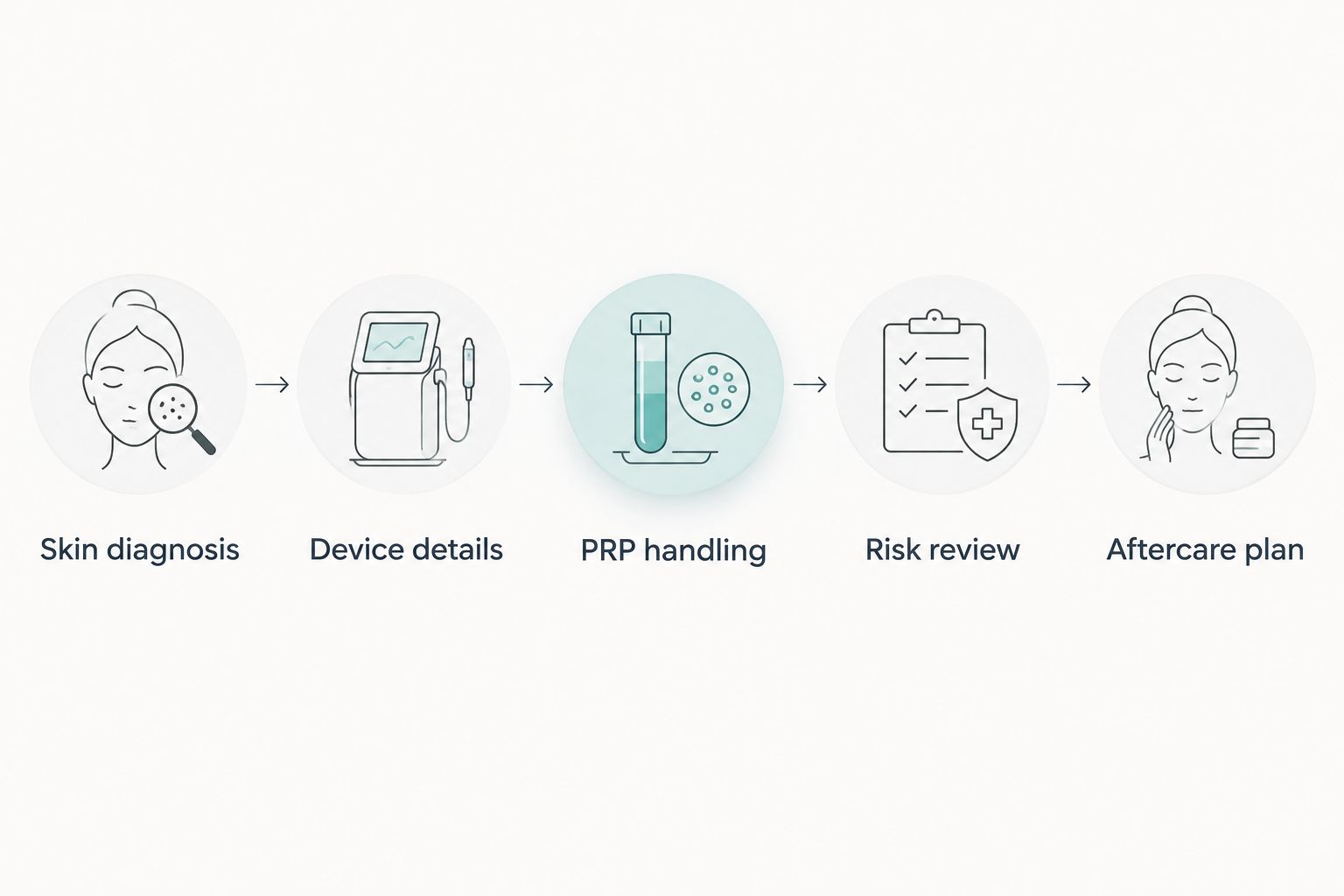
What to ask before agreeing to treatment
Bring a short checklist rather than asking only whether a treatment is good. Each answer should describe your proposed procedure, not the category in general.
- Skin diagnosis: What exactly are you treating, and which concerns will this procedure not address?
- Device details: What device will you use, and does its labeling cover the proposed use?
- PRP handling: How is my blood identified, processed, and kept separate from other patients' samples?
- Risk review: Which aspects of my medical history change suitability or recovery?
- Aftercare plan: What should I use, avoid, and report after treatment?
A clear plan separates these decisions instead of folding them into a package. You should know whether the recommendation is for conventional needling, PRP, radiofrequency, or a combination—and why each part is included.
Recovery and eligibility details that deserve attention
The FDA describes authorized microneedling uses for patients 22 years and older, depending on the device and indication. That is not a blanket eligibility rule for every procedure marketed as microneedling. Ask your clinician to explain the actual device labeling.
American Academy of Dermatology patient guidance advises waiting 24 hours before applying makeup after microneedling. Follow your clinician's written instructions when they require a longer pause or additional precautions.
For routine sun protection, the American Academy of Dermatology recommends broad-spectrum, water-resistant sunscreen with SPF 30 or higher. Immediately treated skin also needs procedure-specific guidance about which products to apply and when.
Tell the clinician about active skin infections, cold sores, medications, bleeding problems, healing difficulties, and previous abnormal scars. Do not stop prescribed medication on your own. Ask what worsening pain, spreading redness, drainage, or other concerning symptoms require prompt clinical attention.
Which skin rejuvenation treatment should you choose?
Choose an assessment before choosing PRP. If your main concern is texture or depressed acne scars, conventional microneedling is the starting comparison; require a specific explanation before adding topical PRP or switching to radiofrequency.
Oasisbeauty offers microneedling for cosmetic skin care in Henderson. Evaluate that service through the same questions about diagnosis, device suitability, risks, and follow-up—not assumptions about an unlisted PRP protocol.
Explore your microneedling options
Review the practice before discussing your skin concerns and treatment suitability.
FAQ
What’s the best PRP microneedling treatment for skin rejuvenation?
The best choice starts with a clinical diagnosis and a comparison with conventional microneedling alone. Topical PRP is an adjunct to discuss, not a guarantee of better results.
Is PRP microneedling better than regular microneedling?
PRP microneedling is not established as better for every skin concern. Research has examined adjunctive PRP for atrophic acne scars, but differing protocols limit blanket claims about skin rejuvenation.
Is PRP microneedling FDA-approved?
The FDA has not cleared microneedling devices for use with PRP. A device’s clearance for a particular indication does not establish clearance of the combined procedure.
What’s the difference between topical and injected PRP?
Topical PRP is applied to the skin as part of a treatment, while injected PRP is placed into tissue through injections. Ask which route is proposed because the procedures and consent discussions differ.
Is radiofrequency microneedling the same as PRP microneedling?
No. Radiofrequency microneedling delivers radiofrequency energy through needles; PRP is a blood-derived preparation added to a treatment. A plan combining them requires separate explanations for both components.
Can I wear makeup after microneedling?
American Academy of Dermatology guidance advises waiting 24 hours before applying makeup after microneedling. Follow your clinician’s instructions if your procedure requires a longer interval.
Does Oasisbeauty offer microneedling in Henderson?
Oasisbeauty offers microneedling in Henderson, Nevada. Ask the practice about the proposed technique, device, suitability, and whether any PRP adjunct is part of its current treatment options.
One last thing
Your own blood does not make PRP a risk-free treatment. Blood collection, processing, skin puncture, and any added energy each need their own safety controls.
Before your 2026 treatment, ask for a plain-language description of the procedure with the PRP component removed. If you cannot explain what the underlying microneedling treatment does—or why the adjunct is being added—you are not ready to consent to the combination.