
Best starting treatment: a topical retinoid. Best hormone-targeted option for appropriate patients: spironolactone. Best nonprescription add-on: benzoyl peroxide. This 2026 guide compares the best treatments for hormonal acne and separates prescription acne care from the cosmetic treatments offered by Oasisbeauty.
- The best treatments for hormonal acne address clogged pores, inflammation, and, when appropriate, hormonal drivers.
- Topical retinoids are a practical foundation for acne treatment; spironolactone targets androgen-related breakouts in appropriate patients.
- Benzoyl peroxide helps inflammatory acne but does not change hormone activity.
- Oasisbeauty offers cosmetic aesthetic care; prescription acne management belongs with a qualified medical clinician.
- Deep, painful acne or developing scars warrants a dermatologist appointment rather than another cosmetic treatment.
Why this matters
Hormonal acne is not a diagnosis you can confirm from a jawline photograph. Breakouts that fluctuate with your menstrual cycle suggest a hormonal contribution, but location alone does not identify the cause. Acne also involves blocked follicles, inflammation, and bacteria.
The right treatment addresses the problem you actually have. A prescription that reduces androgen effects serves a different purpose from an ingredient that clears blocked pores. Neither is interchangeable with treatment for a scar left after a breakout.
For your 2026 treatment plan, distinguish active acne from flat discoloration and depressed scars. They need different approaches. Treat ongoing breakouts before making cosmetic scar correction your priority.
What makes the best hormonal acne treatment?
- Acne control: Does the treatment address clogged pores, inflamed pimples, or deep nodules?
- Hormone targeting: Does it affect androgen activity, or mainly treat the skin consequences?
- Safety fit: Is it appropriate for your medical history, medications, and pregnancy plans?
- Tolerability: Can you use it consistently without persistent irritation or unacceptable side effects?
- Scar prevention: Is the treatment sufficient for the severity of your acne, or do you need specialist care?
Choose by these criteria rather than by the strongest-sounding ingredient. A treatment you cannot tolerate is not a useful maintenance plan, and a gentle routine alone is not enough for severe nodular acne.
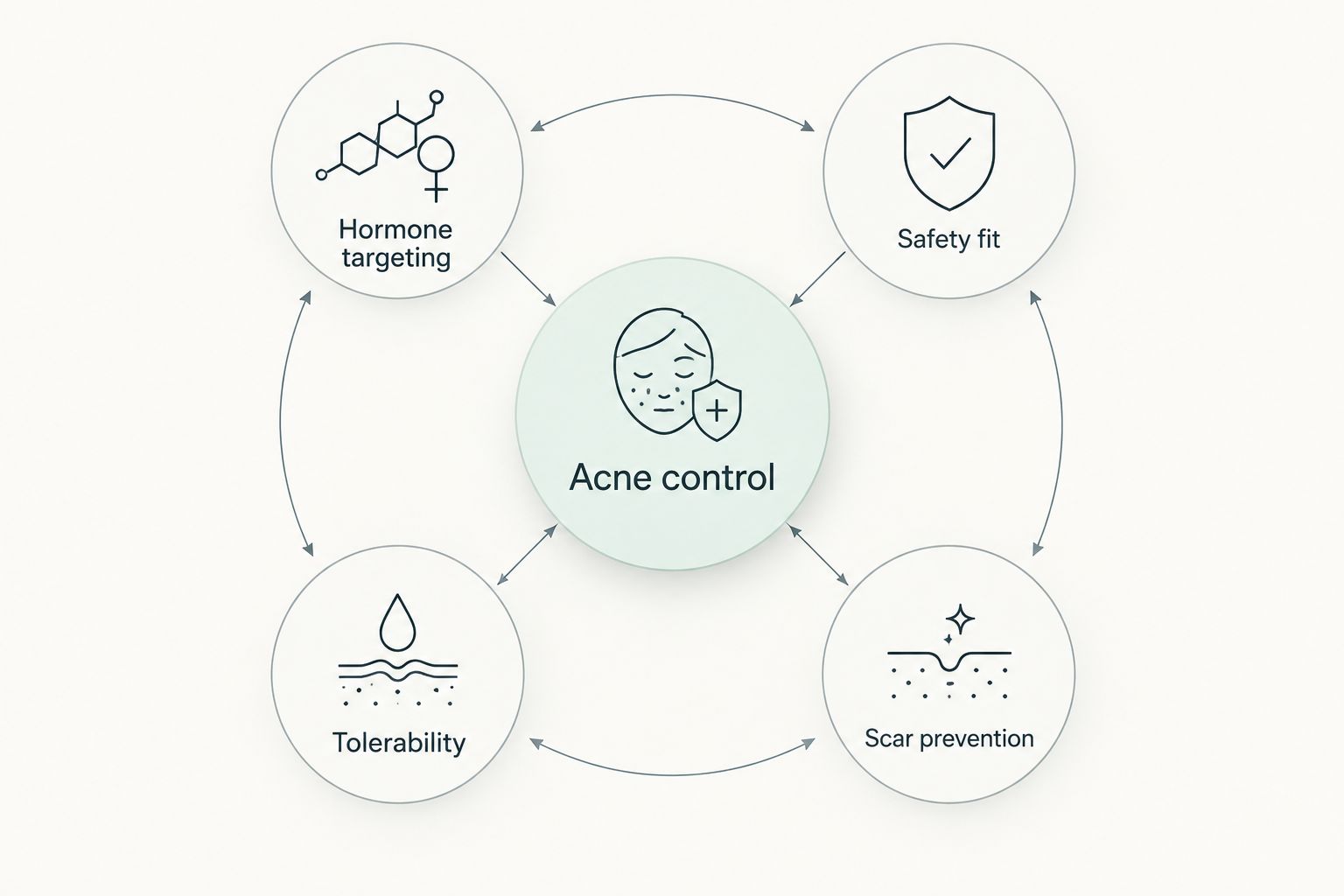
Best treatments for hormonal acne at a glance
The ranking below assigns each treatment a different job. It is not a ladder you must climb: severe acne, pregnancy plans, and medical contraindications can change the starting point.
| Treatment | Best for | Standout role | Key limitation |
|---|---|---|---|
| Topical retinoids | A foundation for clogged pores and recurring acne | Normalize follicle shedding and help prevent new blockages | Irritation; generally avoided during pregnancy |
| Spironolactone | Persistent androgen-related acne in appropriate female patients | Reduces androgen effects | Prescription assessment and medical precautions required |
| Combined oral contraceptives | Appropriate patients wanting contraception and acne treatment | Reduce androgen-related stimulation | Estrogen-containing contraception is unsuitable for some patients |
| Benzoyl peroxide | An add-on for inflammatory pimples | Reduces acne-associated bacteria without antibiotic resistance | Dryness, irritation, and fabric bleaching |
| Azelaic acid | Acne with lingering dark marks | Addresses acne and post-inflammatory pigmentation | Often insufficient alone for deep nodular acne |
| Isotretinoin | Severe, scarring, or treatment-resistant acne | Treats multiple acne pathways, including oil production | Strict pregnancy precautions and clinician monitoring |
1. Topical retinoids: best foundation for recurring hormonal acne
Topical retinoids help keep follicles from becoming blocked and treat both comedonal and inflammatory acne. They do not lower your hormone levels. Their value is preventing the skin-level blockages that allow new breakouts to form.
Adapalene, tretinoin, and other topical retinoids differ in formulation and prescribing requirements. Adapalene 0.1% is available without a prescription in the United States. That does not make it suitable for everyone or eliminate the need for medical advice.
Topical retinoid pros:
- Treat blackheads and whiteheads as well as inflammatory acne.
- Support ongoing prevention rather than spot treatment alone.
- Can be combined with other acne medicines under an appropriate plan.
Topical retinoid cons:
- Can cause dryness, peeling, and irritation, particularly when introduced too quickly.
- Are generally avoided during pregnancy; discuss pregnancy plans before starting.
Best for: You have recurring acne with clogged pores and need a maintenance foundation.
Use a topical retinoid according to its label or your prescriber's instructions. Introducing several exfoliating products at the same time makes irritation harder to identify. Moisturizer and sunscreen support the routine; they do not replace the acne medicine.
Verdict: Choose a topical retinoid as the foundation when it fits your medical situation.
2. Spironolactone: best hormone-targeted option for persistent acne
Spironolactone reduces androgen effects and is prescribed off-label for acne in appropriate female patients. It is especially relevant when persistent breakouts have a hormonal pattern. A clinician still needs to assess your symptoms rather than assuming every lower-face breakout is hormonal.
It treats a different part of the problem from a topical retinoid. Your prescriber can combine the two when both hormone-related activity and follicle blockage need attention.
Spironolactone pros:
- Directly addresses androgen effects involved in acne.
- Offers a non-antibiotic systemic treatment option.
- Can complement a topical maintenance routine.
Spironolactone cons:
- Can cause menstrual changes, breast tenderness, dizziness, and increased urination.
- Requires review of pregnancy risk, kidney health, potassium-related risks, and interacting medicines.
Best for: You have persistent acne and your clinician identifies you as an appropriate candidate for antiandrogen treatment.
Spironolactone is not appropriate during pregnancy. Tell your prescriber about supplements and other medicines, including anything affecting potassium. Whether you need blood testing depends on your health history and clinical assessment.
Verdict: Choose spironolactone through a prescriber when androgen-targeted treatment fits.
3. Combined oral contraceptives: best for acne plus contraception
Certain combined oral contraceptives have FDA approval for acne in eligible patients. These medicines contain estrogen and a progestin and can reduce androgen-related stimulation. Not every birth-control method has the same effect on acne.
This option makes sense when contraception is also one of your goals. It is not a reason to take estrogen-containing medication without a review of your personal risks.
Combined oral contraceptive pros:
- Address acne and contraception within one treatment plan.
- Can reduce androgen-related acne activity.
- Can be used alongside topical treatment when medically appropriate.
Combined oral contraceptive cons:
- Increase blood-clot risk and are unsuitable with certain medical histories.
- Require screening for factors such as migraine with aura, smoking, and cardiovascular risk.
Best for: You want contraception and acne treatment, and a clinician confirms that combined hormonal contraception is appropriate.
For a 2026 medication review, bring the exact name of your current contraceptive. Switching methods solely because of an online acne recommendation skips the safety assessment that determines whether the change is appropriate.
Verdict: Choose a combined oral contraceptive when both treatment goals and medical eligibility align.
4. Benzoyl peroxide: best nonprescription add-on for inflamed pimples
Benzoyl peroxide reduces acne-associated bacteria and helps treat inflammatory lesions. Unlike antibiotics, it does not promote bacterial antibiotic resistance. It does not suppress androgen activity, so it is an add-on rather than a hormone-targeting treatment.
You can find it in washes and leave-on products. The formulation and frequency should fit your skin's tolerance and the rest of your routine.
Benzoyl peroxide pros:
- Helps inflammatory pimples without requiring an antibiotic.
- Is available in nonprescription formulations.
- Has an important role in regimens that include acne antibiotics.
Benzoyl peroxide cons:
- Can cause dryness, irritation, or contact dermatitis.
- Can bleach towels, pillowcases, and clothing.
Best for: You need an accessible add-on for red, inflamed pimples rather than treatment for hormone activity itself.
Benzoyl peroxide products commonly include 2.5% formulations. A higher concentration is not automatically the right choice for your skin. Follow the product instructions, and avoid layering multiple drying treatments without a clear plan.
Verdict: Choose benzoyl peroxide for inflammatory acne support; do not expect it to correct hormonal drivers.
5. Azelaic acid: best for acne with lingering dark marks
Azelaic acid treats acne and can improve post-inflammatory hyperpigmentation: the flat dark marks left after inflammation settles. Those marks are not the same as indented scars. Keeping that distinction clear prevents you from expecting a topical ingredient to rebuild scarred tissue.
Azelaic acid can be useful when acne control and uneven pigmentation are both priorities. It can still sting or irritate sensitive skin.
Azelaic acid pros:
- Addresses acne and post-inflammatory dark marks.
- Offers a non-antibiotic topical option.
- Provides an alternative when a different acne ingredient is poorly tolerated.
Azelaic acid cons:
- Can cause burning, stinging, or irritation.
- Is not a substitute for systemic treatment of severe nodular acne.
Best for: You have acne alongside flat dark marks and need a treatment plan addressing both.
Protecting your skin from ultraviolet exposure matters when treating pigmentation. Do not confuse improvement in discoloration with control of deep breakouts; track those outcomes separately.
Verdict: Choose azelaic acid when acne and post-inflammatory pigmentation overlap.
6. Isotretinoin: best for severe or treatment-resistant acne
Isotretinoin is an oral prescription medicine used for severe acne and other appropriate cases, including acne that fails standard treatment. It reduces oil production and addresses multiple acne pathways. It belongs in dermatologist-led care, not a self-directed skincare experiment.
Scarring changes the decision. Continuing to rotate cosmetic products while new scars form delays the assessment your skin needs.
Isotretinoin pros:
- Treats severe acne beyond the reach of a topical routine alone.
- Can produce prolonged improvement after a treatment course.
- Provides an option when appropriate standard treatments have failed.
Isotretinoin cons:
- Causes serious birth defects and requires strict pregnancy precautions.
- Commonly causes dryness and requires clinical monitoring and risk counseling.
Best for: You have severe, scarring, or treatment-resistant acne that warrants specialist evaluation.
In the United States, isotretinoin prescribing operates through the iPLEDGE risk-management program. Your dermatologist explains the applicable requirements and monitoring. Do not borrow capsules or reuse an old prescription.
Verdict: Seek an isotretinoin assessment when severity or scarring makes routine treatment insufficient.
How the treatments are ranked
This 2026 ranking uses treatment role, safety fit, tolerability, and suitability for acne severity. It is not a head-to-head trial or a claim that one medicine wins for every patient. The treatment roles reflect American Academy of Dermatology acne guidance and FDA medication labeling.
Topical retinoids lead because they provide a practical foundation for recurring acne. Hormonal prescriptions follow for specific candidates. Isotretinoin appears last because its specialist role is distinct, not because it is weaker.
Which hormonal acne treatment should you choose?
Start with the severity of your acne, not the number of products in your bathroom. For mild recurring acne, discuss a topical foundation and an appropriate inflammatory-acne add-on. Persistent cycle-linked breakouts justify asking about hormonal treatment.
Arrange medical assessment promptly for painful deep lesions, new scars, or acne accompanied by irregular periods or increased facial hair. Those accompanying symptoms warrant evaluation rather than an assumption that cosmetic skincare will solve the problem.
Acne treatment usually needs consistent use before you can judge the result. An 8–12 week review is a common checkpoint, although some treatments need longer. Worsening scarring or significant side effects are reasons to contact your clinician sooner.
Keep your 2026 routine simple enough to assess. Record the treatment start date, tolerability, and whether new lesions are decreasing. Changing every product at once makes it difficult to identify what helps.
Where cosmetic care fits
Oasisbeauty is a Henderson, Nevada med spa offering skin, body, and wellness treatments, including microneedling. Cosmetic care and prescription treatment have different jobs.
Oasisbeauty is best suited to readers seeking med-spa cosmetic care, not a substitute for prescription acne management. Ask whether a proposed aesthetic procedure is appropriate for your current skin condition. Microneedling is generally avoided over active inflammatory acne.
FAQ
What’s the best treatment for hormonal acne in 2026?
A topical retinoid is a practical foundation, while spironolactone is a hormone-targeted option for appropriate patients. The best choice depends on acne severity, medical history, and pregnancy plans.
Is spironolactone better than a topical retinoid?
Spironolactone and topical retinoids address different acne mechanisms, so neither is universally better. Spironolactone reduces androgen effects, while topical retinoids help prevent blocked follicles; a clinician can prescribe them together when appropriate.
Can I treat hormonal acne without a prescription?
Nonprescription adapalene and benzoyl peroxide can help some mild acne, but they do not directly suppress hormonal activity. Persistent, deep, painful, or scarring acne needs medical assessment.
How long should I try an acne treatment before changing it?
An 8–12 week review is a common checkpoint for acne treatment, although some medicines need longer. Contact your clinician earlier for significant side effects, worsening deep lesions, or new scars.
Does jawline acne mean I have a hormone problem?
Jawline acne alone does not prove a hormonal disorder. Cycle-related flares can suggest a hormonal contribution, while irregular periods or increased facial hair are reasons to discuss further evaluation.
Can I use hormonal acne medicines during pregnancy?
Do not start or continue an acne medicine during pregnancy without checking its safety with your clinician. Isotretinoin is contraindicated, spironolactone is inappropriate, and topical retinoids are generally avoided.
Is microneedling a treatment for active hormonal acne?
Microneedling is not a first-line treatment for active hormonal acne and is generally avoided over active inflammatory lesions. Control breakouts first, then discuss whether a procedure is appropriate for residual scarring.
When should I see a dermatologist for hormonal acne?
See a dermatologist for deep painful acne, developing scars, or acne that persists despite an appropriate treatment trial. Seek evaluation sooner when breakouts accompany other symptoms suggesting an underlying hormonal condition.
One last thing
A flat brown mark, an indented scar, and an active pimple can sit beside one another, but they are not the same treatment target. Before adding a procedure or another ingredient, identify which problem you are trying to change.
For your 2026 plan, make preventing the next deep breakout the priority over polishing the mark left by the last one. That keeps active acne management separate from cosmetic aftercare and gives each treatment a clear job.