Best overall: a professionally selected laser with cooling and a test spot. Best for darker skin: long-pulsed Nd:YAG. Best for light-to-medium skin: an appropriately selected diode laser. Best for very fair skin with dark hair: alexandrite. The best laser hair removal for sensitive skin in 2026 matches your skin tone, hair pigment, and current skin condition—not just your tolerance for discomfort.
- The best laser hair removal for sensitive skin starts with skin assessment, cooling, and a test spot.
- Long-pulsed Nd:YAG is the strongest starting option for darker skin with dark hair.
- Diode and alexandrite suit different skin tones; neither is automatically gentler because of its name.
- Oasisbeauty offers laser hair removal in Henderson, Nevada, for clients seeking cosmetic and aesthetic care.
Why this matters
Sensitive skin is not a single diagnosis. You can have easily irritated skin, eczema, contact allergies, or persistent redness, and those conditions require different treatment decisions. A laser choice cannot replace an assessment of what is causing your sensitivity.
Oasisbeauty is best for Henderson clients seeking a local laser hair removal service rather than an at-home device. You can explore Oasisbeauty before discussing treatment suitability; this guide compares laser categories, not the equipment used at the practice.
Laser energy targets pigment in hair. Skin also contains pigment, so a treatment must balance follicle heating against unwanted skin heating. Cooling helps protect the skin surface, but it does not make an unsuitable wavelength or aggressive setting safe.
For your 2026 treatment decision, start with skin tone and skin health. Comfort comes next—not because it is unimportant, but because a comfortable sensation alone does not establish safety.
What makes the best laser hair removal for sensitive skin?
A useful ranking needs criteria you can check during a consultation. These matter more than a device's marketing name:
- Skin-tone fit: The wavelength must suit your natural pigmentation and account for any recent tanning.
- Hair-pigment fit: Dark hair provides a clearer target than white, gray, or very light hair.
- Skin-condition screening: Active irritation, infection, or a flare requires assessment before treatment.
- Settings and cooling: Energy, pulse duration, and cooling must work together for the treatment area.
- Test-spot planning: A small-area test helps assess skin response before treating a larger area.
- Operator judgment: The person treating you must recognize unsuitable skin conditions and unexpected reactions.
Choose the treatment plan before choosing the machine. A well-known laser operated with inappropriate settings is not a sensitive-skin solution.
Ask how the provider evaluates your skin, selects settings, and handles an adverse reaction. A clear explanation is more useful than a promise that treatment is painless or suitable for everyone.
Sensitive-skin laser options at a glance
This 2026 comparison ranks starting options by skin-tone use case. It does not establish that any treatment is appropriate for your individual skin or that a particular device is offered by Oasisbeauty.
| Laser category | Best for | Standout feature | Key limitation |
|---|---|---|---|
| Long-pulsed Nd:YAG | Darker skin with dark hair | 1,064 nm wavelength has lower melanin absorption than alexandrite | Still requires suitable settings and cooling; weak choice for lightly pigmented hair |
| Diode | Light-to-medium skin with dark, coarse hair | Common systems operate around 800–810 nm | Suitability varies with the device, settings, and skin pigmentation |
| Alexandrite | Very fair skin with dark hair | 755 nm wavelength strongly targets melanin | Greater concern about competing skin pigment in darker or tanned skin |
Wavelength describes the light emitted; it does not measure how gentle a session will feel. These established laser-category specifications explain why the options serve different skin tones. They are not specifications for any device at Oasisbeauty.
Match skin tone before comparing comfort
Use the categories Darker skin, Light-to-medium skin, and Very fair skin as conversation starters, not self-diagnoses. Your provider must also consider tanning, pigmentation changes, hair characteristics, and the area being treated.
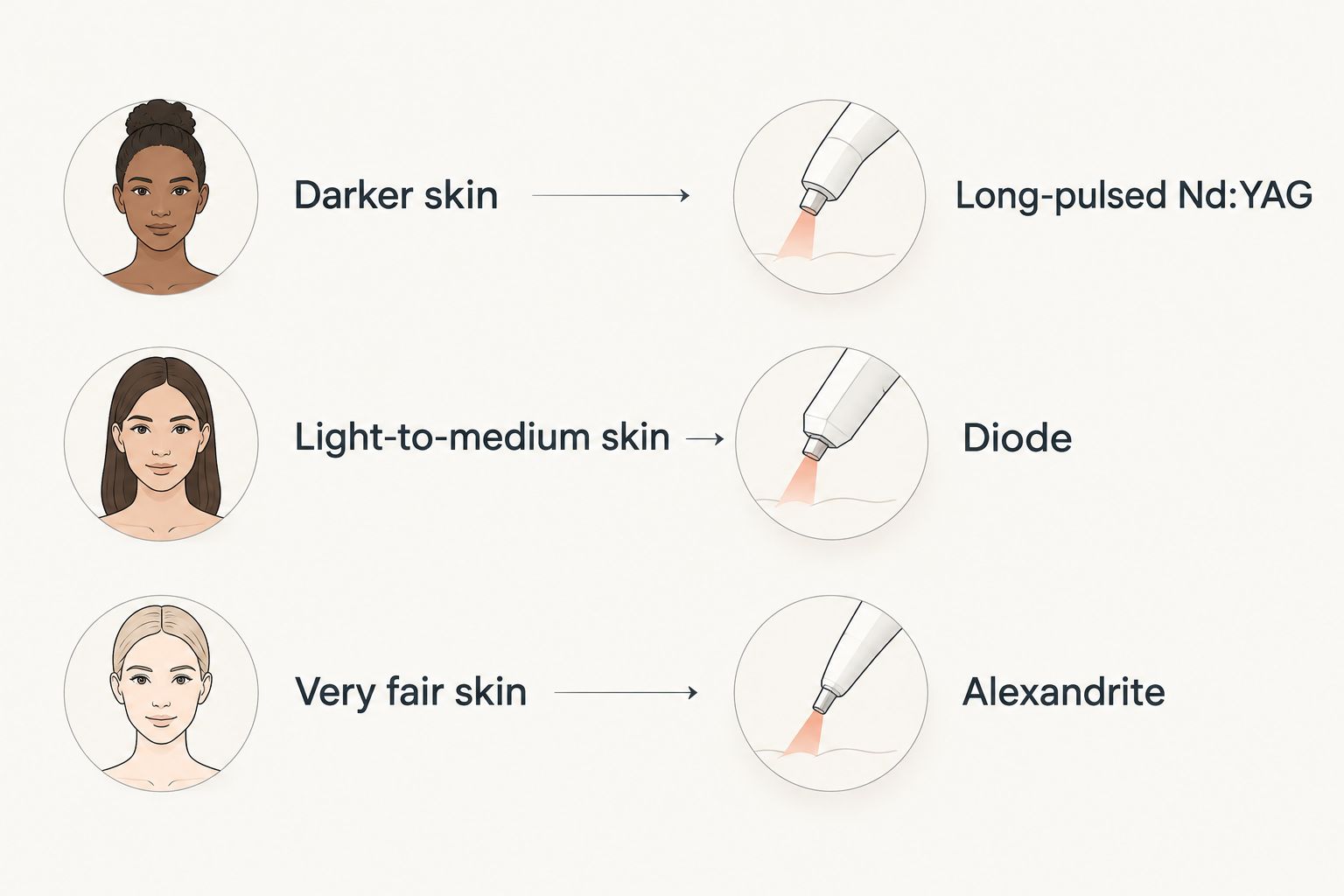
The diagram is not permission to book a laser solely from your skin color. Someone with active dermatitis needs that condition assessed even when the wavelength otherwise matches their pigmentation.
1. Long-pulsed Nd:YAG: best for darker sensitive skin
Long-pulsed Nd:YAG uses a 1,064 nm wavelength. Compared with shorter-wavelength hair-removal lasers, its lower melanin absorption helps reduce competition between pigment in the skin and pigment in the hair.
That makes long-pulsed Nd:YAG the strongest starting discussion for darker skin with dark hair. It is not a guarantee against burns, pigment changes, or irritation. Treatment settings and the operator's experience remain essential.
Long-pulsed Nd:YAG pros:
- Offers a wavelength commonly used for hair removal in darker skin.
- Reduces epidermal pigment competition compared with alexandrite.
- Provides an option for dark, coarse hair when shorter wavelengths are unsuitable.
Long-pulsed Nd:YAG cons:
- Treatment can still feel uncomfortable despite cooling.
- Lightly pigmented hair remains a poor laser target.
- Inappropriate settings can still cause burns or pigmentation changes.
Best for: Darker skin with dark hair, after assessment of current skin health and tanning history.
Ask whether the provider regularly treats your skin tone with long-pulsed Nd:YAG. Also ask how cooling is delivered and what response the provider expects from a test spot.
Do not confuse long-pulsed Nd:YAG hair removal with other treatments that use the Nd:YAG name. The laser medium alone does not identify the pulse type or treatment purpose.
Verdict: Buy only after a clinician confirms long-pulsed Nd:YAG fits your skin and hair.
2. Diode: best for light-to-medium sensitive skin with coarse hair
Diode hair-removal systems commonly operate around 800–810 nm, although devices vary. They target hair pigment and are used across a range of skin tones when the specific system and settings are appropriate.
For light-to-medium skin with dark, coarse hair, diode is a useful middle-ground option to discuss. Do not assume all diode devices behave identically: wavelength configuration, pulse delivery, and cooling differ.
Diode pros:
- Suits many light-to-medium skin and dark-hair combinations.
- Offers a treatment category suited to pigmented, coarse hair.
- Allows the provider to tailor settings to the treatment area and skin response.
Diode cons:
- The word diode alone does not establish suitability for darker skin.
- Heat and temporary irritation remain possible.
- Blonde, gray, white, or very fine hair can respond poorly.
Best for: Light-to-medium skin with dark, coarse hair, particularly when a clinician identifies diode as the appropriate wavelength option.
During a 2026 consultation, ask which diode system is used and why it fits your pigmentation. A provider should explain the choice in terms of your skin and hair—not simply call the device gentle.
If your skin reacts to skincare products, mention the products and the type of reaction. Product sensitivity does not automatically rule out laser, but it gives the clinician relevant information about your skin history.
Verdict: Buy after a suitable test spot and a clear explanation of the device choice.
3. Alexandrite: best for very fair sensitive skin with dark hair
Alexandrite hair-removal lasers use a 755 nm wavelength. Strong melanin absorption makes this category useful when dark hair contrasts clearly with very fair skin.
That same pigment interaction creates a limitation. More pigment in the skin, including a tan, increases concern about unwanted skin heating. Sensitive skin does not erase that wavelength-related distinction.
Alexandrite pros:
- Provides a strong pigment target when dark hair contrasts with very fair skin.
- Offers a well-established professional hair-removal category.
- Gives suitable fair-skinned clients another option to compare with diode.
Alexandrite cons:
- Is not the default choice for darker skin.
- Requires careful assessment of tanning and pigmentation.
- Can still cause discomfort, irritation, burns, or pigment changes.
Best for: Very fair, untanned skin with dark hair, provided the skin is healthy enough for treatment.
Ask why alexandrite is preferred over diode for your particular area. The answer should account for hair thickness, pigmentation, cooling, and your history of skin reactions.
Do not interpret a strong hair-to-skin contrast as automatic clearance. Active eczema, broken skin, or an unexplained rash still needs assessment before the appointment proceeds.
Verdict: Buy for an appropriate fair-skin match; skip when tanning or skin health makes treatment unsuitable.
How these laser options are ranked
The ranking prioritizes skin-tone fit, followed by hair suitability, skin-condition screening, cooling, and operator judgment. It is a category-based buying guide, not a device trial or a comparison of local providers.
Long-pulsed Nd:YAG leads for darker skin because its wavelength reduces melanin competition relative to alexandrite. Diode takes the light-to-medium skin slot. Alexandrite takes the very-fair-skin slot where dark hair creates clear contrast.
No laser wins every sensitive-skin use case. The strongest recommendation is the option that matches your pigmentation and passes a clinical suitability assessment.
What to check before booking treatment
A good 2026 consultation should end with a clear plan, not pressure to commit. Bring your skincare and medication information, and describe previous reactions in plain terms.
Skin history
Explain whether your sensitivity means itching, burning, swelling, eczema, or persistent redness. Mention previous burns or pigment changes after cosmetic procedures. Specific symptoms help the clinician assess risk more accurately than the label sensitive skin.
Current exposure
Disclose recent sun exposure, tanning, and self-tanner use. Ask how those affect scheduling. Do not assume that skin which looks normal today has returned to its usual treatment suitability.
Test spot
Ask where the test spot will be placed and how its response will be assessed. A reassuring immediate reaction does not rule out a delayed problem. Follow the provider's observation instructions before committing to a larger area.
Aftercare
Request written instructions covering cleansing, skincare products, sun protection, and when to seek help. Ask what symptoms are expected and which require contacting the provider. Do not improvise with strong exfoliants on freshly treated skin.
You should also know who to contact after treatment. Severe or increasing pain, blistering, or signs of infection require medical assessment rather than reassurance from an online guide.
Which laser hair removal should you choose?
Choose long-pulsed Nd:YAG as the starting discussion for darker skin, diode for light-to-medium skin, and alexandrite for very fair skin with dark hair. Then let skin health, tanning history, and a test spot determine whether to proceed.
For an undecided reader, the default is not a particular machine. It is a professional assessment that explains the wavelength choice, cooling method, and reaction-monitoring plan.
If you have an active rash, an eczema flare, or broken skin in the treatment area, hold the purchase and get assessed first. If your hair is white, gray, or very light, ask about suitability before paying for a laser course.
Explore local laser hair removal
Review Oasisbeauty’s Henderson aesthetic services before discussing treatment suitability.
FAQ
What’s the best laser hair removal for sensitive skin?
The best laser hair removal for sensitive skin is a professionally selected treatment matched to your pigmentation, hair, and current skin health. Long-pulsed Nd:YAG, diode, and alexandrite serve different skin-tone profiles; cooling and a test spot are important parts of the decision.
Is Nd:YAG better than diode for darker sensitive skin?
Long-pulsed Nd:YAG is generally the stronger starting option for darker skin because its wavelength has lower melanin absorption than shorter-wavelength alternatives. The clinician must still assess the specific device, settings, hair, and skin condition.
Does sensitive skin mean I can’t get laser hair removal?
Sensitive skin does not automatically exclude laser hair removal. Active irritation, eczema, infection, or unexplained redness requires assessment before the treatment area is exposed to laser energy.
Is laser hair removal painless when the skin is cooled?
Cooling does not guarantee painless laser hair removal. It helps protect the skin surface, but discomfort depends on the treatment area, hair characteristics, device, and settings.
Can I get laser hair removal during an eczema flare?
Do not proceed over actively flaring eczema without clinical assessment. Inflamed or broken skin changes the treatment decision, even when the proposed laser suits your skin tone.
Is IPL the same as laser hair removal?
IPL is not a laser; it uses a broad spectrum of light rather than a laser’s specific wavelength. Sensitive-skin suitability still depends on pigmentation, the device, settings, and the operator.
Will laser hair removal work on gray or white hair?
Gray and white hair are poor targets for pigment-based laser hair removal. Ask about another hair-removal approach rather than assuming a different laser wavelength will solve the lack of pigment.
One last thing
The sensation of a test spot is not the same as its safety result. Ask what skin changes to watch for afterward and when the provider wants to review them.
For sensitive skin in 2026, that follow-up instruction is more useful than a promise of zero discomfort. Choose the provider who explains when to stop—not just when to book.