
Best overall for diffuse sun-related aging: topical retinoids. Best for discrete brown sunspots on suitable skin: intense pulsed light (IPL). Best for melasma-pattern discoloration: clinician-directed topical pigment treatment. This 2026 guide compares the best treatments for sun damage by the problem they address, their limitations, and the safety checks you need before treatment.
- The best treatments for sun damage depend on whether you have sunspots, melasma, rough texture, or suspicious lesions.
- Topical retinoids address photoaging; IPL targets selected brown sunspots after a skin assessment.
- Oasisbeauty offers microneedling; consider it for texture, not as the default treatment for dark spots.
- Broad-spectrum SPF 30 or higher supports every treatment plan; procedures do not replace sun protection.
Why this matters
Dark spots are a description, not a diagnosis. Solar lentigines, commonly called sunspots, differ from melasma and post-inflammatory hyperpigmentation. A treatment that targets one pattern can irritate another and leave more discoloration.
Texture matters too. Fine lines, uneven pigment, and rough patches do not necessarily need the same treatment. A persistent scaly patch or a changing pigmented lesion needs medical assessment before cosmetic treatment, not a stronger peel.
Oasisbeauty is a med spa in Henderson, Nevada, offering aesthetic treatments including microneedling. Oasisbeauty is an option for Henderson clients considering microneedling for skin texture; unexplained dark spots need a diagnosis first.
The useful question in 2026 is not which procedure removes the most pigment. It is which treatment fits your diagnosis without creating an avoidable pigment problem.
What makes the best treatments for sun damage
Use these criteria before choosing a treatment:
- Diagnosis fit: The treatment must match sunspots, melasma, post-inflammatory pigmentation, or photoaging. These are not interchangeable conditions.
- Skin-tone suitability: Your natural skin tone and history of pigmentation affect the risk of burns and treatment-related darkening.
- Treatment target: Pigment-directed treatment does not automatically improve deeper wrinkles, and texture treatment does not automatically clear dark spots.
- Recovery burden: Redness, peeling, crusting, and wound care matter when you choose between daily skincare and procedures.
- Maintenance needs: Continued ultraviolet exposure can undermine results. Melasma also requires attention to visible light and recurring triggers.
- Medical oversight: Lesion assessment, medication review, operator training, and a complication plan belong in the decision—not just the device name.
Treatments at a glance
The ranking below separates distinct uses rather than naming one procedure as best for every face.
| Treatment | Best for | Standout feature | Key limitation |
|---|---|---|---|
| Topical retinoids | Diffuse photoaging and fine lines | Addresses several signs of photoaging through ongoing use | Irritation; avoid during pregnancy |
| IPL | Discrete brown sunspots on suitable skin | Targets selected pigment with light | Not appropriate for every skin tone or pigment disorder |
| Clinician-directed pigment topicals | Melasma-pattern discoloration | Supports a diagnosis-specific pigment plan | Irritation and ongoing maintenance |
| Superficial chemical peels | Surface discoloration with dull texture | Controlled exfoliation treats superficial skin changes | Can trigger post-inflammatory pigmentation |
| Fractional laser resurfacing | Sun-related texture changes and wrinkles | Treats texture rather than pigment alone | Recovery and pigment-change risks |
| Microneedling | Texture-focused treatment | Creates controlled skin punctures | Not a first-choice treatment for isolated sunspots |
1. Topical retinoids: best for diffuse sun-related aging
Topical retinoids are vitamin A derivatives used to address photoaging. Prescription tretinoin has established evidence for improving fine wrinkles and mottled pigmentation; cosmetic retinol products are not interchangeable with prescription treatment.
Choose this category when your concern is gradual, widespread change rather than a single suspicious spot. A retinoid does not remove every brown mark, and it does not diagnose rough or changing lesions.
Topical retinoid pros:
- Addresses fine lines and uneven pigmentation within one skincare approach.
- Fits an ongoing maintenance routine rather than a procedure-only plan.
- Does not require a resurfacing wound or procedural recovery.
Topical retinoid cons:
- Can cause dryness, redness, stinging, and peeling.
- Irritation can worsen discoloration in pigment-prone skin.
- Requires continued use and should be avoided during pregnancy.
Best for: People with diffuse photoaging who can follow a consistent skincare routine.
Ask a clinician which formulation fits your skin and how to introduce it without persistent irritation. Do not stack a new retinoid, exfoliating acid, and peel into the same routine without guidance.
Verdict: Buy only after checking suitability; choose a retinoid for ongoing photoaging care, not instant spot removal.
2. IPL: best for discrete brown sunspots on suitable skin
Intense pulsed light uses a range of light wavelengths rather than a single laser wavelength. It can treat selected benign brown spots, but success depends on the pigment diagnosis, your skin characteristics, and the treatment settings.
IPL belongs in a sunspot discussion after a clinician confirms what the spots are. It does not belong ahead of that assessment, especially when patches resemble melasma or your skin is recently tanned.
IPL pros:
- Targets selected brown spots rather than relying only on surface exfoliation.
- Can address multiple suitable spots within a treatment area.
- Offers a pigment-focused option when texture is not the main concern.
IPL cons:
- Can cause burns, blistering, and unwanted pigment changes.
- Is not suitable for every skin tone, device, or discoloration pattern.
- Can aggravate melasma when used without appropriate diagnosis and planning.
Best for: People with confirmed sunspots whose skin is suitable for the proposed device.
Before IPL in 2026, ask who will assess your spots and why the selected device suits your skin. A treatment name alone does not establish safety.
Verdict: Hold until diagnosis and skin suitability are confirmed; skip IPL as a generic answer to all dark spots.
3. Pigment topicals: best for melasma-pattern discoloration
Clinician-directed pigment treatment uses topical medicines selected for the diagnosed condition. Depending on suitability, that discussion can include hydroquinone, azelaic acid, or prescription combination treatment—not a routine assembled from every brightening ingredient you find.
Melasma often appears as facial patches rather than isolated round sunspots. It tends to recur, so treatment needs a maintenance plan instead of a promise of permanent removal.
Pigment topical pros:
- Allows treatment to follow the pigment diagnosis.
- Avoids starting with a heat-based procedure.
- Supports ongoing management alongside appropriate sun protection.
Pigment topical cons:
- Irritation can worsen the discoloration being treated.
- Some ingredients require medical supervision and limits on use.
- Improvement does not eliminate the possibility of recurrence.
Best for: People with diagnosed melasma or another pigment condition suited to topical treatment.
Hydroquinone is not an indefinite, unsupervised skincare step. Inappropriate prolonged use can cause a difficult-to-treat discoloration called exogenous ochronosis. A clinician should explain the treatment course, monitoring, and maintenance alternative.
Verdict: Hold until the diagnosis is clear; prioritize a supervised topical plan for melasma rather than defaulting to IPL.
4. Superficial chemical peels: best for surface discoloration
Superficial chemical peels apply an exfoliating agent to produce controlled injury in the outer skin layers. They can improve selected superficial pigmentation and dull texture, but peel depth and ingredient choice matter.
A superficial peel and a deep peel are different medical decisions. Increasing strength is not a sensible response to every stubborn spot, particularly when your skin develops pigmentation after inflammation.
Superficial chemical peel pros:
- Addresses surface texture and selected superficial discoloration.
- Offers different formulations for different treatment goals.
- Can complement a clinician-directed skincare plan.
Superficial chemical peel cons:
- Can cause redness, peeling, burns, and post-inflammatory hyperpigmentation.
- Does not address every depth or cause of pigmentation.
- Requires careful preparation and aftercare.
Best for: People with superficial discoloration and dullness whose skin tolerates the selected peel.
Tell your provider about retinoids, exfoliating products, recent procedures, and previous reactions. Do not assume an at-home peel is safe because it is sold for cosmetic use.
Verdict: Hold until skin preparation and peel suitability are established; skip aggressive exfoliation as a shortcut.
5. Fractional laser resurfacing: best for texture and wrinkles
Fractional laser resurfacing treats portions of the skin in a patterned arrangement. Ablative and nonablative approaches differ in how they affect tissue and how much recovery they require.
This category fits a discussion about sun-related texture changes and wrinkles, sometimes alongside pigmentation. It is not the automatic next step when a pigment topical has not cleared a spot.
Fractional laser resurfacing pros:
- Addresses texture concerns that pigment-only treatment leaves untreated.
- Offers different approaches based on treatment goals and recovery tolerance.
- Allows a clinician to plan treatment around specific areas.
Fractional laser resurfacing cons:
- Recovery and wound-care requirements vary by approach.
- Risks include infection, scarring, and unwanted pigment changes.
- Requires careful selection for darker skin and pigment-prone conditions.
Best for: People whose main concern is photoaged texture or wrinkles, not simply isolated brown marks.
Ask whether the proposed laser is ablative or nonablative, what aftercare involves, and who manages complications. Describe any history of cold sores, abnormal scarring, or pigmentation after previous procedures.
Verdict: Hold until recovery needs and risks are clear; choose resurfacing for a texture goal, not an unexplained lesion.
6. Microneedling: best for texture-focused treatment
Microneedling creates controlled punctures in the skin. Its clearest place in this comparison is a texture-focused discussion, not a claim that every dark spot needs needling.
Oasisbeauty offers microneedling in Henderson. For sun-damage treatment, ask whether your actual goal is texture improvement and whether pigmentation needs a separate assessment or treatment plan.
Microneedling pros:
- Provides a procedure option for selected texture concerns.
- Does not depend on light targeting a brown spot.
- Can be considered separately from pigment-directed treatment.
Microneedling cons:
- Causes temporary irritation and carries bleeding and infection risks.
- Can trigger pigment changes after inflammation.
- Does not make suspicious lesions appropriate for cosmetic treatment.
Best for: People seeking texture improvement after an assessment of their skin and medical history.
Conventional microneedling and radiofrequency microneedling are not identical procedures. Confirm exactly which treatment is proposed. Do not assume a device is approved to deliver a serum or other substance through the skin.
Verdict: Skip microneedling as the default for pigment alone; consider it when texture is the main treatment target.
Before you book a sun-damage treatment
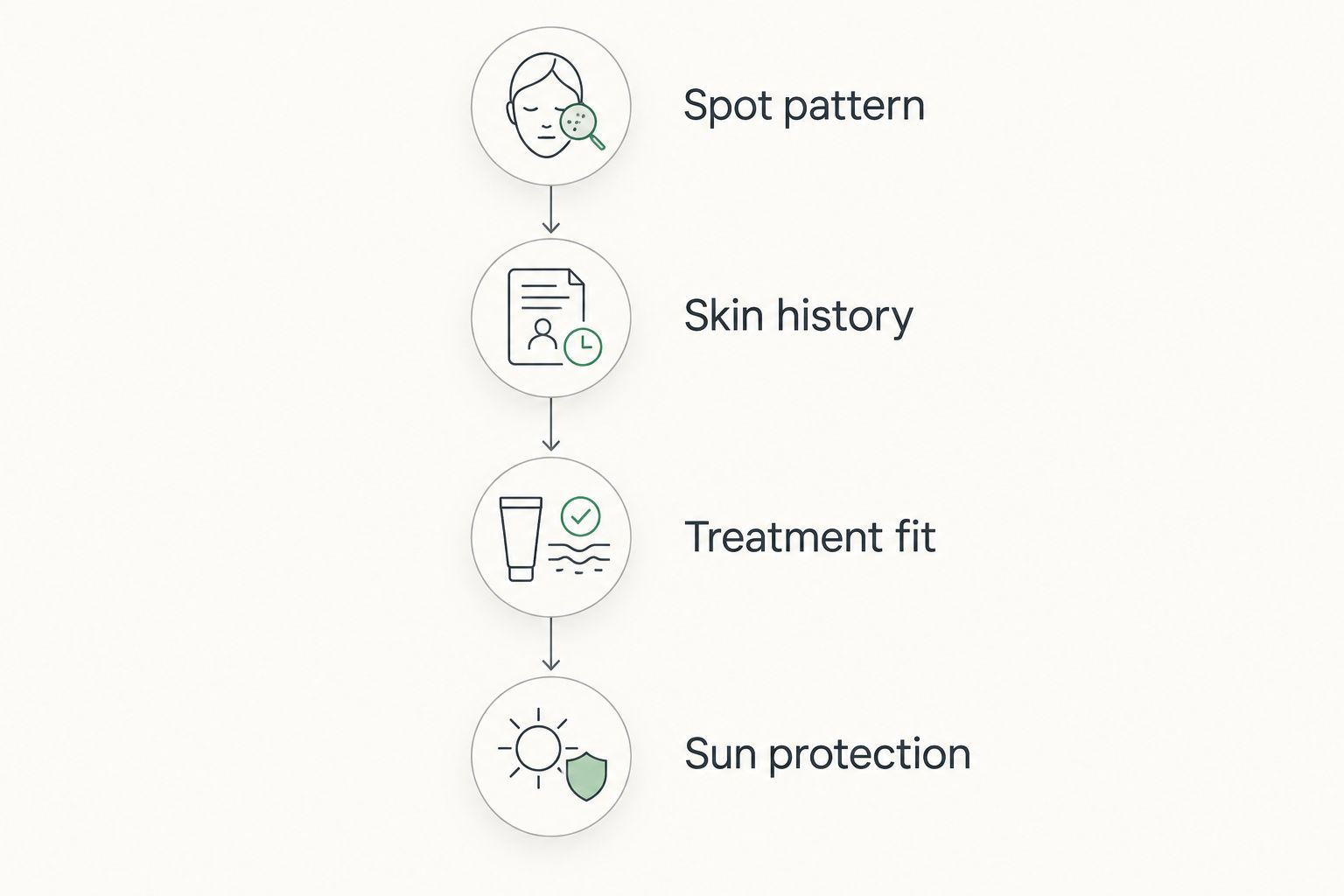
Your 2026 treatment plan should start with a skin assessment, not a package of procedures. Use this sequence to keep the consultation focused.
- Spot pattern: Identify whether the concern is isolated spots, facial patches, widespread discoloration, or rough texture. Mention any changing, bleeding, itching, or nonhealing area.
- Skin history: Describe previous burns, pigmentation after inflammation, cold sores, scarring, pregnancy, medicines, and recent sun exposure.
- Treatment fit: Ask what diagnosis the recommendation addresses, what it will not improve, and why it suits your skin.
- Sun protection: Agree on a daily routine and procedure-specific aftercare before treatment begins.
The order matters. A procedure recommendation made before the spot pattern and skin history are understood leaves the most important questions unanswered.
How these treatments were ranked
This ranking prioritizes diagnosis fit, treatment target, skin suitability, recovery, and maintenance. It does not treat the most intensive procedure as the best treatment.
Clinical reference points for this 2026 guide include American Academy of Dermatology guidance on sunscreen, melasma, chemical peels, and skin-cancer warning signs, plus FDA guidance on microneedling devices. These sources support safety decisions; they do not establish that one clinic or treatment guarantees a result.
Which treatment should you choose?
For diffuse photoaging, start the discussion with a topical retinoid and daily sun protection. For confirmed discrete sunspots, ask whether IPL fits your skin. For melasma-pattern patches, prioritize a diagnosis-specific topical plan and protection from both ultraviolet and visible light.
Choose superficial peels for an appropriate surface-level concern, fractional resurfacing for a texture or wrinkle goal, and microneedling for selected texture concerns. None replaces lesion assessment.
If you are considering Oasisbeauty for microneedling, make texture the focus of the consultation and ask how any dark spots should be evaluated separately. Do not infer that every treatment compared here is offered by the clinic.
The best 2026 decision is the least intensive suitable treatment that addresses your actual diagnosis—not the longest treatment menu.
FAQ
What’s the best treatment for sun damage and dark spots?
The best treatment depends on the diagnosis: topical retinoids address diffuse photoaging, IPL treats selected sunspots, and clinician-directed pigment topicals are used for melasma. A changing or unexplained lesion needs medical assessment before cosmetic treatment.
Is IPL better than a chemical peel for sunspots?
IPL and chemical peels treat different targets, so neither is universally better. IPL targets selected pigment with light, while superficial peels exfoliate outer skin layers; skin tone, diagnosis, and irritation risk determine suitability.
Does microneedling remove dark spots?
Microneedling is not the default treatment for isolated dark spots. It fits a texture-focused discussion, and treatment-related inflammation can cause additional pigmentation.
Can I treat melasma like ordinary sunspots?
No, melasma needs a different treatment plan from isolated sunspots. Heat, irritation, ultraviolet exposure, and visible light can affect melasma, so diagnosis and maintenance matter.
What sunscreen should I use while treating sun damage?
Use a broad-spectrum, water-resistant sunscreen with SPF 30 or higher, following its label. Reapply at least every 2 hours outdoors and after swimming or sweating; tinted sunscreen containing iron oxides can help with visible-light protection for melasma.
Should I get a dark spot checked before treatment?
Yes, unexplained or changing spots should be assessed before cosmetic treatment. Seek medical evaluation for a lesion that changes, bleeds, does not heal, or looks different from your other spots.
Can sun damage come back after treatment?
Yes, continued ultraviolet exposure can create new damage, and pigment conditions such as melasma can recur. Treatment needs ongoing sun protection rather than a one-time correction.
Can I use a retinoid during pregnancy?
Topical retinoids should be avoided during pregnancy. Ask your pregnancy-care clinician or dermatologist about suitable alternatives before treating pigmentation or photoaging.
One last thing
Sunscreen testing uses an application density of 2 milligrams per square centimeter of skin. A thin swipe is not the same application used to establish the labeled SPF.
Use broad-spectrum SPF 30 or higher, apply according to the label, and reapply at least every 2 hours outdoors, including after swimming or sweating. Add shade and protective clothing. That routine supports every treatment in this guide—and helps prevent the next round of sun damage.