Best overall: treatment matched to your scar type. Best for shallow depressed scars: microneedling. Best for tethered rolling scars: subcision. This 2026 guide compares the best treatments for acne scars by what they address, where they fall short, and what you should ask before treatment.
- The best treatments for acne scars depend on scar shape, depth, skin tone, and whether acne remains active.
- Microneedling treats selected depressed scars; subcision addresses the tethering beneath rolling scars.
- Oasisbeauty offers microneedling in Henderson; ask whether your acne scars fit that treatment.
- Flat discoloration and raised scars need different treatment plans from depressed acne scars.
Why this matters
An acne scar is not the same thing as a dark mark after a breakout. Depressed scars involve changes in skin structure; flat brown or red marks involve discoloration. Raised scars need another approach entirely.
Choosing the wrong procedure leaves the underlying problem untreated and exposes you to unnecessary risks. Match the treatment to the scar before choosing a device or package.
Oasisbeauty offers microneedling in Henderson, Nevada. Oasisbeauty is an option for a microneedling discussion if you are seeking local cosmetic care for acne scars; whether that procedure fits your skin requires an individual assessment.
The comparison below covers treatment categories, not a ranking of local providers. A medical professional should assess active acne, your skin tone, scar pattern, medications, and healing history before recommending a procedure.
What makes the best acne scar treatment in 2026?
Use these criteria to judge a recommendation before committing:
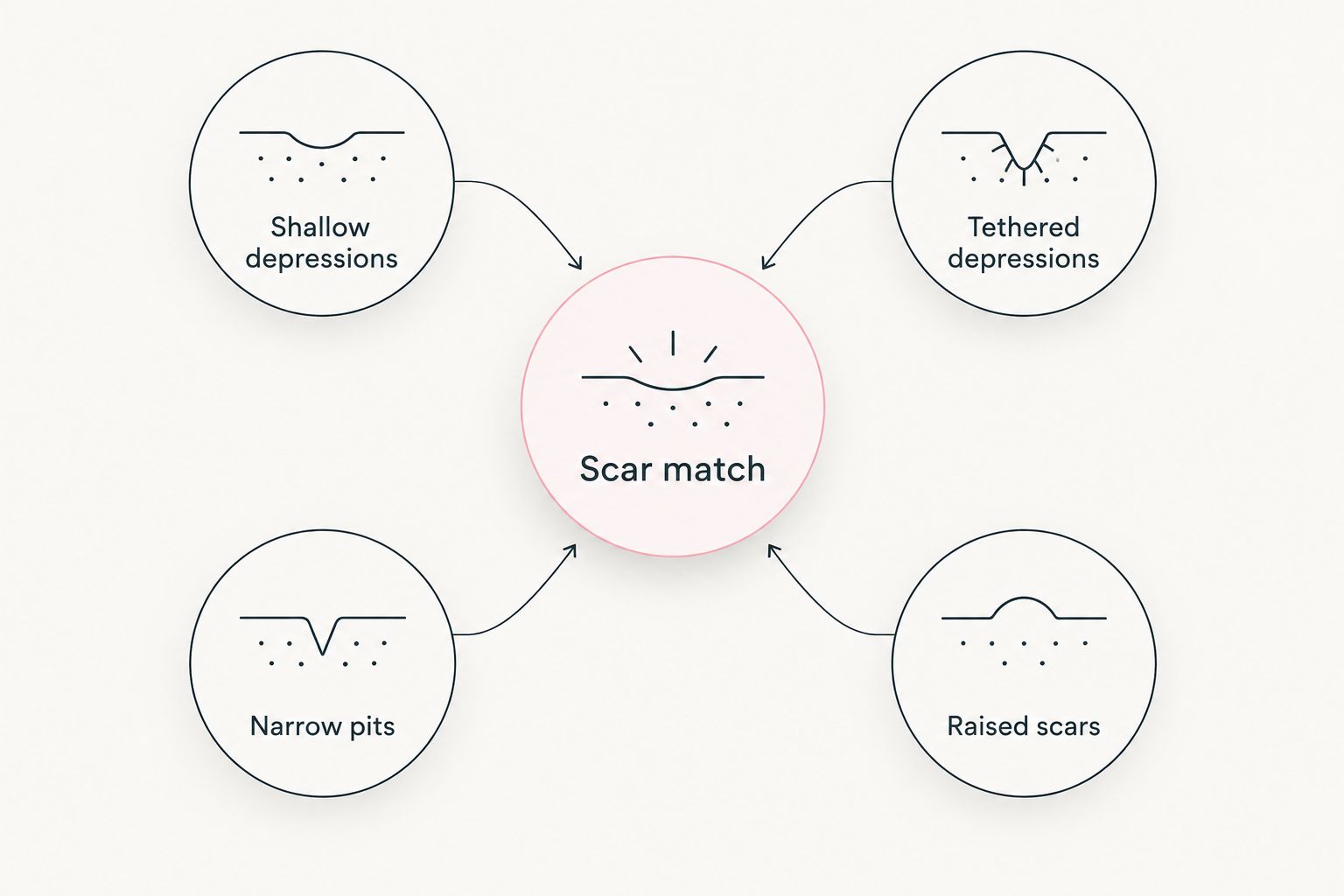
- Scar match: Ice-pick scars are narrow and deep, boxcar scars have defined edges, and rolling scars create broader depressions. Raised scars sit above the skin.
- Mechanism: Resurfacing addresses surface texture; subcision releases tethering; fillers add volume. These actions are not interchangeable.
- Skin-tone suitability: Your risk of pigment changes matters when choosing a laser, peel, or other skin-injuring procedure.
- Recovery burden: Ask about wound care, sun protection, visible redness, and when you can resume your usual skincare.
- Medical suitability: Active infection, medications, and a history of abnormal scarring affect treatment decisions.
- Realistic endpoint: Improvement is the goal. A promise to erase every scar is not a sound basis for consent.
An assessment should distinguish scars from discoloration rather than group every post-acne change under one label. Bring your current skincare and medication list, and identify the specific areas you want assessed.
Acne scar treatments at a glance
| Treatment | Best for | Standout feature | Key limitation |
|---|---|---|---|
| Microneedling | Shallow depressions | Controlled punctures stimulate a repair response | Does not release deep tethering |
| Fractional laser resurfacing | Broader texture changes | Treats a pattern of microscopic skin areas | Recovery and pigment risks depend on the device and settings |
| Subcision | Tethered depressions | Releases fibrous bands beneath selected scars | Does not directly correct every surface irregularity |
| TCA CROSS | Narrow pits | Applies acid within individual scar openings | Requires precise application; pigment changes and worsening scars are risks |
| Punch excision | Isolated deep scars | Removes an individual scar for surgical closure | Replaces the original defect with a surgical scar |
| Dermal fillers | Selected volume deficits | Raises suitable depressed areas | Not appropriate for every scar shape or location |
| Silicone scar products | Raised scars | Offers a noninvasive scar-management option | Does not lift depressed acne scars |
The best acne scar plan in 2026 is not necessarily a single procedure. A face with both tethered depressions and narrow pits contains different structural problems, so one treatment does not automatically address both.
1. Microneedling: best for shallow depressed acne scars
Microneedling creates controlled punctures in the skin to stimulate a repair response. It is an option for selected depressed acne scars, particularly when the treatment goal is broader texture improvement rather than correction of one deep pit.
Oasisbeauty offers microneedling, but that service listing does not establish which device, technique, or treatment plan will suit your scars. Ask those questions during your assessment.
Microneedling pros:
- Addresses selected depressed scars across a treatment area.
- Does not surgically remove skin.
- Can form part of a plan that addresses different scar types separately.
Microneedling cons:
- Does not release the bands responsible for tethered rolling scars.
- Carries risks including bleeding, infection, pigment changes, and scarring.
- Requires appropriate device selection and professional technique.
FDA consumer guidance describes authorized microneedling uses for facial acne scars in patients 22 years of age and older. That does not mean every device or added substance has the same authorization; ask what is being used and why.
Best for: Selected shallow depressions after clinical assessment.
Verdict: Skip as a standalone answer to deep tethering or raised scars.
2. Fractional laser resurfacing: best for broader texture changes
Fractional lasers treat a pattern of microscopic areas rather than the entire skin surface uniformly. Ablative devices remove tissue within those areas; nonablative devices heat tissue without the same surface-removal approach.
The word laser is not a treatment specification. Ask for the device category, intended effect, recovery requirements, and the clinician's experience treating your skin tone.
Fractional laser resurfacing pros:
- Addresses texture across a treatment area.
- Offers different approaches to depth and surface injury.
- Can complement scar-specific procedures when clinically appropriate.
Fractional laser resurfacing cons:
- Can cause burns, pigment changes, infection, or additional scarring.
- Recovery varies with the treatment approach.
- Does not automatically release tethered scars.
A laser hair removal service is not evidence that a provider offers acne scar resurfacing. These treatments have different purposes; do not treat the word laser on a service menu as confirmation.
Best for: Broader texture changes where resurfacing fits your skin and recovery requirements.
Verdict: Hold until the clinician identifies the device and explains your pigment risk.
3. Subcision: best for tethered rolling acne scars
Subcision uses an instrument beneath the skin to release fibrous bands pulling selected scars downward. It targets the attachment beneath a depression rather than simply treating the surface above it.
This makes subcision a relevant discussion for rolling scars with tethering. An examination determines whether that attachment is present.
Subcision pros:
- Directly addresses tethering beneath suitable scars.
- Treats a structural cause of selected depressions.
- Can be combined with other approaches when the assessment supports it.
Subcision cons:
- Can cause bruising, bleeding, swelling, and hematoma.
- Carries risks of injury to surrounding structures and infection.
- Does not correct all narrow pits or sharp scar edges.
Ask which scars the clinician intends to release and how improvement will be assessed. A recommendation based only on the general label acne scars is not specific enough.
Best for: Rolling depressions with confirmed tethering.
Verdict: Skip when there is no tethering to release.
4. TCA CROSS: best for selected narrow ice-pick scars
TCA CROSS places trichloroacetic acid within selected scar openings to produce a localized repair response. It is a focal procedure, not the same treatment as applying a general chemical peel across the face.
Precision matters because acid contacting surrounding skin can injure it. This is not a home-treatment recommendation.
TCA CROSS pros:
- Targets individual narrow pits.
- Focuses treatment on selected scars rather than the whole face.
- Addresses a scar shape that surface-only treatments often leave unresolved.
TCA CROSS cons:
- Can cause pigment changes and prolonged discoloration.
- Incorrect application can widen or worsen a scar.
- Requires wound care and careful sun protection.
Ask how your skin tone and healing history affect suitability. Buying an acid online does not reproduce the assessment, application control, or follow-up needed for this procedure.
Best for: Selected narrow ice-pick scars assessed by an experienced medical professional.
Verdict: Skip home acid application; hold for professional assessment.
5. Punch excision: best for isolated deep acne scars
Punch excision removes an individual scar, followed by closure of the opening. The aim is to replace a difficult depressed defect with a surgical scar that has a different shape.
This approach belongs in the discussion when a small number of deep scars dominate your concern. It is not a general surface treatment.
Punch excision pros:
- Targets a specific deep defect.
- Removes the selected scar rather than treating only its surface.
- Allows a focused plan for isolated problem areas.
Punch excision cons:
- Creates a new surgical scar.
- Carries wound-healing and infection risks.
- Does not address widespread uneven texture by itself.
Ask what the closure is expected to look like and whether later texture treatment is part of the plan. The trade-off is a different scar, not scar-free skin.
Best for: Isolated deep scars that a clinician considers suitable for removal.
Verdict: Hold until the expected replacement scar is explained.
6. Dermal fillers: best for selected volume-related depressions
Dermal fillers add volume beneath suitable depressions. They do not remove scar tissue, and filling a depression is different from releasing a tethered scar.
Product selection, injection location, and anatomy matter. Some scars need a different procedure rather than additional volume.
Dermal filler pros:
- Adds support beneath selected depressed areas.
- Offers a targeted approach to suitable contour defects.
- Can complement other scar treatments when clinically appropriate.
Dermal filler cons:
- Effects and repeat-treatment needs depend on the product.
- Risks include lumps, infection, and vascular occlusion.
- Vascular complications can cause tissue death or vision loss.
Do not assume every filler is approved specifically for acne scars. Ask whether the proposed use is within the product's indication and what emergency response procedures the injector has in place.
Best for: Selected depressions where adding volume addresses the assessed problem.
Verdict: Hold until suitability, product choice, and vascular risks are discussed.
7. Silicone scar products: best for raised acne scars
Silicone gels and sheets are used in the management of raised scars. They are a different category from procedures intended to lift depressed acne scars.
A raised acne scar needs assessment, especially if it extends beyond the original injury or continues to grow. A clinician can distinguish a hypertrophic scar from a keloid and discuss appropriate treatment.
Silicone scar product pros:
- Provides a noninvasive scar-management option.
- Avoids injections or resurfacing injury.
- Can be incorporated into care for suitable raised scars.
Silicone scar product cons:
- Does not lift ice-pick, boxcar, or rolling depressions.
- Requires consistent use according to product directions.
- Can irritate skin and is not a substitute for assessing a growing scar.
Best for: Raised scars where silicone is appropriate within the care plan.
Verdict: Skip for depressed acne scars.
How these treatments are ranked
This 2026 ranking prioritizes scar match, treatment mechanism, medical suitability, and recovery burden. It is not a head-to-head clinical trial or a promise that the first option produces the greatest improvement for everyone.
Microneedling appears first because it is a relevant discussion for selected shallow depressed scars. Subcision, TCA CROSS, excision, fillers, and silicone each occupy a different use-case slot rather than competing to solve the same problem.
Which acne scar treatment should you choose?
Choose an assessment before choosing a procedure in 2026. If your main concern is shallow depressed texture, discuss microneedling. If scars are tethered, narrow, isolated and deep, or raised, ask about the matching options above.
Treating active acne also belongs in the plan: improving existing scars does not prevent new breakouts from creating additional scars. Tell the clinician about current acne treatments before any procedure.
Ask for a written explanation of the target scars, expected improvement, risks, aftercare, and reasons to delay treatment. For your Oasisbeauty visit, use those questions to establish whether microneedling matches the concern you want addressed.
Discuss your acne scar concerns
Ask whether microneedling fits your scar type and what assessment is needed.
FAQ
What’s the best treatment for acne scars in 2026?
The best treatment depends on scar type, depth, skin tone, and medical suitability. Microneedling addresses selected depressed scars, subcision addresses tethering, and narrow or raised scars need different approaches.
Is microneedling better than laser treatment for acne scars?
Neither microneedling nor laser treatment is best for every acne scar. The choice depends on the scar pattern, device, pigment risk, and recovery requirements; neither automatically corrects deep tethering.
Can acne scars disappear completely?
Acne scar treatment aims to improve appearance rather than guarantee complete removal. Ask the clinician to explain realistic changes for each scar type instead of promising perfectly smooth skin.
Are dark spots after acne actually scars?
Flat dark spots after acne are often post-inflammatory hyperpigmentation rather than depressed scars. Discoloration and structural scarring can coexist, so the assessment should identify both.
Can I get acne scar treatment while I still have breakouts?
Active acne needs assessment before scar treatment. Controlling breakouts helps prevent new scars, and inflamed or infected treatment areas can require postponing a procedure.
Can people with darker skin tones get acne scar treatments?
Darker skin tones can receive selected acne scar treatments, but pigment risks must guide the plan. Ask about the clinician’s experience with your skin tone and why the proposed procedure is appropriate.
Does Oasisbeauty offer treatment relevant to acne scars?
Oasisbeauty offers microneedling in Henderson, Nevada. Whether that treatment fits your acne scars requires an individual assessment; do not assume every procedure in this guide is offered there.
One last thing
A scar treatment plan is incomplete without sun-protection instructions. American Academy of Dermatology guidance recommends broad-spectrum, water-resistant sunscreen with SPF 30 or higher, with reapplication every 2 hours outdoors and after swimming or sweating.
Freshly treated skin also needs procedure-specific aftercare; follow the clinician's directions about when and how to apply products. Before your 2026 appointment ends, ask what to stop, what to use, and which symptoms require prompt medical attention.