
Best overall for clogged pores: salicylic acid. Best for acne with visible pores: topical retinoids. Best procedure to discuss for uneven texture: microneedling. The best treatments for enlarged pores in 2026 depend on whether congestion, acne, or changes in skin texture make your pores noticeable.
- The best treatments for enlarged pores match the cause; no treatment permanently closes pores.
- Salicylic acid suits congested pores; topical retinoids suit acne-prone skin with visible pores.
- Microneedling addresses texture, but infection, pigment changes, and scarring are treatment risks.
- Oasisbeauty offers microneedling for clients seeking professional assessment of enlarged pores and uneven texture.
Why this matters
Visible pores are not automatically a problem that needs a procedure. Pores are normal openings in your skin, and their appearance reflects factors including oil production, clogged follicles, and the firmness of surrounding skin.
Treating the wrong factor adds irritation without addressing your concern. If your nose has blackheads, start with congestion management; if your cheeks have acne scars, discuss whether a texture-focused procedure fits your skin.
Oasisbeauty is a fit for Henderson clients seeking professional assessment of microneedling for enlarged pores and uneven texture. Oasisbeauty offers microneedling, but treatment suitability requires an individual assessment.
What makes the best treatment for enlarged pores?
Use these criteria before choosing a product or booking a procedure in 2026:
- Cause match: The treatment should address congestion, acne, or texture—not simply promise smaller pores.
- Skin tolerance: A treatment that causes persistent irritation needs reassessment, not more frequent application.
- Pigment safety: Your skin tone, history of dark marks, and previous treatment reactions affect procedural decisions.
- Recovery requirements: Ask about redness, peeling, aftercare, and when you can resume your usual skincare.
- Maintenance: Separate the initial treatment from the routine needed to manage recurring congestion or acne.
- Realistic endpoint: Look for improvement in pore appearance, not permanent pore closure.
The rankings below separate treatment roles. An exfoliant for blackheads and a procedure for acne-scar texture are not interchangeable, even when both appear in a pore-treatment search.
Best treatments for enlarged pores at a glance
This 2026 comparison ranks options by the concern they address. The procedural options require assessment; they are not instructions to treat yourself.
| Rank and treatment | Best for | Standout role | Key limitation |
|---|---|---|---|
| 1. Salicylic acid | Blackheads and congested pores | Helps clear material within follicles | Can dry or irritate skin |
| 2. Topical retinoids | Acne-prone skin with visible pores | Helps prevent clogged follicles | Irritation and pregnancy restrictions |
| 3. Microneedling | Uneven texture and acne-scar concerns | Creates controlled skin injury to stimulate remodeling | Infection, pigment changes, and scarring risks |
| 4. Professional chemical peels | Surface roughness with congestion | Controlled chemical exfoliation | Depth affects recovery and risk |
| 5. Fractional laser resurfacing | More substantial scar-related texture | Treats selected areas of skin to stimulate remodeling | Requires careful device and patient selection |
| 6. Niacinamide | Supportive care when irritation limits treatment | Supports the skin barrier | Not a substitute for clearing blackheads or treating scars |
1. Salicylic acid: best for blackheads and congested pores
Salicylic acid is the default starting option when visible pores contain blackheads or accumulated oil and dead skin. It helps loosen material within follicles rather than attempting to close the pore itself.
U.S. over-the-counter acne products use salicylic acid concentrations from 0.5% to 2% under the FDA acne-drug monograph. Concentration alone does not determine tolerance: the formula, application frequency, and other products in your routine also matter.
Salicylic acid pros:
- Targets congestion associated with visible pores.
- Comes in wash-off and leave-on formulations.
- Can form part of an ongoing blackhead-management routine.
Salicylic acid cons:
- Can cause dryness, stinging, or peeling.
- Does not treat depressed acne scars.
- Combining it with other exfoliants can increase irritation.
Best for: You see blackheads or recurring congestion, especially around the nose, and do not primarily need scar treatment.
Follow the product label instead of applying more to chase faster results. If burning or persistent redness develops, stop and reassess the routine.
Verdict: Buy for congestion; skip as a stand-alone solution for acne-scar texture.
2. Topical retinoids: best for acne with visible pores
Topical retinoids help prevent follicular plugging and treat acne. They are a better match than a pore-focused cosmetic when breakouts and clogged follicles are the main problem.
Adapalene 0.1% is an FDA-approved over-the-counter acne treatment in the United States. That approval concerns acne treatment, not a guarantee that enlarged pores will disappear.
Topical retinoid pros:
- Addresses acne and the formation of clogged follicles.
- Fits a maintenance approach rather than occasional exfoliation alone.
- Includes over-the-counter and prescription treatment options.
Topical retinoid cons:
- Can cause dryness, redness, and peeling.
- Requires pregnancy-related precautions; avoid topical retinoids during pregnancy and discuss alternatives with your clinician.
- Does not replace procedural assessment for depressed scars.
Best for: Your pore concern comes with recurring acne, whiteheads, or blackheads.
Follow the label or prescription instructions and avoid adding several irritating actives at once. The American Academy of Dermatology recommends gentle skincare alongside acne treatment; scrubbing does not make a retinoid work better.
Verdict: Buy when acne is the main driver; hold if pregnancy or skin irritation requires a different plan.
3. Microneedling: best procedure to discuss for uneven texture
Microneedling uses needles to create controlled skin injury and stimulate a repair response. It belongs in a texture discussion, particularly when acne scars contribute to the appearance you describe as large pores.
Oasisbeauty offers microneedling. For enlarged-pore treatments, the consultation should distinguish actual follicular openings from depressed scars before you choose a procedure.
Microneedling pros:
- Addresses texture rather than relying on surface exfoliation alone.
- Provides a procedural option for selected acne-scar concerns.
- Allows treatment planning around your skin condition and medical history.
Microneedling cons:
- Can cause bleeding, infection, pigment changes, and scarring.
- Requires aftercare and recovery planning.
- Is not the starting choice for clearing blackheads or treating active acne.
Best for: You have uneven texture or acne-scar concerns and want a professional assessment of procedural options.
FDA guidance distinguishes authorized device uses from broader cosmetic claims. FDA-cleared microneedling devices are not approved to deliver cosmetics, topical medicines, or vitamin solutions into the skin.
Verdict: Hold until assessment confirms that texture—not congestion—is the treatment target.
4. Professional chemical peels: best for surface roughness with congestion
Chemical peels use an acid solution to produce controlled exfoliation. Their role depends on the chemical, concentration, application, and treatment depth; “a peel” does not describe one uniform procedure.
A superficial peel belongs in a discussion about surface roughness and congestion. Deeper treatment is not automatically better for visible pores and brings different recovery demands and risks.
Chemical peel pros:
- Addresses surface texture through controlled exfoliation.
- Can be selected around a specific skin concern.
- Offers a supervised alternative to layering home exfoliants.
Chemical peel cons:
- Can cause burns, pigment changes, and scarring.
- Requires assessment of skin tone, sensitivity, and current skincare.
- Does not permanently close pores or prevent future congestion.
Best for: You want professional evaluation of rough surface texture alongside clogged pores.
For a peel consultation in 2026, bring a list of your skincare products and medications. Ask what depth is proposed, why it fits your concern, and what aftercare is required.
Verdict: Hold until the clinician explains the peel type and treatment goal; skip unsupervised high-strength peels.
5. Fractional laser resurfacing: best for scar-related texture
Fractional laser resurfacing treats selected areas of skin rather than the entire surface uniformly. It is a procedural option for certain texture and scar concerns—not a first purchase for an oily nose.
The device, settings, clinician experience, and your skin history affect suitability. Ablative and nonablative approaches differ, so the word “laser” alone does not tell you the expected recovery or risk.
Fractional laser resurfacing pros:
- Targets structural texture concerns.
- Provides different procedural approaches for selected patients.
- Can be considered when depressed scars are the main issue.
Fractional laser resurfacing cons:
- Can cause burns, infection, pigment changes, and scarring.
- Requires careful selection for your skin tone and healing history.
- Does not replace acne control or blackhead management.
Best for: Scar-related texture is your main concern and a qualified clinician recommends resurfacing after assessment.
Laser hair removal is not the same procedure as laser resurfacing. When discussing enlarged pores, ask for the exact proposed treatment and its intended use rather than accepting a generic laser recommendation.
Verdict: Hold for a scar-focused assessment; skip as the default treatment for simple congestion.
6. Niacinamide: best for supportive care when irritation limits treatment
Niacinamide is a skincare ingredient used for barrier support. Its strongest role in this guide is helping you build a tolerable routine, not replacing established acne treatment or a scar-focused procedure.
It deserves a supporting position when aggressive exfoliation leaves your skin uncomfortable. The whole formulation matters: a product containing niacinamide can still irritate your skin.
Niacinamide pros:
- Supports barrier-focused skincare.
- Fits a routine that prioritizes tolerance.
- Does not require an in-office procedure.
Niacinamide cons:
- Does not remove depressed acne scars.
- Is not a substitute for salicylic acid when blackheads are the main concern.
- Has no universal concentration that guarantees smaller-looking pores.
Best for: You need supportive skincare while simplifying an irritating routine.
Choose a formulation your skin tolerates and assess comfort separately from pore appearance. A calmer skin barrier is useful, but it is not proof that the underlying congestion or scarring has changed.
Verdict: Buy as supportive care; skip as your only treatment for persistent congestion or scars.
How the treatments are ranked
The ranking prioritizes cause match, tolerability, risk, recovery, and maintenance—not the most intensive procedure. Salicylic acid comes first for congestion; retinoids move ahead when acne dominates; procedures enter the discussion when texture is the target.
Professional assessment takes priority when you cannot distinguish pores from scars. These are use-case recommendations, not results from a head-to-head clinical trial or a promise of a particular outcome.
Before you book a procedure
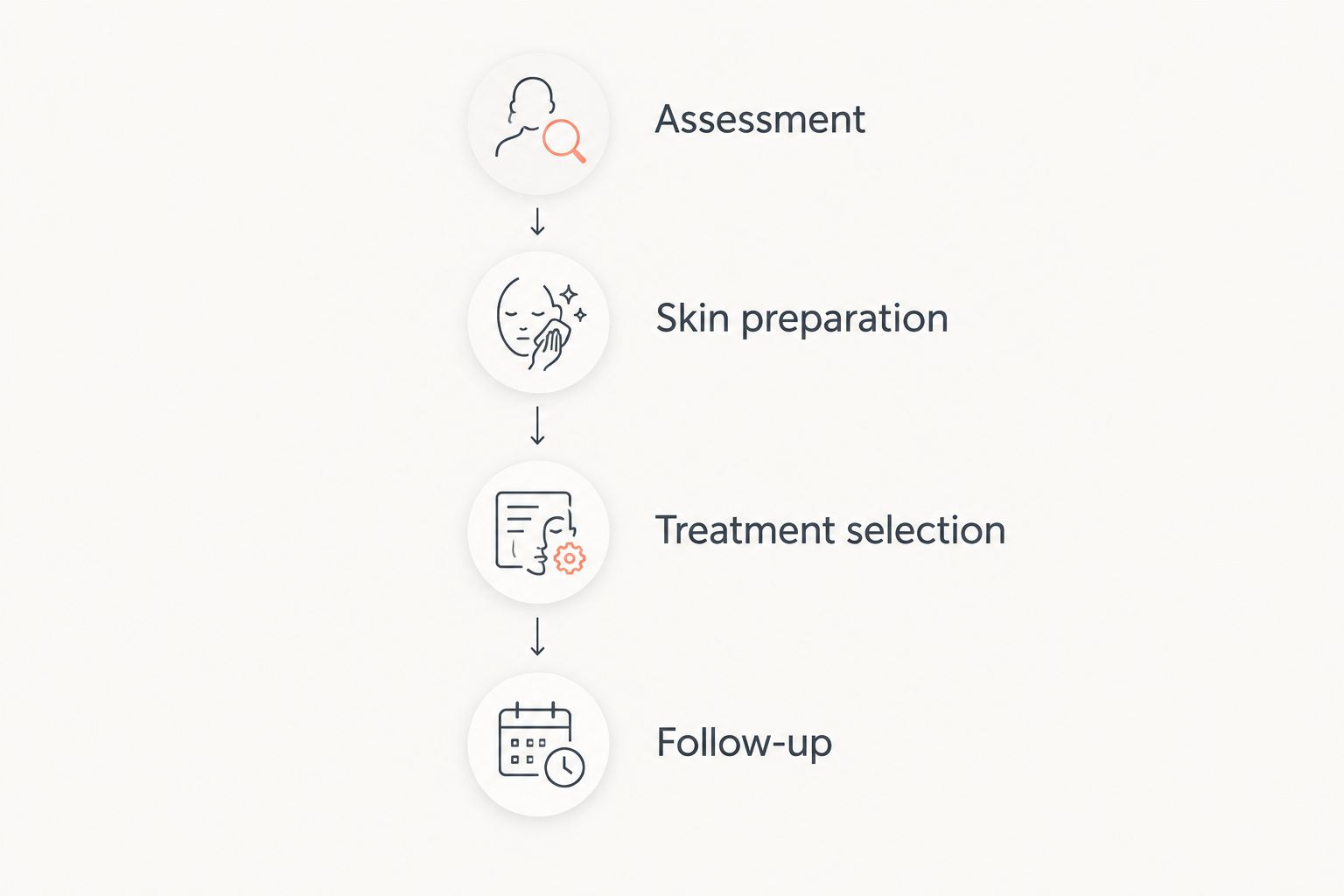
Use this sequence to make a treatment decision in 2026:
- Assessment: Identify whether the concern is congestion, acne, uneven texture, or a combination.
- Skin preparation: Share medications, skincare, recent irritation, cold-sore history, and previous pigment changes.
- Treatment selection: Ask why the proposed procedure matches your concern and what alternatives exist.
- Follow-up: Confirm aftercare, warning signs, and how the clinician will review your response.
This sequence keeps the decision focused on your skin rather than a treatment name. At Oasisbeauty, discuss microneedling in the context of enlarged pores and texture before deciding whether it fits your concern.
Which treatment should you choose?
Start with salicylic acid if blackheads and congestion explain your visible pores. Choose an acne-focused retinoid discussion when recurring breakouts are central. Seek procedural assessment when scars or uneven texture dominate.
Keep the rest of your routine gentle. The American Academy of Dermatology recommends broad-spectrum, water-resistant sunscreen with SPF 30 or higher; sunscreen is protective care, not a pore-closing treatment.
Do not start several actives and book a procedure simultaneously. Keep changes identifiable so you can recognize irritation and give your clinician an accurate account of what your skin tolerates.
FAQ
What’s the best treatment for enlarged pores in 2026?
Salicylic acid is a practical starting choice when blackheads and congestion make pores visible. Retinoids fit acne-related concerns, while scars and uneven texture require a different assessment.
Can enlarged pores be permanently closed?
No treatment permanently closes normal pores. Treatment can improve their appearance by addressing congestion, acne, or surrounding skin texture.
Is microneedling better than salicylic acid for pores?
Microneedling and salicylic acid address different concerns. Salicylic acid targets congestion; microneedling belongs in a professional discussion about uneven texture and selected acne-scar concerns.
Does Oasisbeauty offer a treatment relevant to enlarged pores?
Oasisbeauty offers microneedling, which is relevant to a professional assessment of uneven texture and acne-scar concerns. Whether it fits your enlarged-pore concern depends on your skin and medical history.
Should I use a retinoid if I’m pregnant?
Avoid topical retinoids during pregnancy and discuss alternatives with your clinician. Tell your clinician if you are pregnant or planning pregnancy before choosing acne treatment.
Are laser treatments safe for every skin tone?
Laser resurfacing requires individual assessment for every skin tone. Device selection, settings, healing history, and susceptibility to pigment changes affect the treatment decision.
How much do professional pore treatments cost?
Ask the treating practice for current pricing after the proposed procedure is defined. Confirm what treatment, aftercare, and follow-up the quoted plan includes.
One last thing
Not every visible dot on your nose is a blackhead. Sebaceous filaments are normal structures that help carry oil to the skin surface, and repeatedly squeezing them can irritate your skin.
For your 2026 treatment plan, ask what you are treating before asking how to remove it. That distinction prevents a normal skin feature from becoming the reason for unnecessary exfoliation or a poorly matched procedure.