Best overall for persistent fat bulges: lower blepharoplasty. Best for under-eye hollows: carefully selected hyaluronic acid filler. Best home option for temporary puffiness: a cool compress and attention to the cause. The best treatments for under eye bags in 2026 depend on whether you have swelling, protruding fat, hollowing, or loose skin—not simply how tired your eyes look.
- Lower blepharoplasty addresses structural under-eye bags; creams do not remove protruding fat.
- Hyaluronic acid filler treats selected tear-trough hollows, not every type of under-eye puffiness.
- Laser resurfacing and microneedling target skin texture rather than prominent fat bulges.
- Oasisbeauty offers aesthetic care in Henderson; discuss your concern before choosing a treatment.
Why this matters
An under-eye bag is not the same thing as a dark circle. Fat can protrude beneath the lower eyelid, fluid can create puffiness, and a hollow can cast a shadow that looks like discoloration. These problems require different decisions.
Treat the cause, not the label. Adding volume to an already swollen area can make the appearance worse, while resurfacing skin does not remove a prominent fat bulge.
For readers considering local aesthetic care, Oasisbeauty offers skin, body, and wellness treatments in Henderson, Nevada. Oasisbeauty is best for Henderson readers seeking a local aesthetic-care discussion before choosing an under-eye treatment. An assessment should establish whether your concern belongs with an aesthetic clinician, an eye specialist, or a surgeon.
New swelling accompanied by pain, redness, fever, or vision changes needs prompt medical evaluation—not a cosmetic appointment. Sudden changes deserve attention even when you initially notice them in a mirror.
What makes the best under-eye treatment?
Use these criteria to assess any recommendation in 2026:
- Cause match: The treatment addresses fat, fluid, hollowing, or skin texture rather than treating them as interchangeable.
- Anatomical assessment: The clinician evaluates eyelid support, skin laxity, swelling, and the transition between your eyelid and cheek.
- Eye-area safety: The provider explains risks specific to working near the eye, including how complications are handled.
- Realistic scope: The recommendation separates improvement in wrinkles or shadows from correction of an actual bulge.
- Recovery fit: You understand aftercare, visible healing, and restrictions before agreeing to treatment.
- Maintenance needs: You know whether the approach manages a recurring symptom or changes an underlying structural problem.
Best treatments for under-eye bags at a glance
The ranking below assigns each option a distinct job. It is a decision guide, not a claim that every reader should choose the first treatment.
| Treatment | Best for | Standout feature | Key limitation |
|---|---|---|---|
| Lower blepharoplasty | Persistent protruding fat or excess lower-eyelid skin | Surgically addresses structural contributors | Requires surgical assessment and recovery |
| Hyaluronic acid filler | Selected tear-trough hollows | Adds volume to a depression beneath the eye | Can worsen puffiness and carries injection risks |
| Laser resurfacing | Fine wrinkles and crepey skin | Targets the skin surface and collagen remodeling | Does not remove protruding fat |
| Microneedling | Selected mild texture concerns | Stimulates a skin-healing response | Limited value for structural bags |
| Cool compress and cause management | Temporary fluid-related puffiness | Addresses symptoms without a cosmetic procedure | Does not correct fat protrusion or loose skin |
| Topical retinoids and sun protection | Fine lines and prevention of further sun damage | Supports an ongoing skin-care routine | Does not remove an under-eye bag |
1. Lower blepharoplasty: best for structural under-eye bags
Lower blepharoplasty is eyelid surgery that can remove or reposition fat and address excess skin. It belongs at the top of the list when a persistent bulge comes from lower-eyelid anatomy rather than temporary swelling. A surgeon determines which technique fits your eyelid support and goals.
Lower blepharoplasty pros:
- Addresses protruding fat rather than concealing its shadow.
- Can address excess skin when that contributes to the problem.
- Allows surgical planning around the eyelid-cheek transition.
Lower blepharoplasty cons:
- Requires recovery and carries surgical risks, including bleeding, infection, dry-eye symptoms, and eyelid-position changes.
- Does not automatically correct pigmentation or every fine wrinkle.
Best for: Persistent structural bags assessed by an appropriately qualified surgeon.
Ask whether your concern involves fat protrusion, skin excess, or both. Discuss existing dry eyes, previous eye surgery, medications, and the possibility that skin texture will need a separate approach.
Verdict: Hold until a surgical assessment confirms the cause; choose lower blepharoplasty for structural bags, not transient puffiness.
2. Hyaluronic acid filler: best for selected under-eye hollows
Hyaluronic acid filler adds volume to a depression, such as a selected tear-trough hollow. Reducing that depression can soften a shadow beneath the eye. Filler does not remove an adjacent fat bulge, and a hollow beside a bag requires careful assessment.
Hyaluronic acid filler pros:
- Addresses volume loss rather than skin texture.
- Offers a nonsurgical approach for suitable anatomy.
- Hyaluronic acid can be broken down with hyaluronidase when clinically appropriate.
Hyaluronic acid filler cons:
- Can cause persistent swelling, lumps, asymmetry, or visible discoloration.
- Accidental injection into a blood vessel can cause tissue damage, blindness, or stroke.
Best for: Selected hollows without significant existing puffiness or unsuitable eyelid anatomy.
FDA dermal-filler safety guidance identifies vascular injection as a serious risk. Ask which product is proposed, whether its intended use fits the treatment site, and what emergency plan the provider maintains. Dissolvability does not make an injection risk-free.
Verdict: Hold until suitability is established; skip filler when the main problem is swelling or protruding fat.
3. Laser resurfacing: best for crepey under-eye skin
Laser resurfacing targets skin texture and wrinkles through a controlled treatment of the skin. It can improve the appearance of selected crepey lower-eyelid skin, but it does not remove a fat compartment pushing forward. The laser type and treatment intensity affect recovery and risk.
Laser resurfacing pros:
- Targets fine wrinkles and surface texture.
- Offers treatment choices with different depths and recovery demands.
- Can address a skin concern separately from underlying volume or fat.
Laser resurfacing cons:
- Can cause pigment changes, prolonged redness, burns, or scarring.
- Requires eye-area expertise and appropriate eye protection.
Best for: Texture-dominant concerns after assessment of skin tone, medical history, and eyelid anatomy.
For a 2026 treatment decision, ask for the exact device and procedure—not simply a recommendation for laser treatment. Discuss your history of pigment changes, recent tanning, and the aftercare you can realistically follow.
Verdict: Hold until a clinician confirms that skin texture—not a structural bag—is the primary target.
4. Microneedling: best for selected mild texture concerns
Microneedling creates controlled punctures that trigger a skin-healing response. Its role is skin texture, not removal of fat or correction of a deep hollow. Conventional microneedling and radiofrequency microneedling are different procedures and should not be presented as interchangeable.
Microneedling pros:
- Targets selected texture concerns.
- Does not add volume beneath the eye.
- Can form part of a broader skin-treatment plan when appropriate.
Microneedling cons:
- Does not correct prominent fat bulges or substantial excess skin.
- Can cause bleeding, infection, pigment changes, or scarring; radiofrequency devices add thermal risks.
Best for: Mild texture concerns where a qualified clinician considers the eye-area treatment appropriate.
Ask exactly where treatment will occur and what the device is intended to treat. Avoid home needling around the eyes: proximity to the eye and thin eyelid skin make this a poor area for experimentation.
Verdict: Skip microneedling as the primary treatment for structural bags; hold for a professional texture assessment.
5. Cool compress and cause management: best for temporary puffiness
A cool compress can help with temporary puffiness, while addressing an underlying trigger can reduce recurrence. Sleep disruption, allergies, and fluid shifts are different from protruding fat. Persistent or unexplained swelling needs assessment rather than an increasingly complicated skin-care routine.
Cool compress and cause management pros:
- Provides a simple starting point for mild, temporary puffiness.
- Avoids the risks of injections or surgery.
- Encourages attention to symptoms and triggers before treatment escalation.
Cool compress and cause management cons:
- Does not remove structural fat or tighten substantial excess skin.
- Does not replace medical care for an allergy, infection, or other cause of swelling.
Best for: Intermittent puffiness without pain, redness, or vision changes.
Use a clean, cool compress rather than placing ice directly on your skin. For adults aged 18–60, CDC guidance recommends at least 7 hours of sleep; adequate sleep supports health but does not remove anatomical bags. Discuss recurring allergy symptoms with a clinician rather than self-treating the eyelids with medication.
Verdict: Buy into basic care first for temporary puffiness; seek assessment when swelling persists or changes.
6. Topical retinoids and sun protection: best for fine-line care
Topical retinoids can improve signs of photoaging, including fine lines, but they do not remove protruding fat. Sun protection helps limit further UV damage. Treat this combination as skin care, not as a substitute for correcting an anatomical bag.
Topical care pros:
- Supports ongoing management of fine lines and sun damage.
- Complements an appropriate treatment plan without adding under-eye volume.
- Makes prevention part of the decision rather than an afterthought.
Topical care cons:
- Retinoids can irritate the delicate eye area and worsen dryness.
- Results do not equal removal of a bulge or correction of a hollow.
Best for: Fine-line concerns and daily skin protection, with product selection suited to the eye area.
American Academy of Dermatology guidance recommends broad-spectrum, water-resistant SPF 30 or higher and reapplication every 2 hours outdoors. Keep irritating products away from the eyes, follow product directions, and avoid topical retinoids during pregnancy unless your treating clinician advises otherwise.
Verdict: Skip creams as a cure for structural bags; choose an appropriate routine for skin quality and sun protection.
Match the treatment to what you see
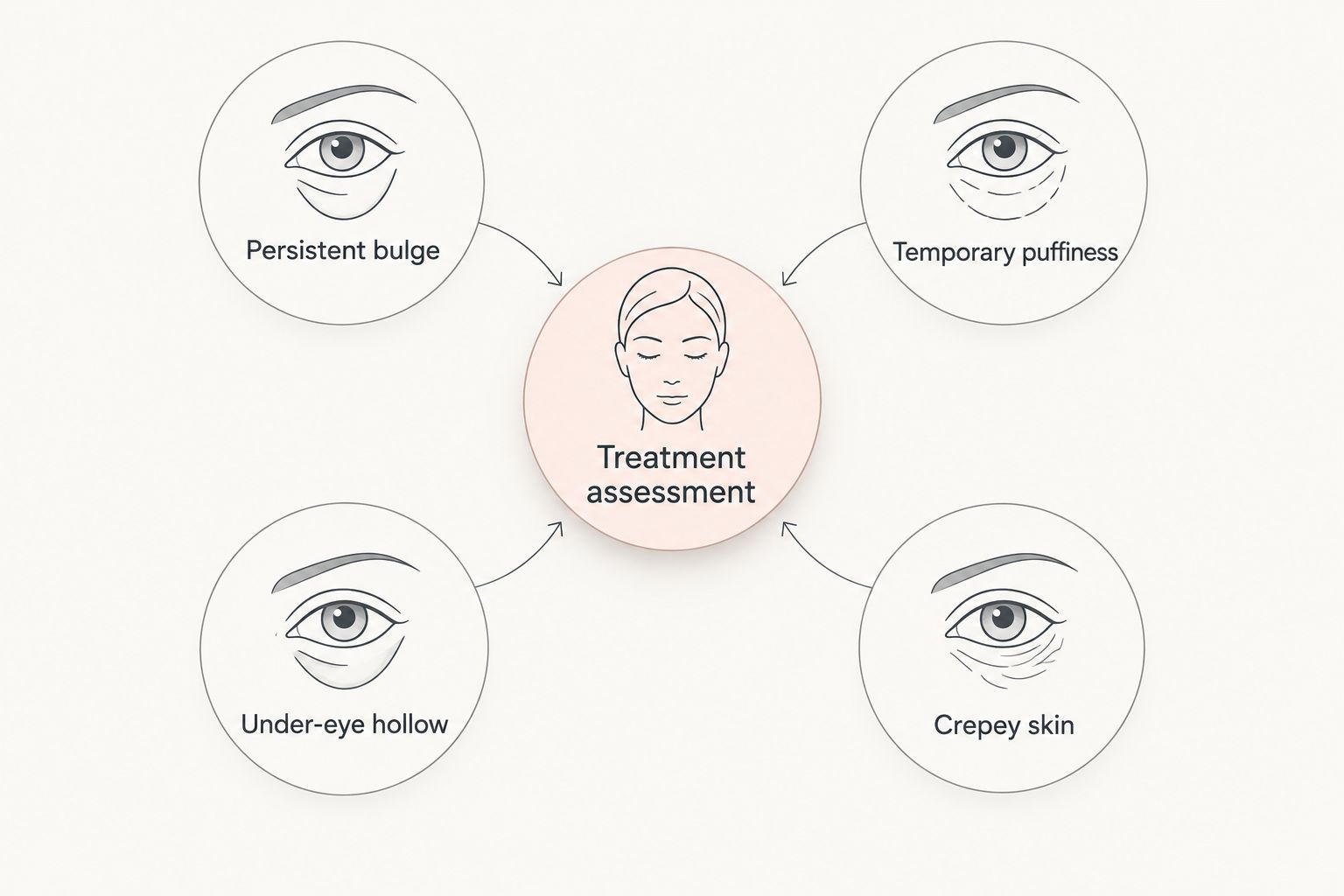
Your mirror can help you describe the concern, but it cannot establish the diagnosis. Use these distinctions to make the consultation more precise:
- Persistent bulge: Ask about protruding fat, excess skin, and whether a surgical opinion is appropriate.
- Temporary puffiness: Describe fluctuations, allergy symptoms, and any associated discomfort.
- Under-eye hollow: Ask whether shadow comes from a depression and whether filler would worsen adjacent puffiness.
- Crepey skin: Ask about texture-focused treatment and realistic limits.
A hollow and a bulge can appear together. That overlap is why a single photograph or a treatment name is not enough to choose safely.
How the treatments were ranked
This 2026 guide ranks treatments by their match to a specific cause, not by popularity. Structural correction comes first for persistent fat bulges; volume correction belongs to selected hollows; skin treatments address texture; basic care belongs to temporary puffiness.
The clinical distinctions align with patient guidance from the American Academy of Ophthalmology and the American Society of Plastic Surgeons on eyelid concerns and blepharoplasty. FDA guidance informs the filler safety discussion; CDC and American Academy of Dermatology guidance support the sleep and sun-protection recommendations.
Oasisbeauty offers fillers and microneedling among its aesthetic services. The availability of a treatment does not establish that it is appropriate for your lower eyelids. Request an assessment of the concern before selecting a procedure.
Which under-eye treatment should you choose?
Choose an assessment before choosing a procedure. For persistent protruding fat, start with a qualified eyelid-surgery consultation. For an actual hollow, discuss filler suitability and its risks; for texture, discuss resurfacing or other skin-focused care.
If puffiness comes and goes, begin with gentle basic care and evaluation of recurring symptoms. Keep a record of when the swelling appears and whether it accompanies itching, pain, or other changes. That information is more useful than asking for the most popular treatment in 2026.
At an Oasisbeauty consultation, ask what explains the appearance, what the proposed treatment cannot fix, and whether another specialist is the better next step. A clear boundary is part of a sound recommendation.
FAQ
What’s the best treatment for permanent under-eye bags?
Lower blepharoplasty is the most direct option when persistent bags come from protruding fat or excess lower-eyelid skin. A qualified surgeon must assess eyelid support, eye health, and whether surgery fits the actual cause.
Is under-eye filler better than surgery?
Under-eye filler and surgery treat different problems. Filler adds volume to selected hollows, while lower blepharoplasty addresses structural fat or excess skin; filler can worsen an already puffy area.
Can laser treatment remove under-eye bags?
Laser resurfacing treats skin texture and wrinkles, not protruding fat. It belongs in a plan for crepey skin rather than as a substitute for structural correction.
Does microneedling help under-eye bags?
Microneedling targets selected skin-texture concerns, not prominent fat bulges. Treatment near the eyes requires professional assessment, and radiofrequency microneedling has different risks from conventional microneedling.
Can I get rid of under-eye bags naturally?
Basic care can improve some temporary puffiness, but it does not remove protruding fat or substantial excess skin. A cool compress and attention to sleep or allergy symptoms are starting points, not cures for anatomical bags.
When should I see a doctor about under-eye swelling?
Seek prompt medical evaluation when swelling comes with pain, redness, fever, or vision changes. Persistent, unexplained, or newly one-sided swelling also deserves assessment before cosmetic treatment.
What should I ask about under-eye treatment in 2026?
Ask what causes the appearance and why the proposed treatment fits that cause. Request its limitations, eye-area risks, recovery requirements, and the provider’s plan for managing complications.
One last thing
A dark under-eye area is not always extra pigment. A hollow or bulge can cast a shadow, so a brightening product can target the wrong problem entirely.
Before your 2026 consultation, write down what bothers you most: the bulge, the shadow, the wrinkles, or the fluctuation in swelling. Naming the problem clearly is the first useful treatment decision.