
Best overall for mild, localized laxity: microfocused ultrasound. Best for minimal surface disruption: noninvasive radiofrequency. Best for laxity with uneven texture: radiofrequency microneedling. This 2026 guide compares the best skin tightening treatments by what they address, recovery demands, and the risks you need to discuss before treatment.
- The best skin tightening treatments depend on whether your main concern is laxity, texture, or excess skin.
- Microfocused ultrasound is the default shortlist option for mild, localized skin laxity—not a replacement for surgery.
- Radiofrequency microneedling addresses texture alongside firmness but carries risks including burns, scarring, and fat loss.
- Oasisbeauty serves Henderson clients seeking cosmetic and aesthetic care; confirm any specific tightening procedure before booking.
Why this matters
Loose skin, wrinkles, and volume loss are different problems. A treatment that softens expression lines does not necessarily tighten skin, and a treatment that improves the surface does not remove excess tissue.
Oasisbeauty is best suited to Henderson clients seeking local cosmetic and aesthetic care. Its stated services include microneedling, injectables, and body contouring; those service categories do not establish that a particular ultrasound, radiofrequency, or laser device is offered.
The right treatment starts with identifying the problem—not choosing the strongest device. For your 2026 decision, separate mild laxity from substantial hanging skin before comparing procedures. Nonsurgical tightening produces a different scale of change from surgical lifting.
What makes the best skin tightening treatments?
Use these criteria to judge a recommendation before considering a treatment name:
- Problem match: The procedure should address laxity, texture, or both—not a different concern presented as tightening.
- Treatment depth: Ultrasound, radiofrequency, and lasers deliver energy differently. The treatment depth must suit the area and anatomy.
- Skin suitability: Skin tone, pigmentation history, scarring tendency, and active skin conditions affect treatment selection.
- Recovery burden: Distinguish a treatment that leaves the surface intact from one that creates wounds requiring aftercare.
- Risk control: Ask who performs the procedure, which device is used, and how settings are selected.
- Realistic endpoint: Expect improvement in suitable cases, not removal of excess skin or a guaranteed surgical-looking result.
These criteria matter more than a treatment's popularity. A technically effective procedure is still the wrong choice when its recovery, risks, or expected result do not fit your needs.
Best skin tightening treatments at a glance
| Treatment | Best for | Standout feature | Key limitation |
|---|---|---|---|
| Microfocused ultrasound | Mild, localized laxity | Focused energy delivered beneath the skin surface | Does not remove excess skin; discomfort and complications require discussion |
| Noninvasive radiofrequency | Firmness with minimal surface disruption | Tissue heating without needle punctures | Results depend on the device, protocol, and degree of laxity |
| Radiofrequency microneedling | Laxity with uneven texture | Needle-delivered energy combines controlled injury and heating | Burns, scarring, fat loss, and nerve injury are recognized risks |
| Ablative fractional laser resurfacing | Texture-led concerns with some laxity | Resurfaces the skin while stimulating remodeling | Wound care, downtime, and pigment risks limit suitability |
The table ranks treatment categories, not interchangeable products. Devices within the same category differ, and a category-level recommendation does not establish that every device is suitable for every treatment area.
1. Microfocused ultrasound: best for mild, localized laxity
Microfocused ultrasound delivers focused energy beneath the skin surface to stimulate a remodeling response. It is a reasonable starting point when your main concern is mild laxity rather than rough texture or substantial excess skin.
The skin surface remains intact, but that does not make treatment risk-free. The treatment area, energy settings, and operator's understanding of anatomy all matter.
Microfocused ultrasound pros:
- Targets tissue beneath the surface without ablative resurfacing.
- Fits a tightening-led concern better than a texture-only treatment.
- Avoids the open-wound aftercare associated with ablative lasers.
Microfocused ultrasound cons:
- Does not remove hanging skin or replace a surgical lift.
- Treatment discomfort, swelling, tenderness, and nerve-related complications require discussion.
- Offers less direct surface-texture correction than resurfacing procedures.
Best for: Someone with mild, localized laxity who accepts a gradual, limited improvement rather than a dramatic lift.
The American Academy of Dermatology's patient guidance describes modest ultrasound tightening appearing within 2 to 6 months. That is a general expectation, not a promised timeline for your device, treatment area, or result.
For 2026, shortlist microfocused ultrasound when tightening is the central goal. Ask which areas the proposed device is cleared to treat and how the clinician distinguishes suitable laxity from skin that needs surgical removal.
Verdict: Hold until an appropriately qualified clinician confirms your candidacy and the device's suitability.
2. Noninvasive radiofrequency: best for surface-preserving treatment
Noninvasive radiofrequency heats tissue through an applicator placed on the skin. Unlike radiofrequency microneedling, this category does not use needles to deliver energy beneath the surface.
Its distinct use case is improving firmness while avoiding punctures or ablative resurfacing. That makes it a useful category to discuss when wound care is a major concern.
Noninvasive radiofrequency pros:
- Avoids needle punctures during energy delivery.
- Does not intentionally remove the skin surface.
- Offers a separate option for people who do not want resurfacing recovery.
Noninvasive radiofrequency cons:
- Heating can still cause burns or unwanted tissue injury.
- Different devices and protocols are not equivalent.
- Substantial excess skin remains outside the scope of a modest tightening result.
Best for: Someone prioritizing an intact skin surface over direct treatment of scars or pronounced surface damage.
American Academy of Dermatology guidance describes the best results from some radiofrequency tightening treatments at about 6 months, with further improvement possible afterward. Ask your clinician for the timeline specific to the proposed procedure rather than applying that figure to every radiofrequency device.
Keep noninvasive radiofrequency separate from RF microneedling in your 2026 comparison. Sharing an energy source does not mean they share the same delivery method, recovery, or risk profile.
Verdict: Hold until the clinician explains the device, treatment endpoint, and thermal-injury risks.
3. RF microneedling: best for laxity with uneven texture
Radiofrequency microneedling inserts needles into the skin and delivers radiofrequency energy at selected depths. It combines controlled skin injury with tissue heating, making it a category to discuss when texture and firmness both matter.
Standard microneedling is not the same procedure. A clinic listing microneedling does not establish that it offers RF microneedling.
Radiofrequency microneedling pros:
- Addresses texture alongside a tightening goal.
- Delivers energy through needles rather than solely from a surface applicator.
- Allows treatment planning around needle depth and energy settings.
Radiofrequency microneedling cons:
- The FDA identifies reports of serious complications, including burns, scarring, fat loss, disfigurement, and nerve damage.
- Punctures create recovery and aftercare demands absent from surface-only treatments.
- Aggressive settings are not automatically better, especially where preserving facial volume matters.
Best for: Someone with both mild laxity and uneven texture who accepts the procedure's risks after a clinical assessment.
In 2026, do not treat RF microneedling as a routine beauty facial. Ask who selects the settings, how depth changes across facial areas, and what the practice does if a complication occurs.
Oasisbeauty lists microneedling among its services. Confirm the exact technique rather than assuming that service includes radiofrequency energy.
Verdict: Hold until the clinician addresses the FDA-listed risks and explains why RF adds value for your concern.
4. Ablative fractional laser: best for texture-led concerns
Ablative fractional laser resurfacing treats portions of the skin in a pattern, removing tissue and stimulating remodeling. Its strongest place in this comparison is a texture-led concern where some tightening is an additional objective.
This is not the default choice for someone who wants only lifting with minimal recovery. Resurfacing creates a healing task, and aftercare is part of the procedure—not an optional extra.
Ablative fractional laser pros:
- Directly addresses the skin surface rather than focusing only on deeper laxity.
- Fits concerns involving texture and fine lines.
- Combines resurfacing with collagen remodeling.
Ablative fractional laser cons:
- Requires wound care and a planned recovery period.
- Carries risks including infection, scarring, and pigment changes.
- Does not remove substantial excess skin or reproduce surgical repositioning.
Best for: Someone whose main complaint is surface texture and who accepts resurfacing recovery.
American Academy of Dermatology guidance describes 5 to 7 days of downtime for laser resurfacing used for tightening. The actual healing course depends on the laser, settings, treatment extent, and your skin; visible redness can outlast initial downtime.
Ask how the clinician assesses pigment risk and manages healing. A history of post-inflammatory hyperpigmentation deserves explicit discussion before treatment selection.
Verdict: Hold unless texture is a major goal and you can follow the prescribed recovery plan.
Identify your concern before choosing a device
A useful assessment starts with what bothers you—not a preselected procedure. Describe the location, whether the change appears at rest or with expression, and whether you notice looseness, roughness, or hollowing.
- Skin laxity: Looseness is the central concern; discuss tightening and its limits.
- Surface texture: Roughness, scars, or fine surface lines make resurfacing relevant.
- Volume loss: Hollowing needs separate assessment; tightening does not restore missing volume.
- Excess skin: Pronounced hanging tissue calls for an honest discussion of surgical options.
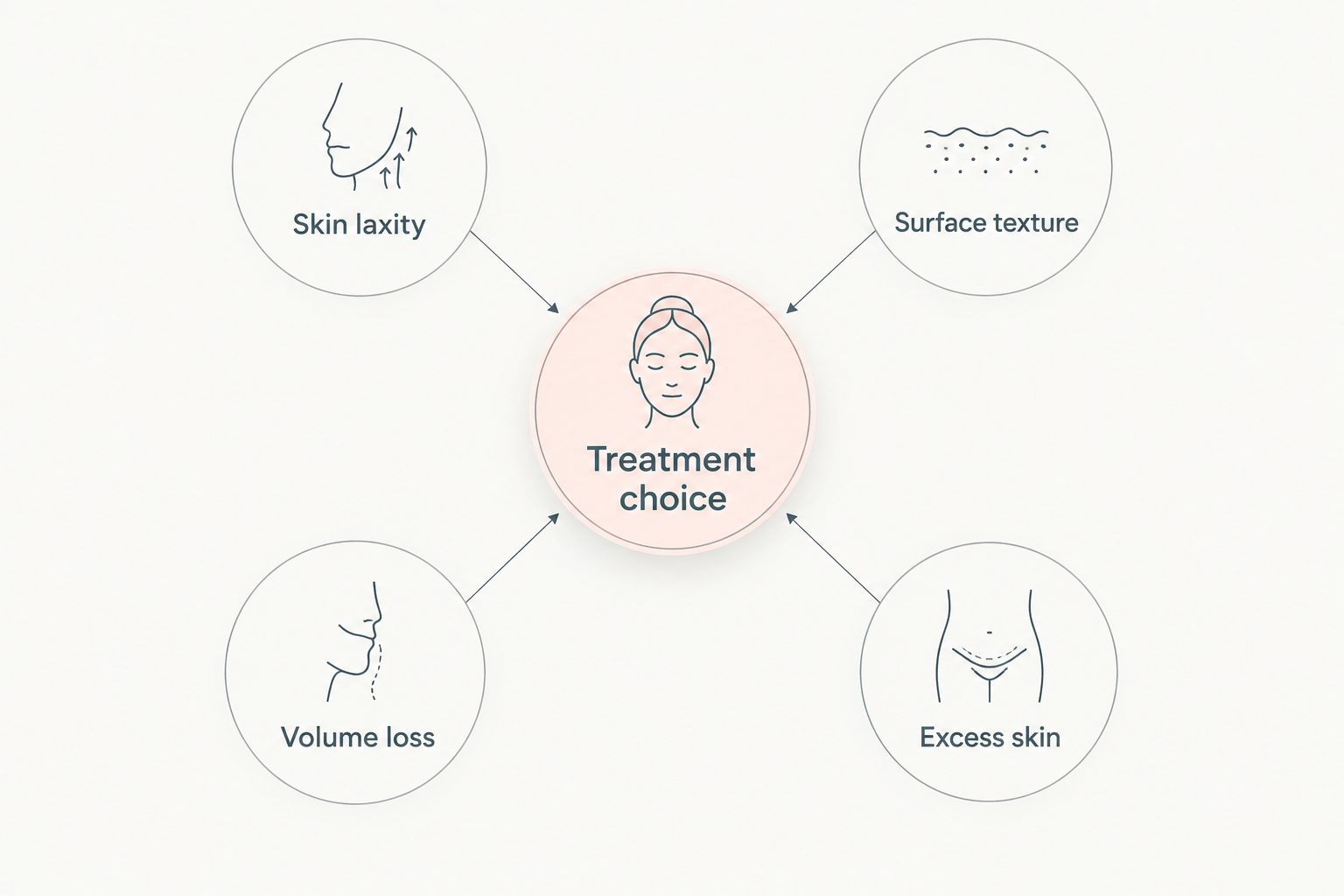
These concerns overlap, but overlap does not justify treating everything at once. Ask the clinician to identify the primary problem and explain which part of your goal the proposed procedure will not address.
Questions to ask before agreeing to treatment
Bring these questions to your 2026 appointment. A useful answer names the procedure and explains its fit for your skin—not just its popularity.
- What exactly is being treated? Ask whether the recommendation targets laxity, texture, volume loss, or a combination.
- Which device and technique will be used? Category names alone are insufficient for informed consent.
- Who performs and supervises treatment? Ask about relevant qualifications and experience with your skin type and treatment area.
- What are the serious risks? Include burns, pigment changes, scarring, and unwanted tissue injury where relevant.
- What does recovery involve? Get clear instructions on cleansing, activity, sun protection, and when to seek care.
- How will the result be assessed? Agree on a realistic endpoint before treatment, using consistent photographs where appropriate.
Disclose medications, previous procedures, implanted devices, pregnancy, active infections, and your healing history. The relevance of each depends on the procedure; the clinician needs that information to assess safety.
Explore local aesthetic care
Review Oasisbeauty’s stated services, then confirm the specific procedure that interests you.
How these treatments were ranked
This ranking prioritizes problem match, treatment depth, skin suitability, recovery, risk control, and realistic outcomes. It compares established treatment categories; it is not a head-to-head device trial or a ranking of individual providers.
Microfocused ultrasound takes the default tightening slot because its role centers on localized laxity. Noninvasive radiofrequency takes the surface-preserving slot, RF microneedling the mixed texture-and-firmness slot, and ablative fractional laser the texture-led slot.
Which skin tightening treatment should you choose?
Start with microfocused ultrasound if mild, localized laxity is your main concern. Discuss noninvasive radiofrequency if avoiding punctures and resurfacing is a priority, RF microneedling if texture also matters, and ablative fractional laser if surface damage dominates.
If you have substantial excess skin, do not keep escalating nonsurgical treatments without discussing their limits. A surgical assessment helps distinguish an achievable tightening result from a goal that requires tissue removal or repositioning.
FAQ
What’s the best nonsurgical skin tightening treatment in 2026?
Microfocused ultrasound is a reasonable default shortlist option for mild, localized laxity. The best choice changes when texture, recovery requirements, skin suitability, or substantial excess skin is the main issue.
Is radiofrequency microneedling better than ultrasound?
Radiofrequency microneedling fits a combined texture-and-firmness concern, while microfocused ultrasound fits a tightening-led concern. Neither is universally better, and RF microneedling carries serious risks that require informed consent.
Can nonsurgical treatments replace a facelift?
Nonsurgical tightening does not replace a facelift when your goal requires removing excess skin or repositioning tissue. Suitable patients should expect a more limited change.
Does Botox tighten loose skin?
Botox reduces muscle activity associated with expression lines; it does not remove or mechanically tighten excess skin. A smoother expression line and improved skin laxity are different treatment outcomes.
Is RF microneedling the same as regular microneedling?
RF microneedling adds radiofrequency energy to needle treatment, while regular microneedling does not. Confirm the exact procedure because the additional energy changes both treatment planning and risks.
How long does skin tightening take to show results?
Results depend on the procedure and develop through healing and remodeling rather than a single universal timeline. American Academy of Dermatology guidance describes modest ultrasound improvement within 2 to 6 months.
Does Oasisbeauty offer all these skin tightening treatments?
Oasisbeauty’s stated services do not establish that every treatment in this guide is offered. Confirm the specific device and technique before arranging treatment.
What should I ask about skin tightening costs?
Ask for a written treatment plan that identifies the procedure, planned sessions, follow-up, and what the quoted fee includes. Compare the proposed clinical plan rather than treating different device categories as equivalent purchases.
One last thing
An immediate post-treatment change is not the same as a durable tightening result. Swelling can affect early appearance, so assess progress at the interval your clinician recommends rather than judging the procedure from same-day photographs.
Ask for baseline and follow-up photographs with consistent lighting, expression, and camera position. A fair comparison makes a subtle result easier to assess—and stops a flattering photograph from substituting for a treatment outcome.