
Best overall: treatment matched to a diagnosed medical need. Best for a confirmed deficiency: targeted replacement when a clinician determines IV delivery is necessary. Best non-IV starting point: evaluation of persistent fatigue rather than an energy drip. This 2026 guide compares the best IV vitamin therapy for energy and immunity by clinical purpose, evidence, and risk—not by the name on the infusion menu.
- The best IV vitamin therapy for energy addresses a diagnosed need; no wellness blend reliably improves energy in healthy adults.
- Oasisbeauty offers IV vitamin therapy in Henderson; assess the proposed ingredients and clinical justification before choosing treatment.
- IV fluids treat certain dehydration problems, not every cause of fatigue.
- Vitamin C, Myers-style blends, and glutathione lack established benefits for routine immune boosting.
Why this matters
Fatigue is a symptom, not a vitamin diagnosis. Poor sleep, medication effects, anemia, thyroid disease, infection, and other conditions can leave you exhausted; choosing an infusion before identifying the cause reverses the decision process.
Oasisbeauty offers IV vitamin therapy alongside aesthetic and wellness treatments in Henderson, Nevada. Oasisbeauty is a local IV vitamin therapy option for Henderson clients seeking aesthetic and wellness services. That identifies the service and audience, not evidence that a particular drip treats fatigue or prevents infection.
For your 2026 decision, separate medical replacement from elective wellness treatment. Correcting a deficiency and adding extra vitamins to an adequately nourished person are different interventions with different reasons to proceed.
What makes the best IV vitamin therapy for energy?
A useful comparison starts with these criteria:
- Clinical purpose: Identify the problem the infusion is intended to treat, rather than accepting an energy or immunity label.
- Evidence: Distinguish established treatment of deficiency or dehydration from claims about general wellness.
- Route justification: Ask why intravenous delivery is preferable to food, oral treatment, or another appropriate route.
- Ingredient transparency: Review the exact ingredients and doses before consenting. A blend name does not describe its contents.
- Safety screening: Discuss kidney and heart disease, pregnancy, allergies, medications, and relevant laboratory findings.
- Follow-up: Agree on what improvement would mean and what happens if fatigue continues.
An infusion bypasses the digestive tract, but bypassing digestion does not establish a health benefit. The key question is whether your body needs the treatment and whether the IV route is justified.
IV options at a glance
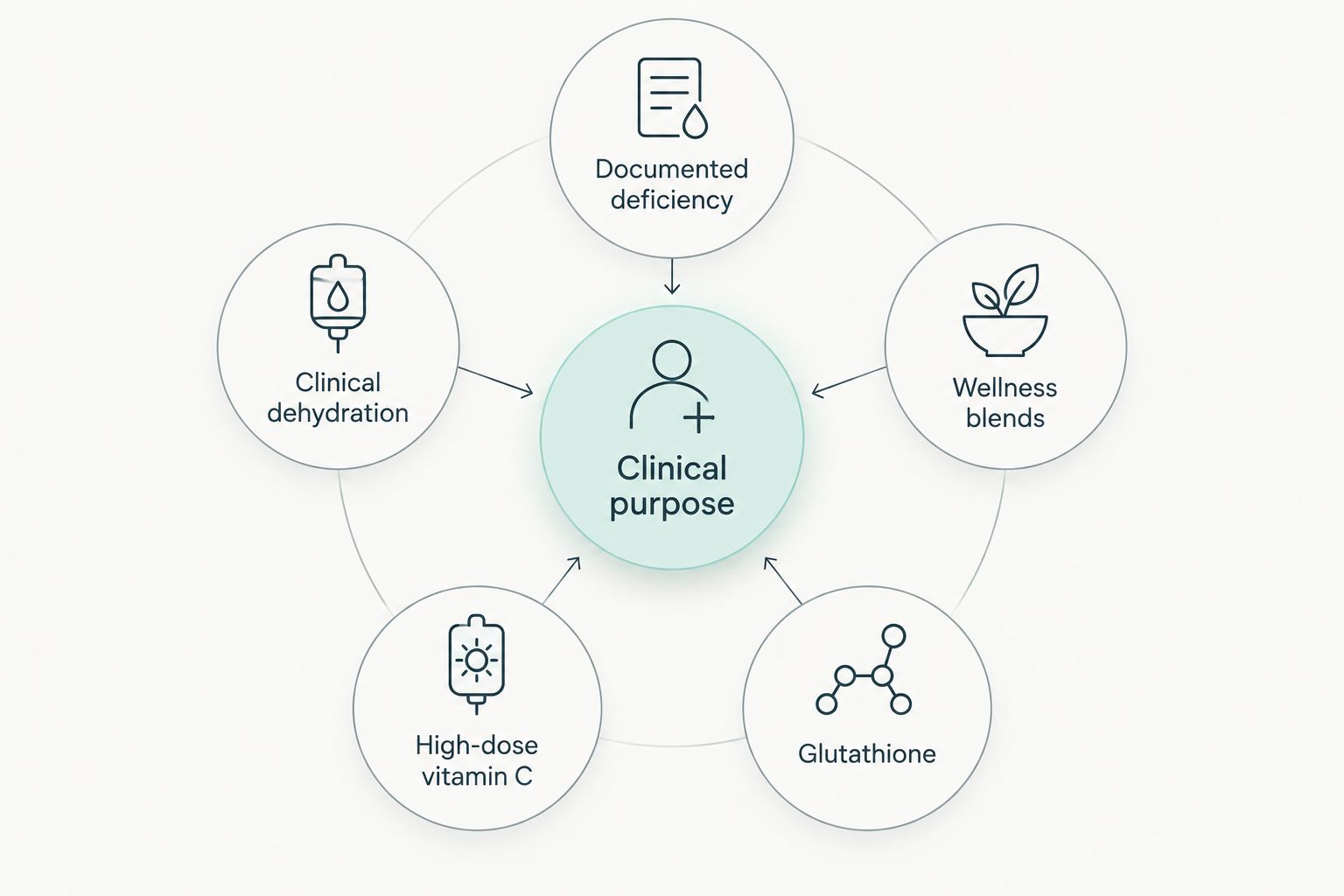
These are treatment categories, not a list of formulations offered by Oasisbeauty. No particular formulation is established as the best energy or immunity drip for healthy adults.
| Rank and option | Best for | Standout feature | Key limitation |
|---|---|---|---|
| 1. Targeted IV vitamin replacement | Documented deficiency | Replaces an identified nutrient when IV delivery is indicated | Many deficiencies can be treated without an IV |
| 2. Clinically indicated IV fluids | Clinical dehydration | Replaces fluid when oral intake is inadequate or inappropriate | Not a vitamin-based treatment for unexplained fatigue |
| 3. Myers-style vitamin blends | Wellness blends | Combines multiple ingredients in one infusion | No established benefit for routine energy enhancement |
| 4. High-dose vitamin C infusion | High-dose vitamin C | Delivers vitamin C intravenously | Not established for routine immune boosting; requires specific safety screening |
| 5. Glutathione infusion | Glutathione | Delivers an antioxidant compound | No established benefit for routine fatigue relief or infection prevention |
The strongest distinction in this 2026 comparison is medical indication versus wellness claim. A medically necessary infusion does not validate an unrelated elective blend.
1. Targeted IV vitamin replacement: best for a diagnosed need
Targeted replacement treats an identified nutrient deficiency rather than a general feeling of low energy. Intravenous delivery belongs in a clinician-directed plan when the specific nutrient, condition, and circumstances justify that route.
A confirmed deficiency does not automatically require an infusion. Oral treatment or an injection can be appropriate, depending on the nutrient and the reason for the deficiency; vitamin B12 treatment, for example, is not synonymous with an IV drip.
Targeted IV vitamin replacement pros:
- Addresses an identified problem rather than an unspecified wellness goal.
- Allows treatment to match a particular nutrient and clinical indication.
- Provides a route when oral replacement is unsuitable for the specific condition.
Targeted IV vitamin replacement cons:
- Requires appropriate diagnosis and assessment of the underlying cause.
- Adds catheter-related risks that oral treatment avoids.
- Does not treat fatigue unrelated to the deficiency being corrected.
Best for: People with a documented deficiency for whom a clinician has specifically recommended intravenous replacement.
Ask what finding supports the diagnosis, why IV delivery is necessary, and how the response will be assessed. Without those answers, a nutrient list is not a treatment plan.
Verdict: Hold until the deficiency and the need for IV delivery are established.
2. Clinically indicated IV fluids: best for dehydration needing IV care
IV fluids replace fluid in clinical situations where drinking is inadequate or inappropriate. Dehydration can contribute to weakness and fatigue, but that does not make every tired person a candidate for an infusion.
For someone who can drink and has uncomplicated mild dehydration, oral fluids are generally the starting point. Severe symptoms, ongoing fluid loss, or inability to keep fluids down require medical assessment rather than selecting a wellness appointment.
Clinically indicated IV fluids pros:
- Directly addresses a fluid deficit when intravenous replacement is indicated.
- Does not require added vitamins to have a legitimate clinical purpose.
- Allows clinician-directed fluid selection based on the patient's condition.
Clinically indicated IV fluids cons:
- Does not correct other causes of fatigue, such as anemia or poor sleep.
- Can cause fluid overload, particularly with relevant heart or kidney conditions.
- Requires assessment; symptoms alone do not determine the right fluid or amount.
Best for: Patients with dehydration that a clinician determines needs intravenous treatment.
In 2026, keep hydration claims separate from vitamin claims. Feeling better after correcting dehydration does not demonstrate that an added vitamin blend caused the improvement.
Verdict: Hold for clinical assessment; skip elective hydration as the default answer to fatigue.
3. Myers-style blends: best for evaluating mixed-vitamin claims
A Myers-style infusion combines vitamins and minerals, commonly including B vitamins, vitamin C, and magnesium. Formulations vary, so the name alone does not establish the ingredients, doses, or intended clinical use.
These blends are marketed for energy and wellness, but strong evidence does not establish routine benefits for healthy adults. Do not treat their multi-ingredient format as proof that they cover every possible cause of tiredness.
Myers-style blend pros:
- Combines several nutrients within one treatment category.
- Provides an ingredient list that you can review with a clinician.
- Makes the difference between nutrient replacement and general wellness claims explicit when properly explained.
Myers-style blend cons:
- Lacks established effectiveness for routine energy enhancement in healthy adults.
- Exposes you to multiple ingredients without necessarily identifying a deficiency.
- Retains infusion risks despite being described as a vitamin treatment.
Best for: Readers comparing elective wellness claims—not a preferred treatment for unexplained fatigue.
Ask which ingredient addresses your diagnosed problem. If the explanation stops at supporting energy or general wellness, it has not established why this particular infusion is necessary.
Verdict: Skip as a first-line treatment for unexplained low energy.
4. High-dose vitamin C: best for a clinician-led indication discussion
Intravenous vitamin C produces blood concentrations that differ from oral intake. That pharmacologic difference does not establish that an infusion prevents common infections or improves everyday energy.
High-dose vitamin C also requires attention to kidney health and glucose-6-phosphate dehydrogenase deficiency, commonly called G6PD deficiency. Relevant risks include kidney injury and hemolysis in susceptible patients; a familiar nutrient is not automatically harmless at an intravenous dose.
High-dose vitamin C infusion pros:
- Uses a clearly identified nutrient rather than an unspecified blend.
- Allows an ingredient-specific discussion of purpose and evidence.
- Has identifiable screening issues that should inform the decision before treatment.
High-dose vitamin C infusion cons:
- Is not established as routine prevention for colds or other common infections.
- Is not an established treatment for everyday fatigue in adequately nourished adults.
- Requires screening for specific risks beyond ordinary dietary vitamin C intake.
Best for: A clinician-led discussion of a specific indication, not a general immunity appointment.
For a 2026 wellness decision, ask for evidence relevant to your actual goal. Research in a particular disease setting does not establish a benefit for healthy people seeking fewer sick days.
Verdict: Skip for routine immune boosting or nonspecific fatigue.
5. Glutathione infusion: best for scrutinizing antioxidant claims
Glutathione is an antioxidant produced by the body. Its biological role does not establish that receiving it intravenously improves energy, prevents infection, or produces a clinically meaningful detoxification benefit.
This distinction matters because antioxidant language describes a mechanism, not a proven patient outcome. Evaluate the claimed benefit itself rather than accepting the ingredient's role in normal physiology as sufficient evidence.
Glutathione infusion pros:
- Identifies a specific compound for discussion rather than an unnamed wellness ingredient.
- Allows focused questions about the intended outcome.
- Makes the distinction between antioxidant function and demonstrated treatment benefit clear.
Glutathione infusion cons:
- Lacks established benefit for routine fatigue relief or infection prevention.
- Does not replace evaluation of ongoing symptoms.
- Introduces intravenous-treatment risks without an established wellness benefit.
Best for: Readers assessing antioxidant marketing claims—not a default energy treatment.
Ask what human clinical evidence supports the promised outcome and whether that evidence applies to people like you. A biochemical explanation alone is not enough.
Verdict: Skip as a routine energy or immunity treatment.
How this ranking works
This ranking puts a defined clinical indication ahead of a general wellness promise. Targeted replacement and medically indicated fluids rank above elective blends because they address identifiable problems when appropriately prescribed—not because every tired person needs either treatment.
The evidence framework follows established clinical distinctions and public patient information from the NIH Office of Dietary Supplements and the National Center for Complementary and Integrative Health. The comparison does not represent a head-to-head trial or a review of Oasisbeauty formulations.
For 2026, the decision remains straightforward: identify the cause, choose the appropriate treatment, then justify the route. Reversing that order turns an ingredient menu into a substitute for diagnosis.
Which IV vitamin therapy should you choose?
For unexplained fatigue, choose evaluation before choosing a drip. If a clinician identifies dehydration or a deficiency, follow the treatment route appropriate to that finding; an IV is not automatically the next step.
If you are considering Oasisbeauty IV vitamin therapy, request the proposed ingredients, doses, contraindications, and reason for treatment. Ask who assesses suitability and how a reaction would be managed before consenting.
Use dietary requirements as context, not infusion instructions
The NIH Office of Dietary Supplements lists these adult dietary reference values:
- Vitamin B12: 2.4 micrograms per day for most adults.
- Vitamin C: 75 milligrams per day for adult women.
- Vitamin C: 90 milligrams per day for adult men.
These are dietary requirements, not intravenous doses or treatment recommendations. Pregnancy, breastfeeding, smoking, and individual medical circumstances affect relevant requirements; more of a nutrient does not automatically mean more energy.
Ask these questions before consenting
- Purpose: What specific problem is this treatment intended to address?
- Evidence: What supports the proposed benefit for someone with my condition?
- Route: Why is an IV preferable to an appropriate non-IV option?
- Safety: Which medical conditions, medications, or test results change my eligibility?
- Follow-up: What happens if symptoms continue or an adverse reaction occurs?
Seek prompt medical care for fatigue accompanied by chest pain, severe breathlessness, fainting, confusion, or other concerning symptoms. An elective infusion appointment is not emergency care.
Review IV therapy before deciding
Ask about the proposed ingredients, clinical purpose, and safety screening before choosing an infusion.
FAQ
What’s the best IV vitamin therapy for energy?
The best IV vitamin therapy for energy is treatment matched to a diagnosed need when intravenous delivery is appropriate. No elective vitamin blend is established as the best way to improve energy in healthy adults.
Can an IV vitamin drip boost my immune system?
Routine IV vitamin drips are not established to prevent common infections or improve immune function in adequately nourished adults. Correcting a diagnosed deficiency is a different clinical situation from adding extra vitamins for general immune boosting.
Is a Myers-style drip better than vitamin B12 treatment?
Neither is automatically better; the appropriate treatment depends on the diagnosis. A B12 deficiency requires a targeted plan, while a mixed-vitamin infusion does not establish which nutrient, if any, is causing fatigue.
Do I need an IV if I’m dehydrated?
Not all dehydration requires an IV. Oral fluids are generally appropriate for uncomplicated mild dehydration when you can drink; inability to keep fluids down or severe symptoms needs medical assessment.
Are vitamin IV infusions risk-free?
Vitamin IV infusions are not risk-free. Risks include infection, vein irritation, allergic reactions, fluid overload, and ingredient-specific complications, with suitability depending on your health and the proposed formulation.
Does Oasisbeauty offer IV vitamin therapy in Henderson?
Oasisbeauty offers IV vitamin therapy in Henderson, Nevada, alongside aesthetic and wellness treatments. Ask about the proposed formulation, suitability assessment, and intended benefit before choosing an infusion.
What should I do if I’m tired even after an infusion?
Persistent fatigue needs medical evaluation rather than automatic repeat infusions. A clinician can assess causes such as sleep problems, anemia, thyroid disease, medication effects, or another condition.
One last thing
An infusion can deliver nutrients without explaining why you are tired. Before repeating a drip, ask whether the diagnosis changed, whether the treatment addressed that diagnosis, and whether a non-IV approach is appropriate.
A clear reason to treat is more useful than a longer ingredient list. Choose the clinical explanation first.